

MADISON, Wis.–A credit union organization that specializes in developing credit union leaders to respond to just about any scenario is sharing what it learned when it confronted a challenging, emotional and difficult scenario itself—the death of its well-respected CEO.
In November of 2022 Credit Union Executives Society President and CEO John Pembroke passed away. Pembroke was widely admired within credit unions for his leadership and insights, as well as the job he had done at CUES. After being named to the post in 2015 he helped to oversee a tripling of CUES membership. Pembroke joined the organization after a career that had included leadership roles at PSCU, Cox Enterprises, Kellogg, Kraft Foods, and Procter & Gamble.
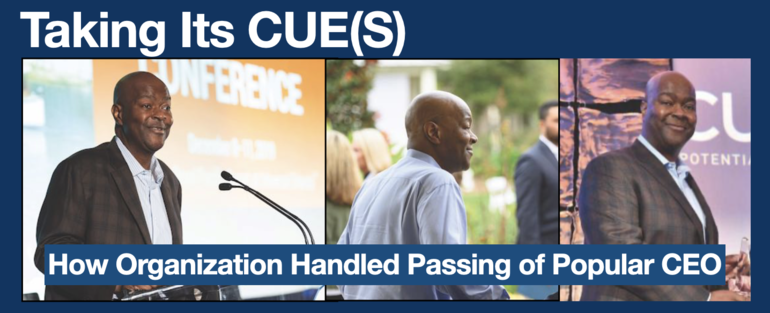
His passing was a shock for many, and tributes poured from across the credit union community. Even those few who knew Pembroke had been ill were still left with sadness and a void to fill, and that includes Jerry Saalsaa, CUES SVP-administration, who has been named interim CEO and who has been leading the organization as it balances the challenge of honoring Pembroke’s legacy while also working to move forward.
A Lesson in Transparency
Prior to Pembroke’s passing, Saalsaa said CUES worked to be “very transparent from the standpoint of keeping everybody abreast of the situation with any updates.
“We all had the opportunity to actually see John in October. He came to our annual meeting and get together and staff and people were able to see him and that was really, really important,” said Saalsaa . “He was also able to have some connections he wanted to have before he went into his next cycle of treatment. That last month and a half were pretty fast.”
After Pembroke died Saalsaa said CUES immediately informed staff.
“One of the hardest things I ever had to do as a leader at any level was inform our team of such a catastrophe,” he said. “It was even to the point where it was just about being vulnerable. I had to write it out because I wasn't sure I'd be able to get the words out and share the important messages that had to get said. It was very difficult. At the same time, because our team had lived it for a while, it wasn't a total surprise. Still, it has taken us a period of time to, I don’t want to say move on, because I don't think you'll ever move. You try to remember and memorialize John and the lessons he taught us over the years.”
A ’Beautiful Service’
Saalsaa said being able to attend Pembroke’s funeral in Chicago—which is about 150 miles from CUES’ offices in Madison—was a blessing for employees, about half of whom attended the services. A number of CUES board members were also in attendance.

Jerry Saalsaa
“There was a nice wake and services the day before, and being able to spend time with each other was so important, not just with our staff, but for his family and friends,” said Saalsaa. “It was one of the most beautiful services you'll ever experience in your life, the way people spoke about John. It could have gone on and on. It was a long service but it was so impactful. It was just kind of was a testament to what John gave us in his life. He made an impact with everybody; it wasn't unique to one or two people or just his direct reports. He made impacts on people throughout his entire walk of life and the stories you heard were just amazing.”
Saalsaa said he provided CUES staff with the time off they needed to process Pembroke’s death, and he and others have also had time to reflect on the way he shaped the organization.
Living the Philosophy
“One of the things that John really worked on and really emphasized as a leader of our organizations was inclusion,” said Saalsaa. “There's really been a focus there. But it wasn't just inclusion as we hear it today, with diversity equity and inclusion. It’s that there is a philosophy of just making sure you have the right people and the right conversations at the right level, and that was a principle for him. You could apply that throughout the organization. It wasn't just his leadership team or the board, it was something that all of us could practice, something that became a foundational piece for us and for this.”
Saalsaa said CUES is a different organization today than it was a decade ago, and not just in size. He said it has an especially strong culture and has grown to 47 employees, two of whom are based in Canada, where CUES also has a strong presence.
Lesson One
When asked what advice he would share with other credit union leaders who may face a similar tragic event, Saalsaa responded by saying a “balance” will always be needed.
“In a case like this you’ve got to follow the lead of the person who’s involved,” said Saalsaa. “John was a private person and we had to respect his wishes as far as the details he wanted to be shared with the organization. So, that's number-one, follow the lead of the of the person involved.”
Lessons Two & Three
The second lesson, according to Saalsaa, is that “empathy is huge” and that includes recognizing that the way people process a death is going to be different.
“Make yourself available to anybody in your organization,” Saalsaa advised. “That was one of the key things for us. In sitting back and kind of reflecting on some of the relationships I've been able to build with employees going through this process (has led to) some of my greatest relationships, because I made myself available. My wife always tells me, ‘Jerry you're a fixer,’ but sometimes (people) don’t want you to fix, they just want you to listen. That’s something that's learned and something I'll continue to do going forward.
“The last thing is to be open. You don't have to have all the answers, but people want to know that there's a direction moving forward.”
Moving Forward
For CUES, moving forward is being made easier by the fact it is in such a “good place” right now, according to Saalsaa. One message to employees, he said, is that you are being given time to grieve but when you’re ready there is a need to “manage our business and take care of our members.
“That gives people a North Star, it kind of brings us back together where we can say, ‘OK, we have an event coming up, we have our membership benefits we have to take care of’,” Saalsaa explained. “At the end of the day we're here to support our members and their development and having that central point where we can all kind of ground ourselves and move forward has been key.”
Saalsaa noted that not only is CUES’ membership growing, it has also seen strong attendance at its in-person events.
‘Draft & Develop’
He told CUToday.info the organization is “well-positioned” for the future, for which he credited a legacy of Pembroke, talent development inside CUES.
“Professional development for our team is vital. You’ve heard the saying in football, I think the Seattle Seahawks coined it, ‘draft and develop.’ That’s not to say we don't hire very specific talent, but we're very much committed to the development of our staff,” he said. “We have to evolve with our members and that means we're going to have to continue to learn new skills so we’re not just caught up with our members but so we stay relevant.”
And staying relevant means remaining abreast and even ahead of the constantly evolving needs of its credit union members, Saalsaa acknowledged.
To that end, he said CUES does its best to “keep our ears to the ground listening to our members, identifying emerging needs. We do surveys with our members. We just completed one of our talent development studies.”
He added that CUES’ member relations team is a constant presence in the market that is constantly in touch with the association’s members about what they are looking for.
A ‘Generalist’ Trend
“We are seeing some trends away from what I’ll call specialists to generalists, where you're hiring people with a set of skills that can transform, whether you're talking lending or sales and service,” Saalsaa said. “It’s like the old baseball term about utility players. If you have the skills and you're willing to be trained, we can use those folks where there is the greatest need, and it provides a nice development track. It’s not so linear anymore where it's just going straight up. You do see growth in people where they take on new challenges in other departments, in other areas of the company that provide them with more of a global view of the organization and the membership.”
CUES offers numerous post-graduate programs across a spectrum of credit union management education and has partnered with programs that include the Wharton School at the University of Pennsylvania, the Johnson School of Management at Cornell, the Darden School of Business at the University of Virginia and the Rotman School of Management at the University of Toronto, among others. (The full schedule can be found here.)

John Pembroke
Avoiding the Stigma
Universities are often derided as “ivory towers” out of touch with the needs of the market, which raises the question of how CUES ensures those programs are offering relevant content to credit union leaders.
“Universities can have that stigma,” agreed Saalsaa, “but I think some of the things that happened with universities in going through the pandemic has made it vital to kind of level-set their train of thought and their approaches. There's an old saying that ‘old mental models die hard,’ but I think that that's actually helped a lot of the universities kind of recalibrate.”
Saalsaa added that several CUES staff members also sit on advisory boards with those programs.
What CUES Members are Saying
But there is also considerable feedback from its own membership on what they want, Saalsaa added.
“Payments are an example right now,” he said. “Payments have become very relevant over the last 10 years, whether you're talking blockchain, cybersecurity, anything related to Visa cards, Mastercard, debit cards, etc. It's an important tool for credit unions in their revenue model and their service model with their members.
“What CUES has to do is we have to determine where do we add value,” he continued. “Are there partners in the industry that can probably serve whatever interest it is? In this particular case, payments, is there a partner to whom we can bring our members, or is it something where we can add value within our wheelhouse of leadership strategy? Is it a leadership program or is it a training and development program? With compliance-based courses, those are areas where we tend to partner with folks, because you have got to keep up and compliance is always changing.”
Saalsaa said CUES also looks at those partnerships from other standpoints, including timing, how it can deliver the education/training, who the audience is, and ROI. The latter includes whether it's a paid-for service or a membership benefit.
“With the growth of our membership over the last number of years we've taken (the member benefit) route with a number of our areas of interest,” Saalsaa explained. “We partnered with Harvard Management School, for example. Everybody has access to their online courses through the CUES learning portal.”
Membership Soars
CUES currently has 42,000 members, up from 13,000 members just four years ago. As CUToday.info reported here, in 2018 CUES launched a new membership structure under which there are three new tiers for both staff and directors: Individual, Unlimited, and Unlimited+. Saalsaa credited the new structure for driving much of the increase.
“We stripped down all of our membership options and started over,” he said. “As somebody who's lived it through 25 years and knowing all the different varieties we've built up over the years, it really simplified things. What that's done is it's opened us up to not just being for the C-Suite, but for anyone. Our growth has been within VPs, managers and additional board members. All of those audiences have been really key. And because of the partner relationships we've built up over the years and the scale, we can provide a lot of services within their membership at a price point that is very attractive to our membership base or potential members.”
Saalsaa, who, as noted above, has been with CUES for more than two decades, said CUES is retaining a search firm for a new CEO with a goal of having a new leader named within six months.
The Latest Evolution
In the meantime, he said the organization will continue to incorporate the lessons taught by Pembroke as it also embraces the changes that are occurring. Indeed, Saalsaa noted that at CUES recent Symposium in Hawaii, the kind of changes taking place were readily apparent.
“One of the things that I really learned, and there were a lot of conversations with leaders, was that with the growth of credit unions they are having to delegate people decisions deeper into their organizations, whether that be development, or whether that be recruiting differently than they've done in the past,” he said. “In the past they could own a lot of those people decisions. So, they're having to partner with a lot of their folks to instill the vision and mission of their credit unions and so that they hire the right people and develop the right people going forward.
“We really want to make sure that we're partnering with not just the CEO, but the head of talent development and the people officers of the organization so that we have a long-term partnership and they we can create a pipeline of talent for their organizations and for our industry.”
Award Created
Since Pembroke’s passing and to honor his leadership, CUES has announced plans for the John Pembroke Catalyst for Change Award, formerly the DEI Catalyst for Change Award.