WASHINGTON—In a city in which competition for financial services is high, Navy FCU claims the largest market share of any FI, according to a new study that reveals branch efficiency is the key to the $73-billion CU’s lead.
According to Moebs Services, Lake Forest, Ill., which recently completed a national study of financial institution market share, the nation’s capital is the only major market in which a credit union claims this distinction.
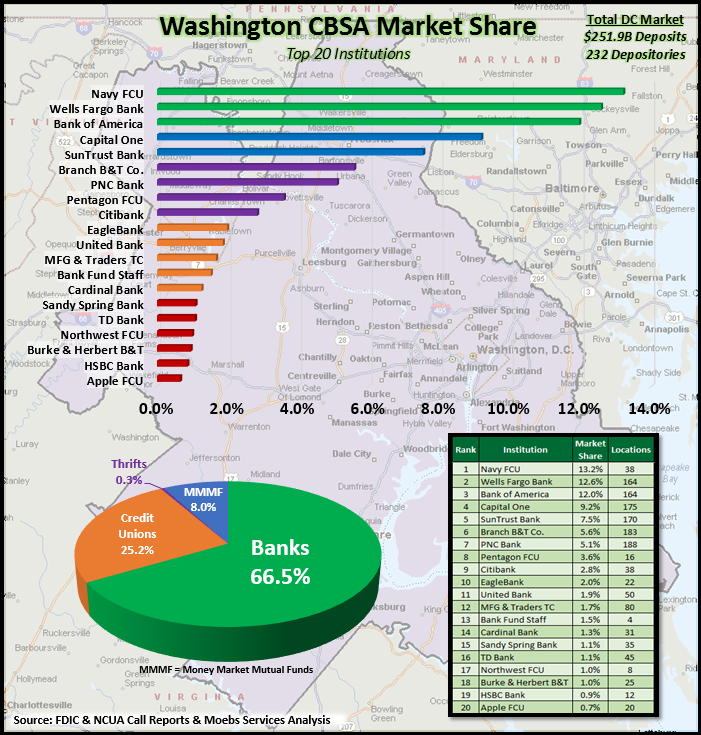
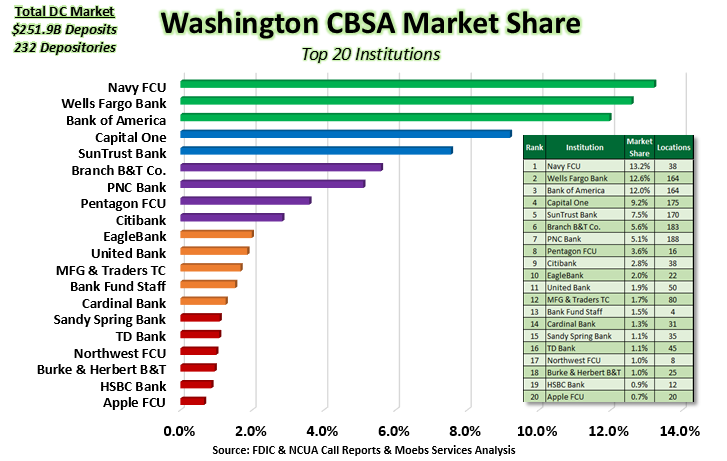
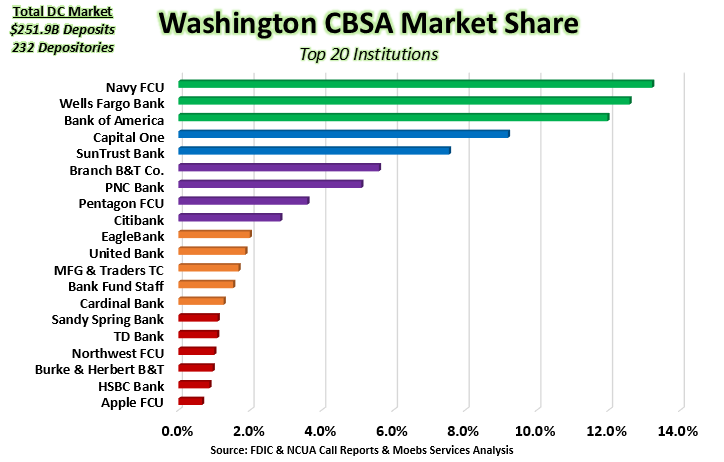
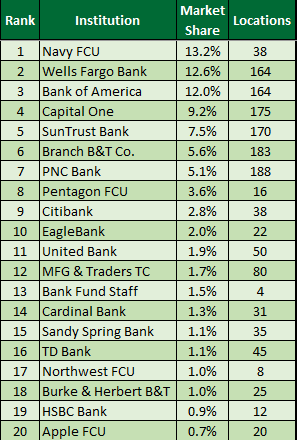
For the Washington core based statistical area (CBSA) market through the second quarter of 2015, Navy FCU had 13.2% market share, while Wells Fargo was at 12.6% and Bank of America was at 12.0%.
“Navy Federal has the lead market share in a highly fractionalized market,” said Michael Moebs, economist and CEO of Moebs $ervices. “With keen market focus and efficient use of resources, Navy Federal is beating six mega-banks. It’s a significant accomplishment for a credit union to lead in a market this size.”
Efficient Service Delivery
What is most interesting about the lead the nation’s largest CU has in Washington—and it speaks to its efficiency in service delivery—is Navy has 38 branches in the Washington CBSA, said Moebs. That’s far fewer than Wells Fargo and Bank of America, each of which has 164 branches. PNC Bank has 188 branches but only 5.1% market share, according to the study. The top 20 FIs here comprise five credit unions and 15 banks, with a total of 85.6% of the Washington CBSA market share. In total, the top 20 FIs have 1,468 branches, or 69.9% of all locations.

Michael Moebs, Moebs $ervices
“Navy FCU claims the market share lead here with a fourth of the amount of branches that the behemoths Wells Fargo Bank and Bank of America operate within the market. This truly is David vs. the Goliaths, and Navy Federal is winning with branch efficiency,” said Moebs
The CBSA of Washington includes the District of Columbia and parts of Virginia, Maryland, and West Virginia. The Office of Management and Budget defines 929 CBSAs in the United States.
“These are geographic areas of 10,000 or more people tied socioeconomically to an urban center by commuting,” explained Moebs. “Washington is ranked number seven with 5.8 million people, which follows closely behind Philadelphia, which Washington is expecting to surpass in the 2020 census.
Fractionalized Market
Moebs noted a “fractionalized market” is one in which the leader does not have a dominant market share. An example of a dominant market share in financial services, he said, is the New York CBSA, where JPMorgan Chase claims more than a third of the market share.
“In a dominant market share, the leader can dictate price, services, strategies, and tactics,” said Moebs. “In a fractionalized market, the market share leader is trying to out-distance competitors to obtain a dominant position.”
Moebs said Navy operates like a “Navy SEAL team” with a sharp focus on objectives and optimal use of limited resources. “This is something other large credit unions and even large banks might want to study and emulate,” he said.
Moebs Market Share study is built on basic monetary economic principles, explained Moebs. It includes M1—transaction account deposits; M2—insured deposits, and M3—uninsured deposits. This means banks, thrift, credit unions, and money market mutual fund deposits are all included in the market share determination, explained Moebs.
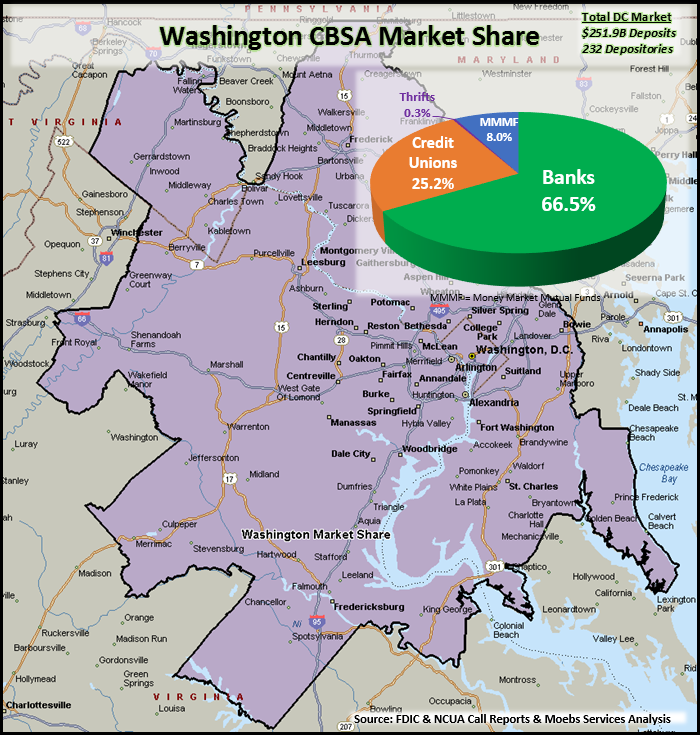
“A unique feature of the Washington CBSA is 66.5% of the $251.9 billion in deposits is with banks,” said Moebs. “Credit unions have 25.2% of the market, followed by 8% for money market mutual funds and only 0.3% for thrifts. This is a bit unusual. Since most large urban markets have more non-bank shares. This would make the Navy FCU achievement even more notable since it is done in a market dominated by banks, which includes two of the three largest banks in the country.”
WASHINGTION—In a city in which competition for financial services is high, Navy FCU claims the largest market share of any FI, according to a new study that reveals branch efficiency is the key to the $73-billion CU’s lead.
According to Moebs Services, Lake Forest, Ill., which recently completed a national study of financial institution market share, the nation’s capital is the only major market in which a credit union claims this distinction.
For the Washington core based statistical area (CBSA) market through the second quarter of 2015, Navy FCU had 13.2% market share, while Wells Fargo was at 12.6% and Bank of America was at 12.0%.
“Navy Federal has the lead market share in a highly fractionalized market,” said Michael Moebs, economist and CEO of Moebs $ervices. “With keen market focus and efficient use of resources, Navy Federal is beating six mega-banks. It’s a significant accomplishment for a credit union to lead in a market this size.”
Efficient Service Delivery
What is most interesting about the lead the nation’s largest CU has in Washington—and it speaks to its efficiency in service delivery—is Navy has 38 branches in the Washington CBSA, said Moebs. That’s far fewer than Wells Fargo and Bank of America, each of which has 164 branches. PNC Bank has 188 branches but only 5.1% market share, according to the study. The top 20 FIs here comprise five credit unions and 15 banks, with a total of 85.6% of the Washington CBSA market share. In total, the top 20 FIs have 1,468 branches, or 69.9% of all locations.
“Navy FCU claims the market share lead here with a fourth of the amount of branches that the behemoths Wells Fargo Bank and Bank of America operate within the market. This truly is David vs. the Goliaths, and Navy Federal is winning with branch efficiency,” said Moebs
The CBSA of Washington includes the District of Columbia and parts of Virginia, Maryland, and West Virginia. The Office of Management and Budget defines 929 CBSAs in the United States.
“These are geographic areas of 10,000 or more people tied socioeconomically to an urban center by commuting,” explained Moebs. “Washington is ranked number seven with 5.8 million people, which follows closely behind Philadelphia, which Washington is expecting to surpass in the 2020 census.
Fractionalized Market
Moebs noted a “fractionalized market” is one in which the leader does not have a dominant market share. An example of a dominant market share in financial services, he said, is the New York CBSA, where JPMorgan Chase claims more than a third of the market share.
“In a dominant market share, the leader can dictate price, services, strategies, and tactics,” said Moebs. “In a fractionalized market, the market share leader is trying to out-distance competitors to obtain a dominant position.”
Moebs said Navy operates like a “Navy SEAL team” with a sharp focus on objectives and optimal use of limited resources. “This is something other large credit unions and even large banks might want to study and emulate,” he said.
Moebs Market Share study is built on basic monetary economic principles, explained Moebs. It includes M1—transaction account deposits; M2—insured deposits, and M3—uninsured deposits. This means banks, thrift, credit unions, and money market mutual fund deposits are all included in the market share determination, explained Moebs.
“A unique feature of the Washington CBSA is 66.5% of the $251.9 billion in deposits is with banks,” said Moebs. “Credit unions have 25.2% of the market, followed by 8% for money market mutual funds and only 0.3% for thrifts. This is a bit unusual. Since most large urban markets have more non-bank shares. This would make the Navy FCU achievement even more notable since it is done in a market dominated by banks, which includes two of the three largest banks in the country.”