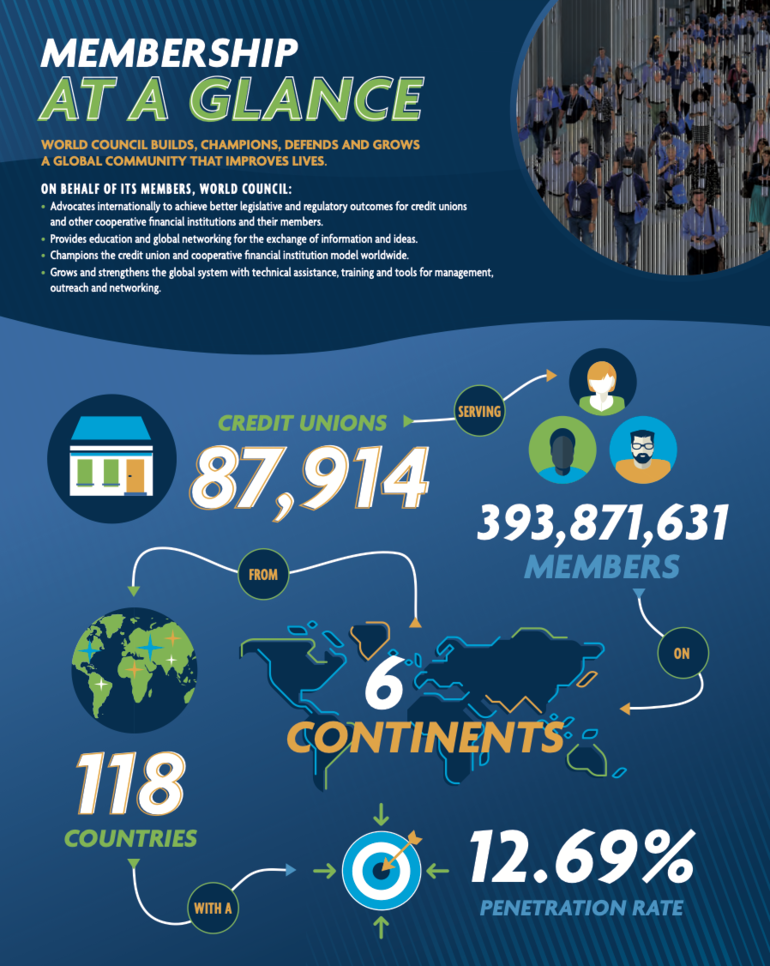
MADISON, Wis.–The number of credit union members globally this International Credit Union Week is approaching 400 million, served by nearly 88,000 CUs, according to a new analysis that also found “major gaps” in different parts of the world in terms of offerings and priorities, while some regions are seeing strong membership growth and others are seeing declines.
The data was released as part of the World Council of Credit Unions’ (WOCCU) new 2021 Statistical Report. WOCCU reported that in addition to providing statistics on members, assets, savings and loans, the 2021 Statistical Report also features first-time data sets on credit union strategic priorities, risk concerns, access to various products and services, and taxation.
First, the global overview, which appears here in CUToday.info as part of a week-long series marking International CU Week. According to WOCCU, as of Dec. 31, 2021, there were a total of:
- 393,871,631 members globally
- 87,914 credit unions
- $3.48 trillion in combined assets across 118 countries.
“Despite the COVID-19 pandemic continuing to impact credit unions across the globe in 2021, they still managed to increase membership by 5% and grow assets by 9%,” said Elissa McCarter LaBorde, WOCCU president and CEO in a statement accompanying release of the data. “For WOCCU to ensure that type of growth continues, and credit unions are able to reach even more underserved populations, we need to gather more specific data from national credit union associations than ever before. While some data sets in this report are more complete than others, this is just the first step in our plan to offer a continuously clearer picture of the challenges and opportunities credit unions face in each region of the world.”
The Global Picture
Among the findings in the new report:
Membership and Assets Are Up, But Not Everywhere
Credit unions in Africa and Latin America saw the most substantial growth in terms of membership and assets, WOCCU reported. Africa saw a 42% spike in assets—the largest worldwide. Latin America witnessed the biggest growth in membership at 16%.
“Europe was the only region to see a decline in credit union assets, while Australia and New Zealand both saw declining membership,” the Statistical Report reveals.
Regional Differences
WOCCU said its 2021 Statistical Report also provides several sets of new data obtained from national credit union associations in more than 40 countries and six regions of the world. The trade group said it asked the CU associations to rank their top strategic priorities and risk concerns moving forward, and to describe the level of access credit unions and their members have to certain products and services that are necessary to strengthen and grow our movement.
WOCCU said responses to those questions revealed:
Strategic Priorities
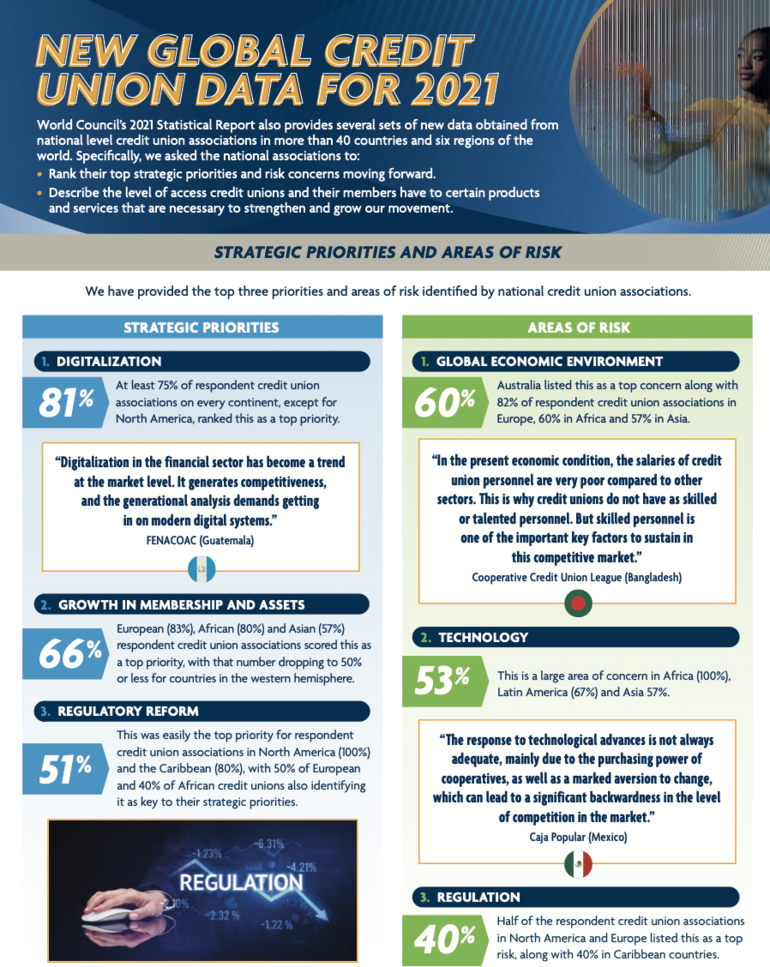
- Digitalization is the clear top priority for credit unions overall, with 81% of respondent credit union associations ranking it at or near the top of their lists.
- 66% identified membership and asset growth as another top priority, including 83% in Europe, 80% in Africa and 57% in Asia.
- Regulatory reform was a top priority for 51% of those surveyed, and easily the top priority for respondent credit union associations in North America (100%) and the Caribbean (80%), WOCCU said.
Risk Concerns
- While there was less consensus on the greatest risk concerns, 60% of respondent credit union associations identified macroeconomic uncertainties as a top risk, with Australia and many associations in Africa, Europe and Asia listing it as a major concern.
- 53% identified technology as another top risk concern, led by Africa (100%), Latin America (67%) and Asia 57%.
Products and Services
According to WOCCU, the 2021 Statistical Report also shows that the ability for credit unions to access or offer certain products and services varies greatly by region.
Among the findings:
- While credit unions in Australia and North America have full access to payment systems, that is only the case for 50% of the credit union systems in Latin America. More than half of respondent credit union associations in Europe, Africa and the Caribbean reported no such access.
- There are also major disparities in the ability of credit unions to offer credit or debit cards depending on where they are located. While 100% of credit unions in Australia, North America and Latin America at least have the ability to offer these payment cards, those numbers drop substantially in the rest of the world—to less than one-third of credit unions offering them in Europe and Asia, WOCCU said.
Tax Status
Although credit unions in some countries have a tax exemption, that “distinction” is not recognized everywhere, WOCCU noted in releasing its analysis.
Among the report’s findings related to tax status:
- There is nearly an even split in the number of countries that exempt credit unions from taxes and those that levy taxes on them.
- Every customer-owned bank (credit union) in Australia pays taxes, along with 80% of credit unions in Asia and 73% in Europe. Those numbers fall “precipitously” in the western hemisphere, with just 17% of respondent credit union associations in Latin America reporting that their credit unions pay taxes—and none in the Caribbean countries with associations that responded to the WOCCU survey.
Additional Insights
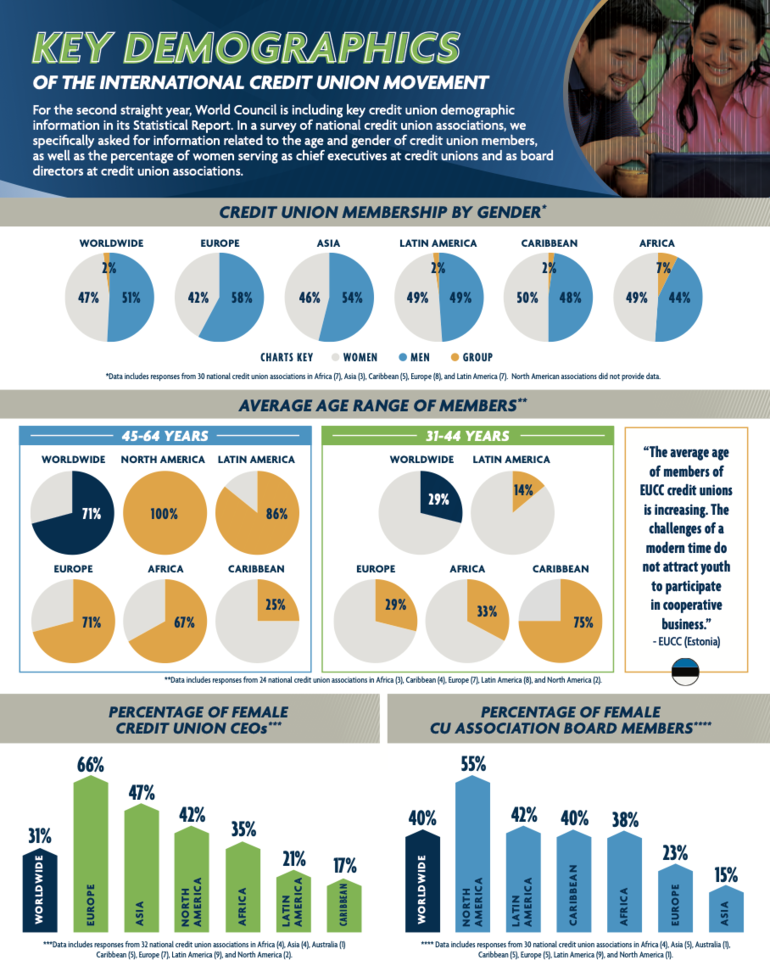
WOCCU noted its 2021 Statistical Report also features gender and age data on credit union members and executives, a breakdown of loan portfolios and insurance offerings, as well as information about access to correspondent banking and deposit insurance guarantees.
The full 2021 Statistical Report can be viewed here.