

MADISON, Wis.–It’s the question CUNA Mutual Group reports it has been getting from credit unions more than any other—what do we need to do to re-open our branches?
It’s a complex question, but as one company expert reminded, in the race to open branches, it’s not a race a credit union has to win.
“This is top of mind for everyone,” said Carlos Molina, senior risk consultant with CUNA Mutual Group during a webinar hosted by the company titled “Employee Safety and the Workplace of Tomorrow.” “Just because your state is preparing to open doesn’t necessarily mean your credit union is ready to open. It’s a business decision on what’s best for your members and your employees. We have a saying at CUNA Mutual: ‘If you think of this as a 10-person race, when you think of opening your branch it’s OK to be seventh or eighth.’”
This article is the second in a week-long series in CUToday.info focused on reopening branches and other facilities. The first article can be found here.
Three Components
Molina said one way credit unions can measure themselves is to use a system OSHA has used for years, the Hierarchy of Controls, which has three components:
Administrative. This is something CUs do well, the creation of policies and protocols, said Molina, such as how to create social distancing in the branch environment, or policies on work schedules, protocols around common areas, meeting schedules, shared office equipment, and even documenting the cleaning schedule.
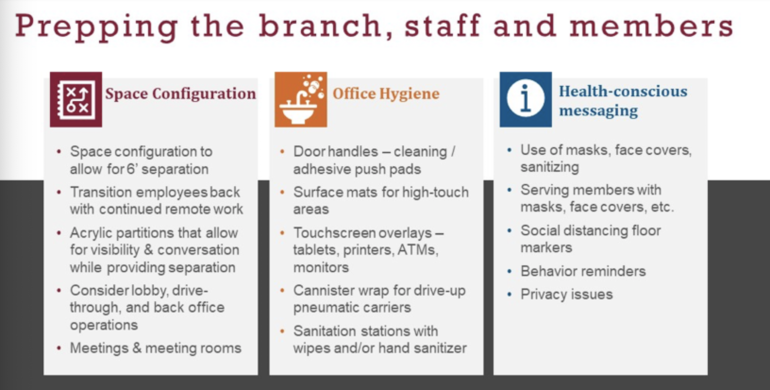
Engineering. “Specifically, this is about prevention of the virus: how to we interact with our physical space? We have CUs now making physical changes in their workplace. They are eliminating cloth or rope queue lines, as soft fabric is difficult to disinfect. They are installing plexiglass around cubicles. They are using copper tape on doorknobs and elevator buttons, as copper stymies the virus. Take a look at the type of furniture you have: is it made of a particular materials that require some choices to be made?”
Personal Protective Equipment. This involves the responsibilities a credit union has as an employer. What does the CU need to provide? Gloves? Screens? Gowns? “There are all kinds of questions to ask,” said Molina.

The Best Defense
“As onerous as this may seem, this Hierarchy of Controls is going to be your best defense against the virus in your credit union,” said Molina. “Things like infection control and social distancing are all going to fall under the General Duty Obligations most employers have in place. The is unchartered territory, but we all understand we are all going to have to adapt to this environment as we do business and focus on the safety and health of the workplace going forward.”
More on OSHA’s Hierarchy of Controls can be found here.
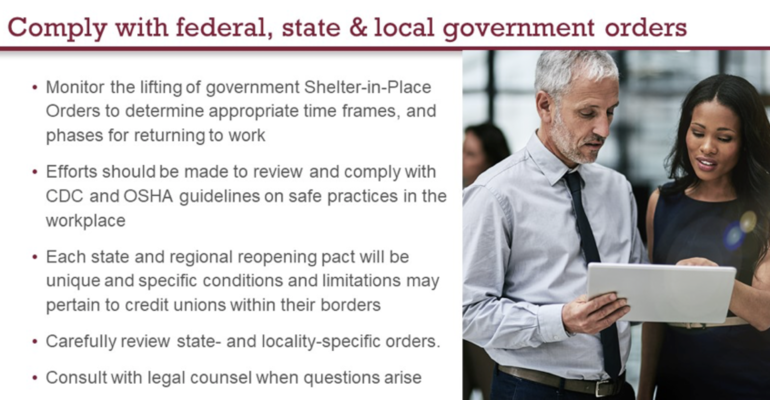
Molina noted it’s important to understand each state and regional re-opening is going to have unique implications, and if a credit union is operating in multiple counties, cities or states, it is going to have to have a plan in place to comply with each of those regulations.
“In transitioning people back to the physical workplace, you have to be mindful of complying with these orders and to monitor the updates,” Molina said. “You may have to consult with legal counsel when issues arise.”
Engage With Your Employees
When reopening physical offices , Molina said the credit union must engage with employees with far more than just an email announcing a return to office hours. He recommended:
- Contact staff that are planned to return. Interview/survey to understand issues or concerns prior to returning. “Really seek to understand how that employee is doing, and what it is you expect of them and what they expect of you going forward”
- Manage fears as both employees and members consider the ramifications of returning to a branch
- Set expectations that the credit union will be sharing facts, not opinions, related to COVID-19
- Provide assurances you are reviewing your state(s) data and will implement necessary changes accordingly
- Consider the various employee legal entitlements
Liability & Work-Related Actions
CUNA Mutual is reminding credit unions to be mindful of potential liability and work-related actions as staff are rapidly transitioned into different work environments.
“It’s very important to understand your exposure around employee rights of absence. Established regulations have been amended, such as Family Leave,” Molina said. “That’s important to understand, especially with schools remaining closed. Also, there can be significant difference between federal regulation and state regulations that make this even more complex going forward, not to mention the wage and hour obligations. There may be folks who get their wages and hours cut.”
Getting on the Same Page
Ray Koenig, senior account executive with M3 Insurance, told attendees on the webinar they should ensure their respective leadership teams are “all on the same page. I call it developing a leadership guide, so when you are planning reentry you have a meeting of the minds across management so you have a consistent message.”
Playbook Available
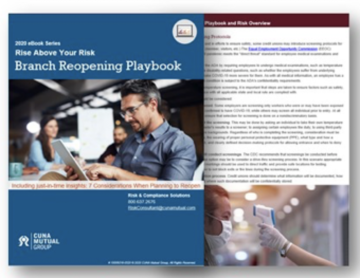
CUNA Mutual has a Branch Reopening Playbook available here.
Other Issues to Consider
Among the other issues credit union leaders will need to weigh:
- Having a plan in place to again move employees should a situation become unsafe
- Any shared spacing or hoteling arrangements will need to be modified going forward
- A credit union may need to consider replacing chairs that swivel at workstations to keep employees from turning and facing each other
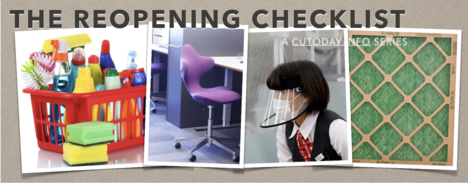
- Michael Petrone, risk consultant with CUNA Mutual Group, said there are a number of new technologies credit unions should be exploring around keeping surfaces clean, including new drive-up canisters that are antiseptic and air quality systems, such as standalone HEPA air filters
Deep Cleaning
CUNA Mutual has entered into an agreement with ServPro, which offers commercial cleaning services, to help disinfect offices. Credit unions should let the company know they are insured by CUNA Mutual in order to get a contracted, discounted price.
Whether using that company or not, cleanup procedures generally include cleaning of porous and non-porous surfaces, disinfecting of nonporous surfaces, cleaning and disinfecting equipment, tools, and/or supplies used for the cleanup process, and disposal of waste.
Cleaning and disinfecting guidelines from the Centers for Disease Control and Prevention are available here.