

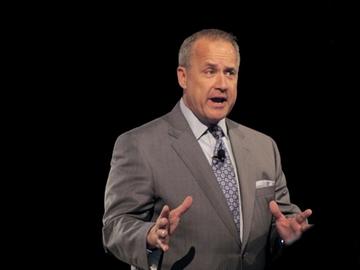
Jim Nussle, CUNA
ORLANDO, Fla.–In his first remarks to the League of Southeastern Credit Unions annual meeting, CUNA CEO Jim Nussle outlined what he said credit unions should expect from him and his association–but also stressed that he expects something from credit unions, too.
Nussle, hired just nine months ago, told his audience of credit unions from Alabama and Florida that he wanted them to remember three key themes:
- Winning is growing. “I think it’s a very important mission for a leader to clearly define what success is, what a win is. As I’ve come into the movement there is some question about whether or not we are winning or have had a big win. I hear people say we haven’t had a big win since HR 1151 (in 1998). Winning to me is more than that. It is about growing and serving whole new folks we’ve never had an opportunity to serve.”
- Advocacy is about telling our story. “I will have a lot of folks come to Washington and they want to know the talking points, the agenda. I will tell them yes, we can give you bullet points and talking points, but advocacy is about telling your story. It’s about talking about what you do, the service you provide to people on a daily basis,” said Nussle, a former congressman. “It’s about sitting across the table from another member and solving their problems. That’s what policymakers remember. I met with Sen. Elizabeth Warren and she talked about a credit union that solved a problem for her niece. My point is that sometimes we forget that the most important thing we can do as advocates is to talk about what we do.”
- Advocacy is good for business. “This is what helps us to move into whole new markets. And sharing it with your members, in particular, is extremely good for business.”
Reiterating a theme he first mentioned in his inaugural appearance before credit unions at CUNA’s GAC earlier this year, Nussle told CUs he has been charged by the CUNA board with “shaking things up.”
“They challenged me to refresh our value proposition and to deliver that in a new way,” said Nussle. “Let me tell you why that’s important. Trade associations typically have worried about themselves; is the trade association succeeding? Trade associations will typically talk about what THEY do for you. But that’s changing. You are asking, ‘What are we getting for the dues that we pay?’ The only way we can communicate that isn’t to say ‘This is what we do for you.’ It’s about showing the results we can deliver to you. My most important partner in doing that for you is (LSCU CEO) Patrick La Pine and people at the league. There is no way he can be as effective at representing you without the network of leagues all across the country. We are all in this together. We don’t get to be individuals.”
Three Measures Of Success
Nussle said he will measure CUNA’s success using three metrics:
- It’s not just about. “It’s about tearing down barriers between you and your ability to serve your members.”
- Creation of awareness. “In order for the connectivity, or just recognizing that current members understand that you can be an even more valuable partner, yes, you can do it separately, but your trade associations need to help you with that.”
- Whatever CUNA delivers, it has to be “top-notch. If it’s not something the national association should be doing, then we ought to partner with a league that is doing it well. If a league isn’t doing it well, we should partner with private business. We need to start focusing our attention on what we need to do in order to grow, and not just trying to be everything to everyone.”
Nussle said one observation he has made in his time in CUNA is that while advocacy is “job one,” the overall credit union advocacy effort has been “confused, disjointed, uncoordinated and old school.” He noted that credit unions were once pioneers in doing Hike the Hills. Today, all special interest groups do them. “So we have to think of new ways of connecting with our policymakers.”
Nussle said the CUNA board said it and the association wanted to be “challenged” by the new CEO. A couple of early challenges Nussle said he has recognized is the question of why, even during the recession, overall market share remained at 6%, instead of 16% or even 60%; and a second question around why so many CU advocates remain untapped.
“There are 6,400 CUs nationally, he observed. “Those are 6,400 presidents and CEOs. When we said in the past we need you to activate, we’d have 6,400 people to activate. Guess how many the bankers are able to activate? About 6,400. We’ve got to grow that number. We’ve got 6,400 CEOs, but we also have about 80,000 board members and another 250,000 employees. One of the most powerful lobby groups in Washington is the National Federation of Independent Businesses. They represent 350,000 small business. I just gave you 350,000 names we could activate. If we activate those who have a skin in the game. And I’m not even talking about the 102-million members.”
Two-Way Street
Nussle said that when it comes to challenges, however, it goes both ways.
“I want you to challenge me to get results. I expect you to challenge me for every dollar you send to your association,” he said. “But I want you to be on notice that we need to challenge each other, too. If we are truly the kind of cooperative that we want to embody, the tradition that is the difference, then we need to start acting like that as a community.”