

BOULDER CITY, Nev.–An extensive new white paper makes clear just how broadly transformative artificial intelligence and generative AI are going to be for credit unions across the enterprise and the markets, yet it also stresses that the starting point for every decision a CU makes must be to protect “member trust by ensuring the credit union’s values are built into the foundation of all models.”
And while many credit unions may believe they have processes or people in place to respond to generative AI in the context of CU values, much of that is not “good enough,” the paper argues.
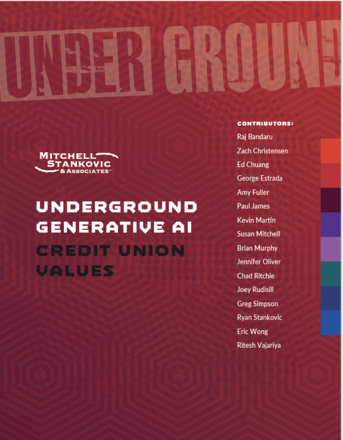
The 77-page white paper, which includes contributions and perspectives from 16 people from across credit unions, delves into dozens of different AI-related topics and subtopics. The paper emerged from discussions that had originally taken place at the “Underground” meetings that are hosted by Mitchell, Stankovic & Associates and was championed by the company’s president, Sue Mitchell.
“We started discussions around artificial intelligence, digital intelligence, and emotional intelligence to determine how to integrate the human voice into machine learning to ensure the industry maintains credit union core values, unique to the cooperative model, and critical to member trust,” explained Mitchell, Stankovic in the introduction to the white paper.
In follow up to those Underground meetings, Mitchell said brainstorming sessions on generative AI on a broader level “than any particular use case right now” made clear the technology has both potential opportunities and potential issues for credit unions if the time isn’t taken now to consider them.

Sue Mitchell
The organization was particularly motivated by a paper from the Sloan School of Management titled, “When Algorithms Rule, Values Can Wither,” according to Mitchell, and the underlying theme of credit union values appears throughout the paper.
That foundational issue is critical, the paper notes, pointing out how the release by Open AI of ChatGPT in November of 2022 has “broken records” when it comes to adoption of a technology, and generative AI has now exploded into countless use cases, some legitimate and others doing harm.
‘What is Your Credit Union Going to Do?’
As CUToday.info has regularly reported, credit unions have raced to be, if not leaders, fast-followers in generative AI, which is already being used among credit unions, CUSOs and vendors for everything from creating content to writing computer code, even if all the potential ramifications remain unknown.
“What is your credit union going to do? Generative AI will transform every aspect of your organization, from your employee engagement with members to replacing human processes with machine bots, a future unlike one can imagine,” the paper observes. “Careful foresight and planning must be done to create a strategic road map on its use within the organization, starting with protecting member trust and continuing through diligent oversight and accountability.”
‘Not Good Enough’
The paper’s authors further posit that when asked who has a generative AI strategy playbook, the response typically is that it lies within the technology stack internally and vendors externally.
“That's not good enough,” the paper argues. “The board and executive team must begin with diligent intention to ensure credit union values are at the foundational models core. It must be an actionable campaign and not just a performative discussion that falls on deaf ears.”
The white paper, which includes an introduction from George Estrada, principal enterprise strategist-nonprofit with Amazon Web Services and who notes “the future possibilities for Generative AI in business are profound,” explores some of the basics, such as what is generative AI, why is generative AI important, and what are the common applications of generative AI.
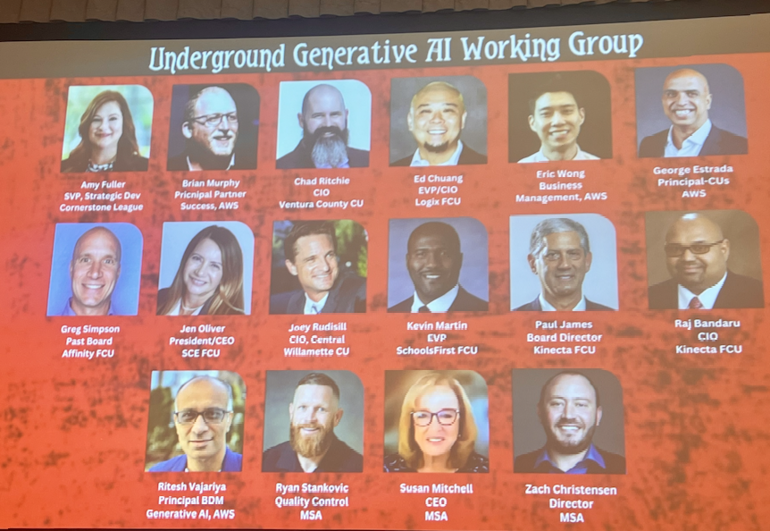
Members of the white paper working group.
In addition, it also explores numerous other areas, including:
Fear of Generative AI
The paper acknowledges the widespread concerns related to generative AI, chief among them worries over job losses. In response, the paper urges “early communication and education” with employees on the issue, and recommends, “The integration of AI should not be perceived as a job replacement but rather as an opportunity to delegate routine and redundant tasks to technology. This shift would allow employees to focus on more strategic and value added responsibilities, empowering employees from a career perspective and making their day-to-day easier.”
Employees should be told to expect shifts in jobs and functions as a result of AI, the paper adds.
Strategic Economic Value of Generative AI
The paper explores AI’s potential effects on members, mission and margin, saying the “key is going to be trust…We must treat AI with the same care that we’ve been giving to our membership since credit unions were founded to ensure our AI models strengthen the trust we have built.”
Credit Union Philosophy and Values
The Eight Cooperative Principles are examined under what the paper describes as the “lens of generative AI.”
Noting the credit union philosophy of people helping people remains “highly relevant” in the modern economy, the white paper observes there remains a “dilemma,” which is the “complexity of running a financial institution today can make it insurmountably difficult to see the forest through the trees…” To that end, the paper examines the individual “trees,” or the eight cooperative principles.
For each of the eight the paper offers a view through the lens how generative AI can provide support and reinforcements.
Establishing a Steering Committee
In the pursuit of “ethical and value-driven AI integration,” the paper’s authors recommend the creation of AI guidelines and policies, regular ethical audits and assessments, and the creation of a transparent and explainable AI model.
It further recommends the creation of a steering committee, and offers 12 key principles for the steering committee to follow.
Addressing Credit Union Gaps, Opportunities
The white paper identifies a dozen areas where Generative AI can be used to identify gaps and opportunities for better service to members, including personalized recommendations, risk assessment, market research and fraud prevention.
Additional Topics Explored
At considerably more depth than is provided in this report, the white paper further addresses issues related to:
- Governance, including the duty of care and oversight and the “vital role” of boards as well as the need for continuous oversight and engagement
- Strategic Positioning related to generative AI, including defining what success will look like
- Regulatory Considerations, including NCUA’s position on the technology
- Risk Management, including around member-facing solutions and the need to address bias, encryption, third parties and more
- Quality Control & DEI Oversight, especially related to any bias that reinforces inequalities
- Vendor Management, with the paper offering six different points to consider as well as tips for making assessments
- Where AI Fits: Human, machine, co-pilot?
- Replacing Processes & Increasing Consultative Engagement, which addresses not just issues related to the workforce, but also increasing people’s digital IQs, including that of C-suite execs. Mitchell, Stankovic noted it has hosted two roundtables of CU leaders and it was “crystal clear it's high time we invested in digital education.”
- Issues Around What AI Can and Cannot Do
- Generative AI Best Practices related to seven different aspects of operations across the enterprise
- Ethics, which represent one of the biggest challenges in generative AI and which is an issue touched upon throughout the white paper
- Serving the Underserved, which again speaks to biases in machine learning models and decisioning platforms
- Technical Considerations, including scalability, interoperability, data quality and more
One Board Director’s View
Paul James, a board member with Kinecta FCU in California and who is among the authors of the white paper, told CUToday.info he was particularly drawn to the governance issues explored in the white paper, but that he also took away much more from the work that was done.
One of his primary takeaways: “There is a lot more I don’t know than I do know, which is always the case. There is a lot more work to be done at least from our board’s perspective to get up to speed and do our jobs well.”
In Kinecta’s case, James said the credit union is already in the early stages of using AI for loan evaluations, but he sees potential for expanding the technology to other areas that can benefit operations, including making employees’ jobs easier and eliminating the more mundane, routine tasks employees must do.
As noted above, one of the most vexing questions surrounding AI is what it will ultimately mean for employment and whether it will lead to job cuts, James said that while those are questions for the operational experts, “My belief is this will change the nature of work and that it will create new jobs that people didn’t contemplate a year or two ago, like some of the other prior technologies that people thought would eliminate jobs.”
Things to ‘Think About’
As for what he hopes people will take away from the paper, James said, “I hope people read it and appreciate the work that went into it. In particular, there are some very thought-provoking questions around what Sue Mitchell calls the foundational model. There are a dozen or so questions that I think are relevant to talk about: living the credit union difference, best practices, roles and responsibilities for AI in an organization. These are the kinds of questions that in addition to the more executable stuff people need to take time to think about.”
‘This Changes Everything’
In the paper’s summary, Chad Ritchie, CIO with Ventura County Credit Union in California, recalled that in 2007 then Apple CEO Steve Jobs unveiled the iPhone with the prediction, “This is going to change everything.”
“None of us really understood what he meant by that,” wrote Ritchie.
Sixteen years later ChatGPT debuted and now is experiencing adoption by an “order of magnitude bigger than what Steve Jobs launched,” Ritchie stated. “This technology is significant. It’s going to change everything in a way that we can’t imagine.”
Ritchie said that out of all of the topics covered in the comprehensive discussion had by authors of the white paper on generative AI, the most meaningful things taken away were around the “need to start with protecting member trust by ensuring the credit union’s values are built into the foundation of all models.”
Added Amazon’s George Estrada, “…This is going to become an operationalized piece of technology, and how we use it in the next 20 years is being defined today.”
The white paper is available here.