


SEATTLE–Credit unions here were given their first official introduction to a significant new “awareness” campaign that CUNA is preparing to launch in 2017.
As CUToday.info was first to report here, the campaign is being driven by a consistent problem, which is the unawareness among American consumers, and particularly Millennials, over what a credit union is or how it is different from a bank. Indeed, as it introduced the new effort at its America’s Credit Union Conference here, CUNA showed a video of street interviews in which Millennials were asked what they know about credit union. The responses made clear few had any idea, and CUNA said its most research had found that 71% don’t know what a credit union is.
“The opportunity now is greater than it has ever been to close the awareness gap,” said Teresa Freeborn, CEO of Xceed FCU and chair of the Creating Awareness Advisory Group, a 13-person committee that is overseeing the awareness initiative.
Freeborn’s remarks, as well as a larger presentation on what CUNA has planned, were made during the trade group’s America’s Credit Union Conference here.
“The implications of the awareness gap are very real. They affect wallet share,” said Freeborn. “We have the opportunity to capture the hearts and the minds of more people, especially the younger folks.”
Not National Branding Or Advertising
As CUNA made clear one day earlier in an interview with CUToday.info, the initiative is not a national branding or advertising campaign. Instead, it will be based on using consistent messaging by credit unions, their employees and volunteers, and will then branch into social media channels plus any paid media a credit union may opt to purchase on its own.
“This is a network approach,” said Freeborn, “so each credit union participating makes our message exponentially stronger.”
Douglas Kiker, CUNA’s chief strategic communications officer, told the ACUC meeting that there are 75 million Americans between the ages of 18-34, nearly all of whom have little familiarity with or understanding of credit unions. He further noted:
- Nearly half (45%) of credit union members think of themselves as “customers”
- 86% are not aware CUs are tax exempt
- 64% are not aware CUs are not for profit
- 40% of non-members in the U.S. did not know they are eligible to join a credit union
- One-third of Millennials, 25 million people, cannot identify a credit union as a financial institution
Kiker said the average of a credit union member is 48.5 years, and just 7% of CU members are 18-24 years old. “We have more to do to spread awareness and bring in new, younger members.”
Where the good news can be found, according to CUNA’s research, and this is what the awareness campaign will be seeking to leverage, is that once consumers learn of the credit union difference, they have a positive impression. Kiker pointed to research that has found:
- 83% of Americans say credit unions are better for the middle class because they return earnings to Main Street
- 83% like the fact CUs are not-for-profit financial co-ops
- 87% like that earnings are returned to members
Kiker said online tests of ads found 89% developed positive views of CUs over banks and 82% who said they are not members indicated they would move one or more accounts to a CU.
The Opportunity
“Now is the time to start telling the credit union story. We have an incredible opportunity right now,” said Kiker, noting the new awareness campaign will be drawing upon 16,000 interviews, focus groups and research conducted over the past 16 years by CUNA.
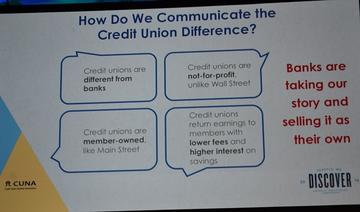
As CUNA CEO Jim Nussle said one day prior to the official announcement, Kiker shared with the audience that the research had found that four messages in particular resonate with consumers and “work”:
- Credit unions are different from banks.
- Credit unions are not-for profit, unlike Wall Street.
- Credit unions are member-owned, like Main Street.
- Credit unions return earnings to members with lower fees and higher interest on savings.
“We have found through research that if we use these messages and hammer them home they will change marketshare,” Kiker said.
As part of the awareness campaign CUNA has retained the Washington-based strategic communications firm Rational 360. Patrick Dorton, partner, and Vanessa Descalzi, director with the firm, were also on hand for ACUC to offer additional specifics around what the campaign will consist of.
“We have traditionally emphasized the ‘what,’ our products and services,” said Dorton. “We need to talk more about the ‘why,’ the credit union difference. The key is to be unified and amplified about the credit union purpose in order to break through with our voice and our message. There are a lot of voices, and it’s always a challenge when you have so many smart people and voices to align those voices. The key in that type of environment is to try to unify those voices into a common language about the credit union difference.”
One indicator the credit union message works, said Dorton, is how often banks have attempted to “steal the words” and “sell it as their own.”

Descalzi said the key elements of the awareness “toolkit” will include:
- Phase I: An Employee Ambassador Initiative, a Digital Engagement and Mobilization Toolkit, and an Awareness Best Practices Analysis and Hub
- Phase II: State by state financial influencer database; financial scorecard with state-by-state rollout; a regional earned media program, and creative activations.
- Phase III. Measurement and metrics.
Awareness Best Practices
“In my opinion, the Employee and Volunteer Ambassador initiative is the most important,” said Descalzi, referring to the more than 350,000 credit union employees and volunteers who could potentially participate in the awareness effort.
The Awareness Best Practices Analysis and Hub will seek to draw from a thorough analysis of past and existing awareness resources, as well as a centralized suite of all all awareness Initiative materials, including media templates, emails, social media language and images, one-pagers, and other collateral, “that will empower credit unions to communicate more effectively.”
Descalzi said part II of the Hub will allow people to connect and share what’s working, serve as a learning site where state leagues and credit unions can upload their content and share best practices. It will also house an earned media bank.
Dorton said that in Phase III of the awareness campaign credit union will “realize the fruits of our sustained labor with transparent measurements of new members and greater wallet share.”
For more info: http://www.cuna.org/awareness/