

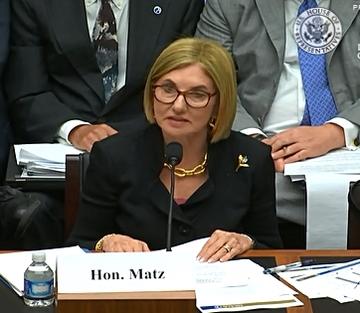
Debbie Matz, NCUA
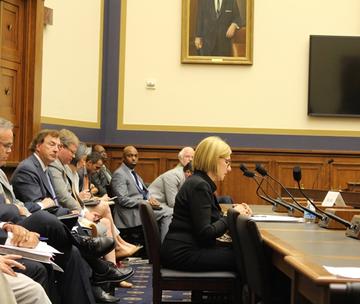
WASHINGTON—During a congressional committee meeting here Republican members of Congress did not hold back in grilling NCUA Chairman Debbie Matz with hard questions about the agency’s budget and the agency’s supervision of credit unions.
One member of Congress even referred to a statement made by Matz that it was “self-serving crazy talk.” NCUA later issued a clarification of that statement, and has since issued a fuller statement that includes an apology and additional explanation, that can be found here.
Following Matz’s prepared remarks, Committee Chairman Randy Neugebauer (R-TX) immediately began by addressing NCUA's 2015 budget, which reflects a 4.2% increase over 2014. That increase follows average budget increases of 8.4% over the last seven years.
“This contrasts dramatically to the budget of the FDIC, which has been decreasing for the last five years,” said Neugebauer, who noted that NCUA has stated that the need for the additional dollars, despite credit unions performing well, is due to CUs’ increasing complexity.
Matz responded saying that the FDIC has a resolution budget—which has been rising—and an operating budget. And when those budgets are looked at together, NCUA’s budget increases are on par with the FDIC’s.
CUs Consolidate While Budget Grows
Neugebauer kept at the questioning, and as was the case with other members of the committee questioned why even as the number of CUs shrinks the NCUA budget has continued to grow.
“We are operating effectively, but we need to keep ahead of the complexity of the industry,” said Matz. “The industry has to be competitive, provide electronic services to their members . . . we have given them derivative authority. Today we eliminated the cap on their fixed asset investments.”
Neugebauer also addressed the growing size of NCUA staff, noting that the agency’s OIG found that many of the failures that occurred during the recession occurred even though agency examiners spotted problems–but there were issues with follow-up. “So you don’t need more examiners, you need more competent examiners,” he told Matz.
Some of the toughest questions were asked by Mick Mulvaney (R-SC), who is sponsoring legislation that would require the Government Accountability Office to study almost every aspect of NCUA’s budgeting and expenditure practices.
Referring to an earlier response from Matz, Mulvaney asked the chairman why she said CUs are not representing their members when they ask for more budget transparency.
“We all turned to each other in a stunned fashion when we heard that,” said Mulvaney. “So if they are not representing the best interests of their members, whose interests are they representing?”
“Credit unions asking for budget hearings and to cut budget dollars and exam hours is not representing the best interests of their members,” Matz reiterated.
Follow-Up Statement
In a follow-up statement issued by NCUA after the hearing, the agency clarified Matz’s statement (see story, right).
“Are you a CU member? I am,” continued Mulvaney. “And I think they are representing me when they ask for those things. As a member of the credit union I like the fact the credit union is trying to guard my money and be conservative with that. You have a budget increasing higher than the rate of inflation and a staff going up in numbers higher than other regulatory bodies.
“So you said earlier that you did not think input to input from CUs would be helpful, and you also thought input from your own employees is helpful,” Mulvaney noted. “So what I am hearing, as a member of a credit union, is that you don’t think the input for the people who pay for NCUA is helpful but you do think that that input from the people you pay is? So help me reconcile what an ordinary human being would describe as self-serving crazy talk.”
Matz responded saying that she visits with credit union leaders and boards regularly, and has done that during her first four years as a board member and now her last six as chairman.
“In that time I can tell you that the NCUA budget is not something that has come up,” said Matz.
“So you are saying that credit unions never raised concerns with you about your budget, that this is something the trade associations have drummed up?” Mulvaney asked.
“That is what I am saying,” replied Matz.
“So you think the credit unions are happy with your budget,” said Mulvaney.
“I don’t think they care about it,” said Matz.
Trades Meet With Reps
Both NAFCU and CUNA met with members of the committee and their staffs in the weeks leading up to the hearing.
Mulvaney then asked that if the NCUA budget is not an issue for credit unions, what is the harm of having budget hearings and going through NCUA expenses line by line.
“We are independent regulator, and while a budget hearing might have good intentions, I don’t think it’s good government to have the people who are regulated participating in the budget-making process of their regulator—the regulator who determines how many exam hours they need,” said Matz
Mulvaney then asked if Matz would be happier to be simply be placed under the budget appropriations process and have “Congress looking over your shoulder.”
“I am fine with the ways things are,” said Matz.
“I thought you might feel that way,” said Mulvaney.
Leader In Transparency
Ranking Member Lacy Clay (D-MO) asked Matz about her statement during the oral testimony that NCUA is a leader among its peers in providing budget transparency. “Describe the information you make available to the public and how your budget transparency efforts compare to other financial regulators.”
“When I came back to NCUA in 2009, I came back with the goal to improve transparency with all stakeholders,” said Matz. “We have held Listening Sessions across the country and Town Hall webinars, finding more effective ways to listen to credit unions . . . In terms of budget transparency, we have a budget website—it contains budget advisory memos, line-by-line budgets for each office in the agency, audits from accounting firms, it goes on. No other regulator has that level of transparency.”
Bill Posey (R-FL) turned to NCUA’s risk-based capital proposal, noting that data shows that only a limited number of credit unions would have been downgraded if RBC was in place today, questioning why the rule is needed at all to address what appears to be a small number of CUs experiencing problems with an industry performing well.
Matz emphasized that RBC is focused on the future.
“Like other regulators, we feel it is important to have a forward-looking indicator,” said Matz. “(RBC) is not intended to just catch problems today, but have credit unions monitor their risk in the portfolio to catch issues going forward.”
Posey addressed the of the so-called “stop and study” bill on which he is a co-sponsor, saying that NCUA should not move forward with its risk-based capital plan until a comprehensive study of the rule is completed. He urged NCUA to consider slowing down in its move toward a final rule. “Especially since the second risk-based capital proposal received more comments than the first.”
Matz, noting that many of the comments in round two are form letters stating that the rule should be withdrawn, and added that the agency is carefully reviewing each substantive comment.
“We studied risk based capital exhaustively between RBC1 and RBC2,” responded Matz. “We don’t intend to delay it. We feel this is a fair rule.”
Fraud Losses
Scott Tipton (R-CO) turned the discussion to fraud losses, which the agency has pointed out in board meetings in the last year are driving much of losses the insurance fund has seen.
“Does this concern you?” Tipton asked.
“I am always concerned about fraud and cybersecurity,” said Matz. “But in terms of an impact to the Share Insurance Fund, these losses are minimal. Often the losses are due to lack of control in small credit unions.”
Tipton challenged NCUA that if it is having difficulty overseeing fraud at small CUs, how will the agency be able to monitor fraud at third-party vendors, if granted such oversight—an issue brought up by a few House members.
Matz responded by saying NCUA is increasing staff dedicated to looking for fraud and that cybersecurity training will be ongoing.
CU Numbers Shrinking
The subject of the steadily shrinking number of credit unions, and how consumers—especially in small towns and rural areas—need those services where banks don’t always venture was also frequently raised during the hearing. Rep. Frank Guinta (R-NH) asked Matz if the regulatory burden, specifically from Dodd-Frank, is the major problem here.
“I don’t think Dodd-Frank is the reason,” said Matz, stating the agency works diligently to find ways to relieve CUs—particularly small ones—from regulatory burden. “It’s a sad story, and one important to me, losing credit unions each year. But it is the result of not being able to achieve economies of scale, and not being competitive in the marketplace. And, because a manager who has been in place for 25 years decides to retire and the credit union has no succession plan in place.”