

ALEXANDRIA, Va.–Just how serious was the corporate credit union crisis of a decade ago? It was an “extinction-level event,” according to the person who was closer to the crisis than just about anyone else. And no, not extinction for some or all corporate CUs—instead, for the U.S. credit union system itself.
This month marks the final maturity on the investment securities NCUA packaged up in a one-of-a-kind offering to the financial markets. It’s a date that 11 years ago, when the NCUA Guaranteed Notes (NGN) program was announced, even the strongest advocates for NCUA’s response to the crisis were skeptical they would see.
And that includes Larry Fazio, credited by many as the architect behind NCUA’s corporate resolution program, which involved placing U.S. Central, Wescorp, Southwest Corporate, Members United FCU, and Constitution Corporate FCU into conservatorship. Fazio himself is quick to credit everyone at NCUA, including the then board members, for their work in bringing about what most agree is a successful resolution to the crisis, or at least as successful as could be given a situation in 2008-09 in which there were more than $30 billion in mark-to-market toxic mortgage securities held by corporate CUs—against approximately $10 billion total in the National Credit Union Share Insurance Fund.
Fazio’s insights are shared here as part of a week-long series in CUToday.info being published in conjunction with the final maturity in the NGN portfolio and that features insights and recollections of those who were involved in efforts to save the U.S. credit union community.
Larry Fazio joined the NCUA in 1991 as an examiner in Chicago and then served in various roles in the field before arriving at the agency’s Alexandria, Va., headquarters in 2002. He served as the deputy executive director from 2008-2011, as director of the Office of Examination and Insurance from 2011-February 2020, and as executive director from February 2020 to the present.
Fazio agrees it’s hard to believe the decade has passed and the maturity dates on the NGNs have arrived. It wasn’t a day anyone within credit unions, much less the agency, was ever confident they would see.
‘Very Unsettling’
“We were going through the Great Recession and it was very unsettling,” recalled Fazio. “Looking back now 10 plus years later, you know it all worked out and a lot of what we know seems sort of obvious with hindsight bias, but back then we were not sure we were going to be able to work our way through this. It was very difficult.
“It wasn’t just the Great Recession affecting everything; we had this very concentrated risk, because the five (failed) corporate credit unions, and U.S. Central and Wescorp in particular, had concentrations in private-label mortgages that were under a significant amount of stress. When you added that dimension to it, were we even going to come up with a solution and make it all the way through, let alone all the way to 2021? That was the big question in everybody’s mind in that time period.”

Larry Fazio
Potential ‘Extinction’
What may be lost after a decade is just how deep was the abyss into which credit unions were staring in 2007-08, suggested Fazio, who noted the corporates had approximately $60 billion in unpaid principle balances at the time, and on a mark-to-market basis the securities were valued at approximately half that figure.
“So, you’re looking at a $30 billion loss that would flow through the system and down into the natural-person credit unions. That was a potential extinction-level event for the credit union system if we didn’t come up with a plan,” he said.
It was a plan Fazio now calls “bold and audacious for us.”
“This was a too-big-to-fail problem for the credit union system—not for the U.S. economy or the banking system, but for us,” Fazio said. “The five (conserved) corporates had about $100 billion in assets in total with about $60 billion in toxic securities or so, and the share insurance fund was $10 billion and our borrowing authority was $6 billion. And that $30 billion in losses, which would have turned into $40 billion had it cascaded through the system—that was half the net worth in the entire credit union system at the time. So, it was a big deal.”
‘Not as Well Understood’
But in the lead-up to that potential demise of the credit union system, what was the level of concern inside the agency? Did it recognize just how enormous the threat was to credit unions?
“At the time I think it was probably not as well understood as it is now, obviously, because we know exactly how it played out,” Fazio said, noting that it wasn’t just concentration risk that wasn’t as well understood at the time, there was another reason no one was running to grab the red flags.
“You have to remember back then, even though they were private-label, they were mortgage-backed securities that were AAA or, in a few cases, AA rated. Yes, there is a concentration in them, but they were perceived to be super high-quality securities. Of course, we now know that wasn’t the case.
“When you think about concentration risk it is not the same as being concentrated in relative risky retail loans,” Fazio continued. “These were securities that were mortgage-backed that were very, very highly rated.”
In retrospect, it is clear the five corporate credit unions that were conserved had an undue and unsafe level of concentration risk, especially relative to their capital levels, but as Fazio noted, “It’s hard to say that it was exactly obvious at the time. I do think it was, as I recall, something that had started to bubble up in the 2006-07 timeframe. But in mid-2007 the markets abruptly froze and at that point you were in and you were going to ride it out.”
‘A Definite Liquidity Problem’
As the mortgage market was crashing in 2006-08, Fazio was serving as deputy executive director at the agency and said he wasn’t in all of the meetings that were being held, especially by its Office of Examination and Insurance.
But he recalls the general conversations in the offices on Duke St. –as they were all over the country and on the cable business shows--were over whether the housing downturn was just a temporary market anomaly that would bounce back, or was it far deeper?
“When you're looking at these bonds at the corporates, are the values depressed because the markets are unsettled or are these really going to be credit losses where you are going to realize losses whether you sell or hold?” Fazio recalled of the debate at the time. “There was that issue. But when you looked at the corporate credit union balance sheets what you also saw was the significant drawdown in deposits by natural-person credit unions because they saw the risk. They saw the mark-to-market numbers on the financials for the corporates.
“So, now it started to become a definite liquidity problem for the corporates; that started coming to a head,” Fazio explained. “Now you’ve got this real liquidity problem you’re trying to deal with. I think at that point it became more of a ‘We are going to need all hands on deck,’ and I remember then Executive Director Len Skiles coming to me and saying, ‘We’ve got a big problem and we need to figure this out.’ And part of it was also driven by then Chairman (Michael) Fryzel, who deserves a lot of credit for his leadership during that time period, as well as Debbie Matz when she came on as chairman a year later, to really rally the organization and put together a broad team.”
A Three-Phased Approach
Fazio said NCUA approached the huge dilemma in front of it more than a decade ago in three phases.
“We really had to think about this holistically and strategically. There was a stabilization phase where we needed to deal with the immediate liquidity needs and get our arms around are these temporary losses. Were they really mark-to-market, or are they really going to realize in terms of credit losses on the bonds and what does that mean?” he said of the questions being asked at the time. “And then there was the resolution aspect of it. It was, ‘OK, yes, these are real losses, liquidity is not coming back, and we are going to have to resolve these institutions.
“And then, of course, there were the reform aspects of this, as well. How do we make sure this doesn’t happen again and what is the future? What is the path forward for the system? It wasn’t just a financial crisis for us,” Fazio told CUToday.info. “Yes, there was a major financial aspect to this. Those losses could have cascaded through the system and basically impaired the whole system. You also had the operational side of it. At the time U.S. Central was the third-tier wholesale institution. Almost all the payments transactions in the credit union system ultimately went through U.S. Central, so how do you make sure these thousands of credit unions and these millions of consumer transactions that are flowing up through their corporates and then up through U.S. Central and the payments rails—how do you make sure that doesn’t get interrupted? That was a major aspect of this, too, that we had to solve for.”
‘We See No Way Out of This’
What was the mindset of the corporates themselves? Many objected strongly after the conservatorships took place and there was considerable angst within the credit union community that the conservatorships should have never happened. But Fazio recalls that at least early on many recognized they needed help.
“I wasn’t very involved early on as this was sort of building up in the 2006-07 timeframe,” Fazio said. “It was in mid-2008 and forward where this really all started coming to a head from a liquidity standpoint, and the reason I remember that is I because I started as the deputy executive director in May of 2008.
“Shortly after that that Len brought me in and we created this team. What I recall from that point forward is the corporates knew they had a problem. I distinctly recall a meeting where all the corporates came in and met with our top executives and basically said, ‘We see no way out of this. We’re going to run out of liquidity before the end of the year, and NCUA you need to help.’ We knew that already. But I don’t recall any resistance at that point from the corporates. This was a systemwide event where everybody needed to be rowing together.”
Pulling Back the Curtain
In late September of 2010 NCUA pulled back the curtain on its formal Corporate System Resolution Program. It was an effort that had been in the works for some time and involved numerous parts—parts no one at NCUA had ever seen before, much less assembled.
Fazio said the agency spent all of 2008 and early 2009 marshalling resources behind the stabilization effort, including liquidity support programs such as the Temporary Corporate Credit Union Guaranteed Loan Program, which brought in external funds that NCUA would guarantee.

There was also the Temporary Corporate Credit Union Guaranteed Share Program in which the agency guaranteed the deposits in the corporates to stem the outflow of what Fazio called the “slow and silent run that had accelerated at that point.”
Overall, Fazio recalled, NCUA provided U.S. Central with approximately $3.7-billion in liquidity toward the end of December 2008, which the corporate paid back relatively quickly, and then provided a $1 billion note in early 2009 that remained outstanding for a much longer period of time but which was eventually recovered. Around the same time, NCUA, which had retained PIMCO for its advisory services, was given an evaluation that stated the credit losses showing on the corporates’ books were most likely to become actual losses.
‘Another Big Realization’
“Another big part of that period was the realization that the share insurance fund has to reserve for these losses and that’s going to cause not just an impairment of the 1% deposit in the share insurance fund, which then downstreams an expense to the credit unions, but also our need to start charging premiums to help restore the fund,” Fazio said. “And there were all the concerns around credit unions struggling because of the recession, with job losses and high delinquencies and loan losses, and now we have this additional challenge rolling through the system and onto the credit union balance sheets that we really couldn’t control.
“And so we worked with Congress to get the passage of the Temporary Corporate Credit Union Share Insurance Fund legislation, which allowed us to take those losses out of the NCUSIF and put them into the (Temporary Corporate Credit Union Stabilization) fund,” Fazio said. “And because of the way we set it up and designed it in working with Congress, that allowed us to spread those costs—in terms of expenses to credit unions—over time, which ameliorated that issue.”
In May of 2009 when the corporate resolution program was unveiled internally at the agency, Fazio said the thinking was the “patient had been stabilized” and the new question was “how do we do the surgery to extract the problem and then do what we need to do from there.” That led to the resolution phase planning, fazio said, and the public unveiling of NCUA's plans, including the NGNs, in September of 2010.
A New Abbreviation
That’s when NCUA also introduced a new abbreviation to the credit union lexicon, the NCUA Guaranteed Notes, or NGN, program, which was designed to provide long-term funding for distressed investment securities from the five failed corporate credit unions. The NGNs represented more than 2,000 investment securities secured by approximately 1.6 million residential mortgages, as well as commercial mortgages and other securitized assets. The NGN trusts then issued approximately $28.3 billion of NGNs, backed by the cash flows from the legacy assets. Under the program, NCUA then guaranteed timely repayment of principal and interest to the investors in NGNs.
But the financial piece was just one slice of the resolution pie. Fazio said NCUA also had to work through the operational side of the corporates, including how to ensure the ongoing stability of the bridge corporates, how to retain the employees that were needed, and how to keep credit unions engaged with their corporates at a time when the reputation of what were often then referred to as credit unions’ credit unions was muddied at best.
In order to do all that, Fazio explained, NCUA had to free up some of the securities in order to resecuritize them—a task that involved more than 900 derivatives that had to be unwound, representing approximately $25 billion in notional value.
“That was a Herculean effort in and of itself,” said Fazio. “That had to happen before the Sept. 24 date, because that’s when we would be going into the market with the NGNs, as well as do some other securities sales in advance of all that.”
Ingredients & Recipes
Terms that are common to many in credit unions today—good bank/bad bank, bridge corporate, NGN—were unknown just over a decade ago. Where did NCUA find the models for the components of its corporate resolution program?
Fazio credited what he called the “broader ecosystem” of state and federal regulators, as well as the International CU Regulators Network (ICURN), for their experiences and insights.
“A lot of these raw ingredients that we were working with, none of that was brand new in the ecosystem,” said Fazio. “Those things had been done in some form or fashion by somebody over the years, including us. But what I think was innovative and was critical here was it’s one thing if you’re going to bake a cake to have all the right ingredients. It’s another to have the exact right recipe, the right mixture of things, and knowing when to add certain things and how long to cook it, and that was what I think was innovative and essential for us.
“We knew we had all these different pieces, but how do you put them all together in a way that meets all the legal requirements, meets the accounting issues, preserves the maximum value we could preserve? How do you reconcile all of those things and make the recipe work?”
Fazio described the Stabilization Fund, which closed on Oct. 1, 2017, ahead of its planned June 30, 2021, expiration, as a “significant innovation” even though at the time not everyone was confident it would work. It was, after all, a program put together and funded in near record time, especially by Washington standards.
“We also had the good fortune that Congress ran with that and signed it into law. I had the core of the idea and briefed Chairman Fryzel on it and he said, ‘Do it,’ and I got with one of our brightest lawyers and we wrote it in the morning and went over to the Hill with then PACA Director John McKechnie and briefed certain key congressmen,” Fazio related. “From the point we envisioned it to the point President Obama signed it into law was three months, which is remarkable. And it worked.”
‘Could We Really Pull This Off?’
As CUToday.info reported here, former NCUA Chairman Debbie Matz described sitting on “pins and needles” on the day the NGNs were first taken to the markets. No one knew if they would actually attract investors.
Fazio agreed there were plenty of unknowns.
“Could we really pull this off? We had never done anything on this scale. Could we really pull off all of this with all the moving parts and not have something financially or operationally go wrong? It was long odds. I always viewed it as a bit of a ‘We don’t have a better option, this is the best we’ve got,’ short of Congress writing a big check, and it was certainly feasible, but there were a million things that could go wrong and many that did that we worked through and still got it done without a hitch.
“But it could have easily not worked and one of the big concerns was how was the market going to perceive the NGNs? Were they going to be attractive? Were we going to get good execution and pricing? What we didn’t know at the time was FDIC was going down a parallel path. They got into the market with one of their securitization deals a couple of months before we were ready to go. The good news was we got to see how that went. Ultimately, they struggled, while our NGN program was wildly successful. The market loved it. We got great execution and pricing. And people were clamoring for it. But we didn’t know.

‘Who’s NCUA?’
“The other difference was if you think about it back then, people know who the FDIC is, especially in the market, so when FDIC puts a guarantee on those securities people are, ‘OK, full faith and credit of the U.S. government.’ FDIC, people get it,” said Fazio. “Who’s NCUA? And how is this little agency backing $30 billion in securities? There was certainly no guarantees and a lot of worry over whether we were going to be able to pull this off. And, thankfully, it was well received and it hit all of our expectations.”
About Wescorp
Not every credit union that held capital in a corporate CU has had their expectations met.
Western Corporate FCU (Wescorp), then headquartered in San Dimas, Calif., and the largest of all the corporates, served some 950 CUs. It had been chartered as California Central FCU in 1969 and by 1975 had expanded its field of membership to every CU in what was then NCUA’s Region VI. In 1976 it changed its name to reflect that it was the first regional corporate CU.
That wasn’t all that was unique about Wescorp. It invested more aggressively than other corporate CUs, offering the kinds of attractive returns that had allowed it to grow to $34 billion in assets at the time NCUA took control.
The result over the next decade was that Wescorp capital-holders have not seen the same return on their capital as have CUs in the other four failed corporates. Wescorp Bridge Corporate was eventually merged with Southwest Bridge Corporate and today operates as Catalyst Corporate, based in Plano, Texas.
“My recollection is Wescorp had the highest concentration to total assets in these types of securities, and U.S. Central was next, although it was maybe half, and it kind of went from there,” said Fazio. “U.S. Central’s securities were predominately private-label residential mortgage-backed; they hadn’t bought as many of the mezzanine tranches. Wescorp loaded up on the mezzanine tranches. There was this sort of clever mezzanine tranche the market started doing at the time, so you had the most senior tranche, but even the senior tranches took hits in the private label space. The mezzanine was just below that—it was still getting a AAA or AA rating, it was still the second highest tier in those deals, but that was going to get wiped out before the super-senior pieces.”
The Biggest Question of All
One of the biggest questions that has been debated by some in credit unions since the five corporate CUs were placed into conservatorship is whether NCUA needed to have acted at all.
Some observers argued at the time of the conservatorships—and a few still do—that the recovery of the underlying assets is evidence the agency was too hasty.
Fazio says the argument lacks merit and the facts prove that out, and he adds there are issues beyond just the balance sheet. While the underlying mortgage-backed securities rebounded more quickly than many had projected, selling off the assets was not an option.
“We couldn’t actually sell them,” Fazio explained. “The loss on the sales would have been even worse than the mark-to-market losses and we didn’t have the wherewithal to fund that and absorb that. Setting that aside, the other part of the strategy was that maybe we’ll do better than the current estimates over time if we can isolate and fund them, which is what the NGN program allowed us to do.
“A lot of things contributed to the resolution plan doing better than initial estimates,” he continued. “Yes, the bonds performed better than initially suspected, which is not necessarily that surprising." Fazio said the overall performance of the securities in total, in terms of credit losses, was better by about $2-$5 billion over the early estimates from Barclays, as the actual realized losses (including implied write-downs and a relatively small level of remaining projected losses) performed better.
"Also, the way we did the NGNs created what we call ‘excess spread,’ and that offset some of the credit losses because we had positive spread between the funding rate on the NGNs and what the underlying securities were throwing off in income, even with the defaults," Fazio said. "And we did a good job of matching those off in terms of how we designed the interest rate features for the NGNs relative to the underlying securities.”
‘Not Realistic’
As for those who continue to maintain the five corporates would have ultimately survived, Fazio says, “That’s not realistic. These institutions were completely illiquid and utterly dependent on extraordinary government support for liquidity. The credit losses were real and were beyond the ability of those organizations to absorb. The actual realized losses to date are, I think, in the $9 billion range, and those institutions did not have that kind of capital.
“I think people forget the reason they had the liquidity problem is because credit unions were withdrawing their funds because they were concerned about the risk,” he continued. “Who was going to put more at-risk capital in, not to mention at-risk deposits in those institutions until they really knew the problems were behind them? The only way for us to extract the problem out of those institutions was to go through this resolution process, hence the need for the conservatorships and the good bank/bad bank and the NGNs and the overall resolution program.”
The Legal Recoveries
What many also overlook, said Fazio, is another critical piece in the process the corporates could not have done on their own, and that is win the more than $4 billion in legal recoveries NCUA has gotten from Wall Street banks and other firms that sold the toxic securities to the corporates.
Fazio said the corporate resolution process was engineered to ensure NCUA retained the ability to preserve legal recoveries.
“Initially we never included in our estimates any potential legal recoveries, because they are inherently difficult to estimate,” he said. “And also back then there wasn’t a lot of optimism on the legal front. These were institutional investors, so it’s a little bit harder to prove they didn’t know the risk of the transactions. But a lot of things worked to our advantage to ultimately offset the losses that were originally estimated.”
Moreover, Fazio explained, the “huge, huge reason” there has been money available to refund to credit unions has been due to the wins in court.
“We netted almost $4 billion. That’s a significant portion—in fact, that’s all of what is allowing us to have recoveries for the depleted capital-holders of those corporate credit unions,” said Fazio. “And those corporates likely would not have been able to have the legal recoveries. One, I don’t think they would have had the wherewithal: we have the backing of government and the Justice Department. And we had the resources to pursue the legal remedies. But another big piece of it was because when we took over an institution that was failing, we got a statute of limitations extender. So, in many cases those corporates would not have been able to prosecute those lawsuits because the statute of limitations would have expired.
“It’s a combination of all those things that when looking back it makes it seem like we didn’t have to act, but we absolutely needed to do what we did.”
Two Other Issues
Fazio added that none of that takes into account two other issues. First, the pressure the agency was getting from Congress, the Administration, the Federal Reserve and Treasury, all asking, “Hey, what are you going to do with these institutions?”
And second: Concerns expressed by Treasury and the Fed over U.S. Central and Wescorp in particular, which processed transactions through the Federal Reserve system.
“The Fed has standards and they shut you off when you get to a certain weak financial condition, so we had to act,” Fazio said.
Passing Along the Knowledge
More than a decade later, Fazio said the lessons of the corporate crisis remain with him and the agency. They are lessons he and NCUA are working to ensure aren’t lost when he and others depart.
“We spend a lot of time thinking about how do we make sure this doesn’t happen again and, heaven forbid, if it does how do we make sure the next generation is prepared,” Fazio said. “Interestingly, fast forward to 2020 and the pandemic, a lot of the planning and prep we were able to do for how the COVID-19 pandemic was going to affect credit unions (was because) we had a lot of the playbook, so to speak, on the shelf ready to use and we could pivot it to deal with different contingencies like this one. What it also allowed us to do was some additional knowledge transfer for the up-and-coming generation of managers and entry-level executives,” Fazio continued. “People like myself and others who were around and shepherded the agency through the Great Recession and the corporate crisis, we’re anywhere from already eligible to retire to less than five years away from retiring, and we’ll be rolling off in the not-to-distant future. Having that ability to do that succession planning and knowledge management is a big benefit and a big lesson learned.”
What’s Left to Be Done
The last of the NCUA Guaranteed Notes matures this month, but there are securities underlying the NGNs that remain to be monetized, said Fazio, adding there are a few other remaining assets to be sold, as well.
“We want to space these out and time them right and get good execution and price,” he said. “There is still the legal side of it that we are pursuing and those have to pay out. But once all that is done we’ll be able to wrap this up with finality. Is that another year or two years? That depends. But it’s not June of 2021.”
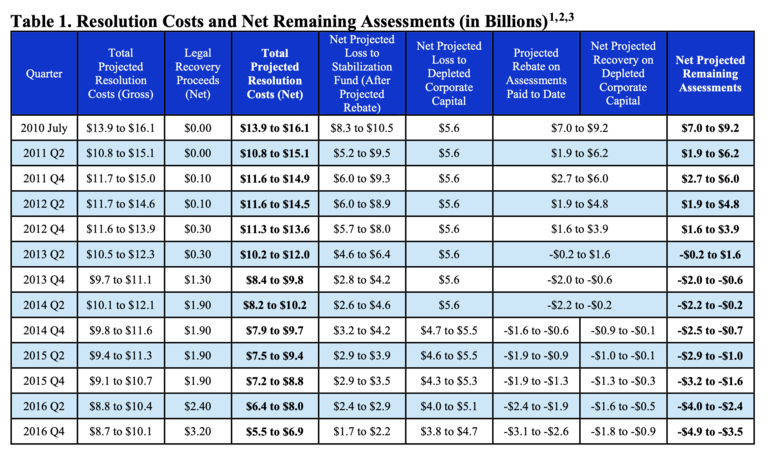
Chart from 2017 shows NGN projections over time.
Looking Back: The One Lesson
While Fazio said there are plenty of stories to share from the years surrounding the corporate crisis and the agency’s resolution plans, the one point he said should be noted above all was that it was a “broad organizational effort.
“I think at once point we had 80 people who were dedicated to the corporate resolution planning process, and then executing the various aspects of it involved almost every aspect of the agency,” said Fazio. “We made it work and it worked out better than I think anybody could have expected. I also want to reiterate the leadership shown by then Chairman Fryzel, and then by Debbie Matz when she came on. The whole board was supportive of the team and the effort I was leading. It’s not that they were rubberstamping by any means; they were very engaged.
“If there is one lesson that should be taken away from this it’s this: when you get to something like this where nothing else matters, it’s vital that everybody works together.”
Other Articles in this Series