

By Ray Birch
ALEXANDRIA, Va.—NCUA says its new field of membership rules will not raise the thorny issue of “redlining” for credit unions.
The agency shared its view with CUToday.info following one analyst’s suggestion that the new FOM rules, among which is the elimination of the requirement for an FCU to serve its core area in any new charter expansion or conversion request, could create scenarios under which credit unions might decline to serve certain low-income communities.
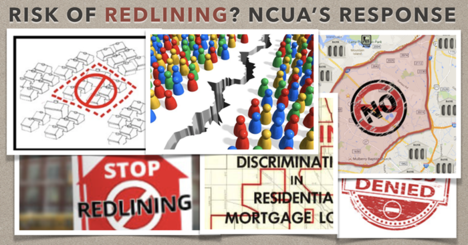
Keith Leggett, the former senior vice president and senior economist at the ABA, recently suggested that the final FOM rule passed last month could lead to the illegal practice. Leggett stated that NCUA originally implemented the “core area” requirement for the primary purpose of acknowledging the core area of a Core Based Statistical Area (CBSA) as the typical focal point for common interests and interaction among residents—therefore extending FCU services to low-income persons and underserved areas, both typically located in the core area of a CBSA.
With the requirement gone, Leggett asserted that the new rules “could result in the redlining of low-income or minority communities by community chartered credit unions.”
No Redline Risk
In response, NCUA told CUToday.info it believes there is no risk redlining will take place as a result of the new rules.
NCUA Deputy Director of Consumer Protection Matt Biliouris emphasized that while the new rules no longer require a credit union to serve the CBSA when applying with NCUA to expand, that the agency’s supervisory process, process for granting FOM expansion, and the credit union’s own business plan and mission that address serving the underserved will not lead to redlining.
Biliouris, who headed the NCUA’s task force created to form the FOM proposal, shared the agency’s thinking to address this potential issue as the FOM rules were assembled.
“We felt it was appropriate to not unnecessarily require something that could be burdensome to credit unions,” said Biliouris about waiving the CBSA requirement. “Instead, we left in place our supervisory process in which we evaluate a field of membership application. Every year for three years after expansion or conversion we look at the marketing and business plans to see how a credit union is doing in implementing those plans. And this is something we will continue to do.”
Biliouris stated that during the last few years the agency has learned from credit unions that serving the core area as the result of an expansion was not always a sound business move, often taxing a credit union’s operations capabilities.

Keith Leggett
“There were a number of instances when a credit union came to us to expand and they were told that based on our rules they had to serve the entire core area, even though they were making a compelling case that their business scale and focus were best suited for a much smaller area. That led a number of CUs to tell us that they did not have the desire or ability to serve a much larger area,” Biliouris said.
NCUA Board Comments
The issue of potential redlining was raised by NCUA staff at the Oct. 27 board meeting at which the new FOM rules were approved. Staff noted that many commenters expressed concern that some of the changes would essentially allow credit unions to serve wealthier areas while redlining other, lower-income areas.
“We think it is appropriate to hold credit unions accountable for implementation of business and marketing plans,” staff told the board, “in contrast to a requirement forcing a credit union to serve the core area outside the service area or scale of operations.”
Biliouris acknowledged that NCUA, in its preamble to the final FOM rule, could have been more specific in outlining the issues surrounding CUs serving CBSAs, how this can impact their abilities to serve all members effectively, and what the agency will do to ensure that CUs still serve their basic mission.
Going forward, Biliouris said the NCUA supervisory and field of membership expansion processes will continue to look closely at how credit unions are servicing all the groups in their communities.
“If we get a (FOM expansion) package in and the scale of it is very large, and the credit union is not serving the CBSA, we will ask for reasons why the credit union is not taking a larger area. Is there any reason why the CU is not looking at the full metropolitan statistical area?” Biliouris said. “I think those are valid questions and we would have our analysts go back to the credit union and ask for supporting data on how the credit union is choosing its well-defined local community.”
'Insightful' Questions
Biliouris said NCUA analysts look at an FOM expansion package carefully and ask “insightful” questions about how well an area is defined and why the credit union wants to serve a certain area, and why they CU wants to expand.
“Our analysts have extensive conversations with the credit union and ask things such as is the credit union sufficiently staffed to handle what they are asking for,” said Biliouris. “There are a lot of conversations that take place in person, over the phone and via email before an application is approved. In many cases, an application is tweaked to address many of the things I just mentioned.”
Biliouris said NCUA will be issuing further guidance on this matter, 60 days following the effective date of the rule.
“We will address a number of these issues,” said Biliouris. “And I am certain credit unions will come away after reviewing the guidance that while NCUA has repealed the core area requirement, that does not mean we (when reviewing an FOM expansion request) will not be asking questions and looking at what areas you want to serve, how you chose that area, what is your strategy to serve it, and as you grow do you intend to take on this core area? Those are all questions we will ask.”