

WASHINGTON–The election of Donald J. Trump as the next president of the United States, along with the outcome of congressional races in which credit unions had made some significant investments, will have numerous implications in the years to come.
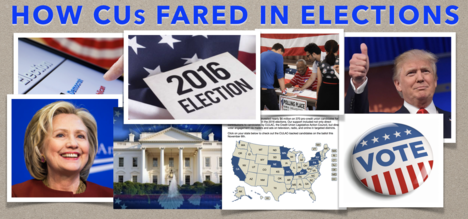
On the congressional level, credit union-backed candidates won nearly all of the races in which they were involved, with one race reportedly still too close to call.
On the presidential level, unlike Democrat Hillary Clinton with whom credit unions had built a relationship while she was a senator representing New York, there is little CU relationship or history with the president-elect. Trump’s election will affect the make-up of the NCUA board to reflect a Republican majority with two of the three seats once a nominee is put forward and approved by the Senate. In addition, a Republican president combined with GOP majorities in the House and Senate could have strong implications for the future of the Consumer Financial Protection Bureau (CFPB), other laws and regulations created by Dodd-Frank, healthcare, and the overall regulatory environment assuming the Republicans can overcome internal divides and Democratic resistance to get legislation passed.
CUToday.info will have additional coverage as it develops.
CUNA Chief Political Officer Richard Gose earlier said there are more than 370 candidates, making up roughly 80% of those running this election cycle, that CUNA is supporting.
CUNA and the CUNA/league system reported they invested nearly $6 million on the pro-credit union candidates for the U.S. House and Senate in the 2016 elections. Earlier this year CUNA launched a new website identifying each of the Credit Union Legislative Action Committee-backed candidates for the 2016 elections.
In races in which CULAC had made strong investments, the results include.
- Rep. Ami Bera (D) won re-election to represent California’s seventh district, defeating challenger Scott Jones. Bera, who received a $197,082 independent expenditure, is a former credit union board member.
- Democrat Kim Myers, who was running for the open seat to represent New York’s 22nd congressional district and who was the beneficiary of $159,967.31 as an independent expenditure by CULAC, lost her race to Republican Claudia Tenney.
- Rep. Rick Nolan (D) won re-election to represent Minnesota’s eighth congressional district. Nolan was in a rematch of his 2014 race against Republican Stewart Mills. Nolan was supported by partisan communications by CUs on his behalf.
- Rep. David Valadao from California’s 21st district was re-elected. Valadao defeated Democrat Emilio Huerta and was the recipient of an independent expenditure from CULAC of $200,000 Valadao won a third term with 58.3% of the vote.
- Sen. Roy Blunt of Missouri, who was called a “good friend to credit unions” by CUNA’s Richard Gose, won his race against Democrat Jason Kander.
- Kentucky Sen. Rand Paul (R) was re-elected wth the defeat Democrat challenger Jim Gray.
- Sen. Pat Toomey (R) of Pennsylvania defeated challenger Katie McGinty.
- While still being described as too-close-to-call, Rep. Brad Ashford (D) was trailing challenger Don Bacon for the House seat representing Nebraska’s district 2. CULAC reported spending $349,753 on behalf of Ashford.
In addition to the congressional races, the outcome of the election will also have a bearing on appointments to numerous agencies and boards, including NCUA. The current chairman, Rick Metsger, is a Democrat. The remaining board member, Mark McWatters, is a Republican. John Herrerra had been nominated by President Obama for the third seat, which is vacant, but that nomination is now dead until President-elect Trump can put forward another nominee.