

By Ray Birch
LAKE FOREST, Ill.—With the new COVID-19 stimulus package set to drive even more deposits into credit unions, checking deposits are likely to hit record levels in 2021, one economist is forecasting.
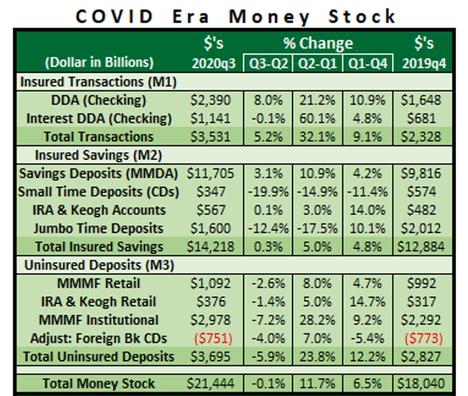
The latest Moebs $ervices study shows that of the $3.4 trillion in stimulus money from April, much of it is still in deposit accounts at financial institutions, and a large percentage is in checking—$1.3 trillion or 38.3%.
“Why is the consumer holding and not spending these dollars? The ongoing fear of COVID even with vaccines being distributed is keeping the consumer concerned about personal finances,” said Michael Moebs, economist and CEO and Moebs $ervices, who has previously suggested credit unions could be in a battle for the funds as rates rise.
The company’s new Report on Money Stock, shows the changes (see chart) by the first three quarters and foretells what to expect in 2021, according to Moebs.
“Again, more money keeps moving into checking and some into money market deposit accounts (MMDA) at banks, credit unions and thrifts or savings banks. Lots of liquidity but little spending,” said Moebs of what has transpired to date during the pandemic. “Uninsured deposits at security firms and other Wall Street institutions initially came in during the first and second quarters, and then moved out to stocks and bonds in the third quarter.”
Why have funds shifted around various deposit account but not been injected into the economy?
Moebs pointed to the chart showing actual dollars at the end of 2019 and then at the end of September 2020.
Unprecedented Movement
“The movement of money from the end of 2019 is historic and unprecedented,” said Moebs. “The Fed should get an A+ for its effort. In the first quarter, checking money moved incredibly high, so did money into Wall Street firms. Also, the consumer moved money out of small-time deposits in depositories at a lightning rate into checking and partially into MMDAs. Wall Street funds in money market mutual funds increased and was held.”
Moebs said the Federal Reserve unleashed almost all of its monetary weapons or tools in the second quarter to fight the financial impact of economic shutdown.
“Liquidity was unmatched in the past 100-plus years for Wall Street and Main Street,” said Moebs. “The consumer, as well as businesses, used checking as the warehouse to store funds. Interest in DDAs (demand deposit accounts) grew at two-to-one dollars to non-interest checking. Also, DDAs were flooded with funds from not only retail CDs but jumbo CDs, $100,000 and greater. Institutional MMMFs (money market mutual funds) reaped money from the Fed’s moves. By the end of June 2020, the consumer and businesses held over $3 trillion in short-term dollars, mainly checking.”
Three Things Take Place

Michael Moebs
But Moebs said three things happened around July 4.
“First it became apparent the consumer was not spending. While Internet sales soared, the shortage of coins revealed in-person sales were not being done,” said Moebs. “Secondly, the Fed recognized the money it pumped into the economy was being held in checking accounts. Finally, Wall Street saw the massive amount of liquidity and started to buy stocks and bonds.”
Recent third quarter results show money market mutual funds began contracting as money flowed to investments in stocks and bonds; funds continued to flow out of retail and jumbo CDs—mainly into DDAs, and COVID started to subside, Moebs explained.
“And finally, the Fed started to pump $80 billion into the economy by purchasing twice a month $80 billion in bonds,” Moebs said. “The net results were a stagnant third quarter—money moved internally between M1, M2 and M3 accounts, ending up eventually in checking, not in the economy.”
What to Expect in 2021
What can credit unions expect into 2021?
“With the Fed pumping $160 billion into the economy every month, another stimulus is probably not fully needed—however, we are getting it,” said Moebs. “Small businesses and workers without jobs are exceptions, yet this assistance needs to be just enough to avoid excess debt. Vaccines are underway, yet the inclusion of all who want the vaccine probably won’t happen until about July 2021. As the U.S. gets vaccinated the economy will get moving—consumers’ rate of spending will be similar to the vaccination rate. Retail sales beyond groceries and gasoline will start to raise at a pace similar to vaccination rates. Housing will be a key component of the recovery with liquidity in abundance to fund mortgages.”
Adjustments Need to Be Made
Moebs said banks, CUs and savings banks need to track the movement of money, especially checking.
“Offering higher rates, even on interest checking, reducing fee prices and minimum balance requirements for deposits are critical to maintain stimulus funds on deposit,” said Moebs. “However, adjustments to these features will need to be made quickly to coincide with the vaccine rates and the economy opening up in 2021.”