

By Ray Birch
LAKE FOREST, Ill.—After earlier forecasting rates will begin to move up near year’s end, one economist has now outlined steps credit unions can take to protect their share of the more than $4 trillion in deposits at stake.

“Credit unions need to be careful not to step up to the plate and swing the bat at the wrong pitches, or even worse, miss entirely,” cautioned Michael Moebs, economist and CEO at Moebs $ervices.
Instead, what CFOs and ALCOs need to be doing is recognizing how the fundamentals of pricing have been altered by the pandemic, said Moebs.
“The Federal Reserve has shifted from price to volume,” Moebs explained.
Moebs, who had several discussions with the Federal Reserve in 2019, explained that during the Bernanke and Yellen eras (2006-2018), the Federal Reserve was heavily concentrated on rate management—price—and not money supply—volume.
“Powell changed this by pumping over $4 trillion into the economy and focusing on money supply to avoid an economic crisis because of COVID. Powell’s move saved the day economically by keeping investments going in both the stock and bond market,” Moebs stated. “The fundamentals of managing the economy by money supply are different than rate.”
With this in mind, and deposits still high as the result of stimulus funds, Moebs said the astute credit union marketer/CFO will be the first to change rates, do it often, in order to retain much of the stimulus funds members do not spend. And credit unions should begin to do that by moving deposits away from liquid funds, like savings and checking, he advised.
“Use higher rates to park liquid deposits with money market deposit accounts (MMDAs), and one-year or less term money CDs,” said Moebs. “It will take well into 2022 to move deposits back into CDs with terms of two to five years.”
What Analysis Shows
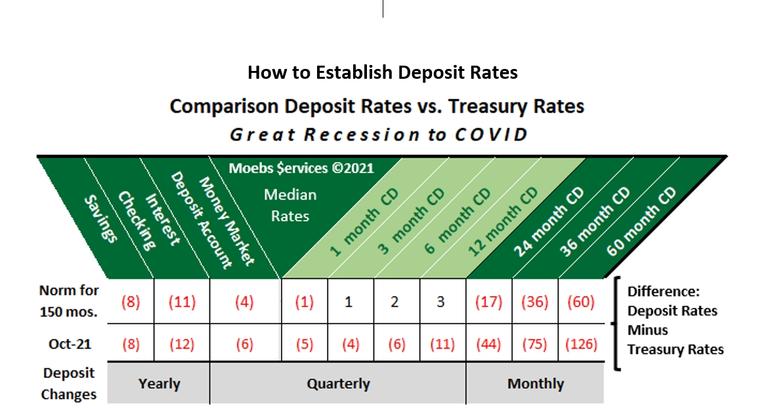
A careful analysis of deposit rates vs. Treasury rates since the Great Recession reveals a great deal regarding pricing strategy, according to Moebs (see chart).
“Deposit rates are closely linked to U.S. Treasury rates—the key to rate pricing,” said Moebs. “The total value of the U.S. Treasury market at $28.4 trillion is 28% larger than the size of the deposit market at $22.1 trillion. However, the two markets are fundamentally connected by pricing.”

Michael Moebs
For transaction-oriented deposit services such as savings, checking, and MMDAs, the rates are always underpriced in relationship to the corresponding Treasury rate, explained Moebs.
“For term accounts, certificates of deposit of one-year or less in term, the deposit and T-rates are the same,” Moebs said. “For CDs greater than one year in term, their rates are substantially less than the equivalent T-rate. We have created a methodology (see chart) showing different rates for each of 10 deposit services compared to the equivalent Treasury rate.”
Treasury does not report on 48-month rates.
A Deposit Comparison
“The major T-rates are currently Fed funds, 12-month and five-year T-bonds based on frequency of rate changes and volume,” said Moebs. “The most prolific T-rate in dollar value and volume of rate changes is the 10-year T-bond. Median rates are collected for Treasuries and deposits. T-rates are the median of daily rates. Deposit rates are monthly.”
Deposit rates change much less frequently than Treasury rates, pointed out Moebs.
“Pre-COVID, deposit rates varied considerably in how often these rates change,” he explained. “For savings and interest checking, the norm was yearly. Term accounts one year or less changed about four times a year, whereas CDs greater than one year changed monthly and sometimes weekly. MMDAs overlap with CDs. This structure has not changed. However, with the arrival of the delta variant, financial institutions have responded slower to the T-rate changes. As the delta variant subsides, so does rate uncertainty. The time to increase rates is now.”
‘Need to Change Now’
Moebs reiterated rates for savings, interest checking, and MMDAs are aligned and changing in tandem with Treasury rates.
“Deposit rates for one year or less are out of market alignment and need to change now,” he said. “The Delta variant rearranged the deposit and T-rates. Now is the time to grab market share by being the first to boost deposit rates fast. Most depositories will probably raise interest rates on savings, checking and MMDAs because that’s where the stimulus money is. So, increase rates on three, six and 12-month CDs and keep the money longer.”