

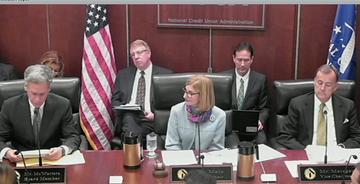
L-R: Mark McWatters, Debbie Matz, Rick Metsger
ALEXANDRIA, Va.–During the board meeting here, NCUA Chairman Debbie Matz and Board Member Mark McWatters locked horns in sharp disagreement over the agency’s budgeting process, whether it has been manipulating the overhead transfer rate, and whether a separate regulator for credit unions is even needed anymore.
Among the most provocative of statements made by McWatters:
- A statement that as the number of federal charters declines NCUA has “redeployed its examination resources to state examinations, thereby increasing the insurance-related hours” and, as a result the overhead transfer rate that largely funds the agency.
- A statement suggesting that NCUA may no longer be needed and should be merged into another regulator.
McWatters’ statement to the board meeting was followed by Matz saying it was so full of “misinformation” that she couldn’t respond to it all.
McWatters detailed remarks to the board meeting, which include extensive supporting footnotes and which are available in CUToday.info’s The Gov, began with his views on the NCUA budgeting process and his belief that far from being transparent, the agency is actually just the opposite.
Following Matz’s comments to the board meeting, McWatters offered a response under the heading, “NCUA should increase its transparency, not its budget.”
He called on NCUA to address what he called “two fundamental inquiries. First, what actions may the NCUA take to reduce its operating budget and, second, how may the agency make its operating budget and the budgetary process more efficient, effective, transparent, and accountable?”
While Matz spoke of using a “zero-based budgeting” approach, McWatters said “I continue to have doubts. Instead of budgeting to justify each expenditure, I remain concerned that the agency appears to spread a set of ever-increasing fixed costs over a decreasing workload as the number of credit unions shrink.”
McWatters said that he also remains concerned that “while the agency touts its budget transparency, the process for allocating resources remains opaque.”
Referring to Matz and Vice Chairman Rick Metsger, he said the “refusal of the NCUA Board majority” to hold a hearing on how NCUA sets its budget is a “breach of transparency, as those who fund the budget are forbidden to comment and present their analysis…”
'Dreadful Governance'
With NCUA proposing a two-year budget that Matz said would enhance “transparency,” McWatters said he questioned that statement.
“How can less opportunity to review even basic agency budget information offer more transparency?” he asked. “If two-year operating budgets are the talisman of transparency, then why hasn’t NCUA offered two-year operating budgets over the past several years? Was it somehow appropriate to offer less budgetary transparency during the financial crisis?
He called the approach “dreadful governance.”
But in a comment that may have been most provocative, a word McWatters would later use to describe himself, he suggested that perhaps NCUA is no longer needed.
“While, in my view, credit unions are best served by having a regulator that understands the not-for-profit, cooperative business model, the justification for a separate federal credit union regulator becomes less apparent as the agency shifts to more of an insurer and less of a regulator,” he said. “This distinction becomes even more pronounced as the regulations promulgated by the NCUA closely parallel those of the FDIC and are less tailored to the specific risks presented by the credit union community to the NCUSIF. If the NCUA simply acts as an insurer with a panoply of FDIC-centric regulations, some may begin to question its reason for being.”
In regards to the overhead transfer rate—the board voted 2-1 to transfer authority for setting the rate to the Office of Examination and Insurance—McWatters said, “NCUA is a federal regulator and should develop and implement policies in an impartial manner, yet the inexorable increase in the OTR over the past several years generally favors federally chartered credit unions. This creates the appearance of a conflict of interest between a federal regulator and federally chartered credit unions to the particular detriment of state chartered credit unions.
“As the number of federally chartered credit unions has decreased it appears that the NCUA has redeployed its examination resources to state examinations thereby increasing the insurance related hours and, as such, the OTR,” continued McWatters. “This result necessarily follows if there is an increasing examination force shift toward more active state charter insurance examinations. Thus, as the operating budget steadily increases or remains substantially unchanged year-in and year-out or the number of federal charters diminish relative to state charters, the OTR continues its climb as well.”
'So Much Misinformation'
When McWatters finished reading his statement Matz responded, “There was so much misinformation in that statement I won’t even attempt to refute all of that. But I will address a few.”
Among her responses:
- Matz reiterated a statement she had made earlier at the meeting and at others that she is “not shutting the door” on an 18-month exam cycle, which McWatters had called for. “We are looking at extraordinary amount of regulatory relief and it would be inappropriate to reduce our exam cycle at the same time,” she said. “We are putting more infrastructure in place to do more off-site reviews.”
- Matz said the overhead transfer rate has been in place since 2003, under former Chair Dennis Dollar, and has been validated by Price Waterhouse Coopers. “There is no guesswork involved,” said Matz. “I think it’s rather extraordinary to suggest we manipulate our exam hours to affect the overhead transfer rate. I am absolutely shocked. That is impugning the integrity of the agency.”
- In response to a remark that suggested he was not being provided with all the information he needs, Matz said, “There are those who would rather complain than participate and the staff will participate with the board on as many issues as the board would like, as long as the board would like. Possibly that’s the result of your lack of interaction, not the staff’s.”
- In response, McWatters said, “We have a sunshine law, so I cannot go to the other board members and talk to them directly. We have policy advisors, and mine is Sarah Vega, and Sarah is the embodiment of engagement. Anyone who says Sara Vega is not engaged doesn’t know her. The problem isn’t lack of engagement; I ask too many questions. I write statements like this. I press. I am extraordinarily engaged. Go to my website, see what I’ve written, with footnotes and in detail. These are not ad hoc things I dreamed up the night before. These are concepts I came up with, and what I hear is ‘No, no, no.’ Is that my job to fold?”
- When McWatters referenced what he said was the credit union point of view, Matz said, “It’s interesting that you have set yourself up as the spokesperson for the credit unions.”
“Did anyone hear me say that?” said McWatters to the room.
“The record will speak for itself,” answered Matz.
“The problem is you confuse dialogue with agreement,” said Matz. “What’s on your website is your point of view, but it’s not a dialogue or an understanding, or an attempt to understand some of the decisions we make. We all travel around; that’s part of our jobs. But we also engage with the staff. Any board member who wants information from the staff will get as much information on any topic you want. You may not agree with it. But some of these statements indicate you have no understanding of some of these issues you’re talking about.”