

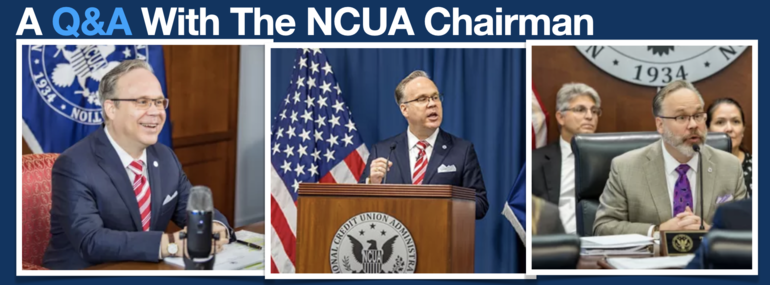
WASHINGTON–In a Q&A with CUToday.info, NCUA Chairman Todd Harper has shared his thoughts and responses around questions related to whether CUs are underpricing loans, the future of smaller CUs, what’s ahead for overdrafts, and more.
The discussion took place during CUNA’s recent GAC. Here’s a look at what was discussed.
CUToday.info: CUToday.info has seen extensive interest among readers in recent reporting over whether credit unions are underpricing their auto loans and creating risk. How do you view the issue?
Harper: You heard me talk about interest rate and liquidity risk earlier today (before GAC). I know that a number of credit unions went out with (a low) interest they were doing as (part of an) originate-to-sell model. They were making these loans, going out and selling them and the interest rate environment went up really quickly and they got caught with a whole bunch of loans that are now underwater and they don't want to sell them. They are now in a liquidity vice.
I am concerned about it. I think it was in December that I saw a headline that read banks’ average auto loan rate is eight-point-something percent, and credit unions were at, like, 5.9%. I saw that headline and everybody was saying, ‘Oh, aren’t credit union's the best? This is the credit union difference,’ and I am sitting at my desk and I'm thinking, ‘Oh, God, we've got interest rate risk and liquidity risk potentially here in the longer term.
It is something that is a great focus for the agency. We are seeing increased numbers. In fact, if you take a look at the last (Share Insurance Fund) quarterly report, I think we doubled the number of assets and the number of credit unions having a CAMELS code 3. We asked at the board table what is triggering that, and liquidity risk and interest rate risk are the key factors.
CUToday.info: How do the concerns raised at the board table reach back down to credit unions, and what are you advising?
Harper: What we do is we work through the examination process as we always do, and as our examiners go in and take a look, for example at a smaller credit union, I've heard that our examiners have said you're still setting your rates at 1.9% (for example), but the markets have moved. You really need to start thinking about moving. Let’s face it; we lived in a low interest rate environment for a very long time. (We) are old enough to remember what a high-interest-rate environment looks like and what the damage can be.
We've helped them to see that, ‘Oh yes, I do need to raise my rates, I do need to do a survey within the area to see where I am.’ For some it may actually be a good opportunity to get market share if they can do it.
But we (get the message to CUs) through our examiners and it's the coaching side, too. Sometimes it has to be through a document of resolution or an exam finding. We expect credit unions to respond. It's one of the reasons why we put it in the supervisory priorities this year; it's a key focus for the agency
CUtoday.info: The second issue on which CUToday.info has gotten significant feedback and readership is overdrafts. What is your concern there and what do you think is coming?
Harper: I’m going to go back to what I said last year at GAC. The market is changing for overdrafts. Those market forces are happening because big banks are walking back from how they structure their overdraft programs to other institutions restructuring it. That’s going to trickle down and the market may be expecting you to pay instead of a $32 fee that is the norm, a $16 fee or an $8 fee. I don't know where the market is going to net out.
I often hear that my words are perceived that I'm anti overdraft. No, but you must make sure that the fees are reasonable and that they're proportional. You don't want to become overly dependent on a line (of income). We know that some credit unions rely heavily on overdraft. In fact, I’ve heard some credit unions say, ‘I'd need to close branches if we cut back our overdrafts.’
It's going to take time for credit unions to adjust and make that turn on overdraft, because, let's face it, you don't change your program overnight. You have to figure out where are the alternatives going to come in revenue? Am I going to ramp up lending here to compensate for changes in overdraft?

Take a look, figure out where your fees are and how you're going to structure it. Make a holistic decision. The market is changing, your revenue is going to change because people will start to walk if you don't set it right.
Part of my job is education. The other part of my job is also to make sure from a consumer financial protection standpoint that we're looking at certain types of fees. One of those that is problematic is authorized positive/settled negative (programs). Those types of programs that are unfair, often because they've got the money when they write the check and then all of a sudden they’ve got to pay this overdraft fee that they didn't expect.
CUToday.info: The credit unions that are going to feel this pressure most from reducing fees are small credit unions, which are disappearing. What about the future for small credit unions?
Harper: I'm glad you asked that question. First of all, it's one of the reasons why we put in the supervisory priorities letter this year that we would be taking a look at does a credit union have a succession planning document. What we know about succession planning is there are a few things to know.
First, you need to prepare years in advance for somebody leaving, including by training somebody on the inside. Frankly, one of the reasons I've heard we're having some difficulties in bringing on new CEOs and managers is because salaries haven't kept up to where they need to be.
It's going to take a credit union a few years to adjust and to make that increase to salary that you would need to draw the talent you need to run the credit union and keep it as a viable, independent entity.
For me, it's very important that we keep that small credit union; it's the heart of the credit union movement, it's where the system has been. I can remember when three out of four credit unions were under $100 million. Now, we’re down to three out of every five.
Small credit unions are important because they do that niche lending, that personal loan at a church, which is really a character loan in so many ways.
Second, you take a look at your income streams and are you also able to take a look at what the market opportunities are. You have to go out there and grow lending. I know of a credit union in Indiana that I was talking to that at the time was $40 million (in assets) and now it's more than doubled that by doing some very direct to member advertising about certain types of products and loans. They’re also doing consolidation loans and they have changed the way in which they do their operations. That's allowed them to grow.
The most important thing you can do is find those market holes and step in and fill them for the members.
CUToday.info: What do you hear most often from credit unions, positive and negative? What filters up to the chairman’s office?
Harper: I hear how the war for talent is real, and particularly for smaller credit unions. I also hear from credit unions that are concerned about cyber security risks. I hear a lot of one-offs, such as ‘My credit union encountered this.’
Part of our job is to be an ombudsman, so I can't really put those into a particular bucket except to say that I hear from credit unions about their individual problems that need to get fixed.
I’m increasingly hearing that more and more credit unions want (NCUA to have) vendor authority. I am seeing a change in where the industry has been historically. There's a greater recognition of it. You've seen the evolution of some state leagues. For example, the GoWest Credit Union Association is now in favor of vendor authority, especially for cybersecurity.
Cyber security shouldn't be the only reason, because there are other safety and soundness risks.
CUToday.info: What other points would you like to make to credit unions?
Harper: Supporting (minority deposit institutions—MDIs). To come back to the issue of small credit unions, this is an important point, because it's not been talked about as much as it should be.
When I became chairman of the Federal Financial Institutions Examination Council, I made economic equity and justice my focus. I went to the task force on supervision asked how are all the banking agencies taking a look at MDIs. Is there something that we can do there to support MDIs? What came back to me was a surprising result. The banking regulators all had adopted procedures so that they wouldn't compare MDIs to peer metrics of group of non-MDIs. That was sort of a startling moment.
(Credit unions) have by far the largest number of MDIs and yet we were examining them as if they were not MDIs. We have to recognize that there's a difference in the model.
As a result we spent a year where we worked out and created peer metrics for MDIs and now we're actually going to be making those proper comparisons. We've actually rolled it out starting with this year's exams. That really hasn't been spoken about as much as it should be. That's going to be good for the MDIs because what do we know about MDIs? Well, we know MDIs often have higher expense ratios. Listen, if you're working to keep your members in their loans and sometimes doing workouts, you're working to avoid delinquencies, that (leads to) higher expense ratios. But at the end of the day, if you have people that are staying in their homes, keeping their cars running, that's a good thing.
This is going to allow those credit unions that are MDIs to continue to stay focused on serving their members rather than having to fight or appeal an exam rating all the way up to the board.