

By Ray Birch
SPOKANE VALLEY, Wash.–One-year terms for board members? It’s just not long enough—even when those board members are in college, which is why Numerica Credit Union is making a change in its unique program.
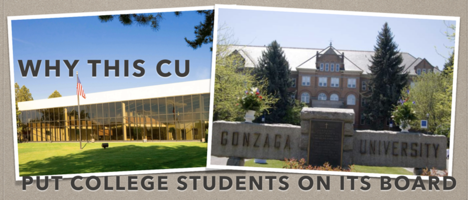
Numerica CU has embarked on a program with Gonzaga University to seat two college students on its board for what will now be two-year terms. The $2.3-billion CU told CUToday.info the program provides great value to the young directors and to the credit union, as well.
“The reason why we know it's working out well is the two students feel that two years will be better for them than one,” said CEO Carla Cicero.
Cicero told CUToday.info Numerica plans to keep the program—which launched in September 2018—in place for years to come.
“We want to make the positions open to juniors, not just seniors, so they can spend more time on our board,” said Cicero. “The students and the credit union believe there's so much they could learn and contribute, and that one year—one school semester—is not quite enough.”
Benefits to the Credit Union
Cicero said the current student board members, Anthony Kaskurs and Micaela Granberg, have gained a great deal of knowledge about how a company and a credit union work. But she emphasized Numerica Credit Union is learning from the young directors, too.

Anthony Kaskurs
“They get all the board packages and they read them carefully. At the meetings they ask questions and offer insights and we get a perspective from a younger, highly educated segment of the population,” said Cicero. “The younger perspective is important, and one we would not generally obtain, since we don't have any college-age employees. We learn from the students being on the board and offering ideas about marketing and operations.”
The student directors are not associate directors, emphasized Cicero. They do not have voting authority but are invited to all of the board meetings, as well as the credit union’s annual strategic planning sessions.
The arrangement also strengthens the partnership Numerica has with Gonzaga, noted Cicero.
Cicero approached Gonzaga about the program and the college took it from there, she said.
“Gonzaga’s business school went out to their students and asked for those who are interested. The students were asked to write a summary about why they should be selected and submitted their resumes,” explained Cicero. “Last year, Gonzaga narrowed down a group of about 14 candidates to six, and we chose two.”
Gaining Credit
With the program now being expanded to two years it will also begin giving the students college credits. Cicero said that change occurred thanks to one of the student director’s perseverance in working with a department of the Gonzaga business school.
“They should receive school credit for this program, especially since it is two years now. That is a lot of time to dedicate,” Cicero said. “One of the student directors is currently designing a questionnaire to use to interview board members and senior leaders of our organization. He’ll then take that information and write a report and present it to a panel of professors to get credit for his work here.”
Since launching the program, Cicero said Numerica has learned it’s best to set up a “buddy system” with board members to mentor the students.
One Board Member’s Perspective
Liesel Kittlitz, director of marketing and sales for Global Financial Markets Institute, is one of Numerica’s board members who volunteered to be a mentor.
“The student director experience has been a great opportunity for students to see leaders from multiple divisions work together, to see board governance in action, and to learn more about credit unions and what makes them different from other financial organizations,” Kittlitz said.

Micaela Granberg
Kittlitz noted that while in school the student directors learn about marketing, finance, accounting and other areas, all of which are siloed.
“Most of these classes, however, are singularly focused on their respective topics. In the board room, the student directors have seen leaders from these separate functions work together to serve Numerica’s members and their communities,” Kittlitz said. “They witness a multidisciplinary approach to solving problems and providing services. They also deal with real-world obligations, such as managing confidential information in the board packet.”
Better Questions
Kittlitz said in learning more about credit unions, the young directors can now answer the question, “What is the purpose of business?”
“In fact, one student director told me the board’s mentality contributes to the idea that a business isn’t just built on profit, but also the passion of employees and the community,” Kittlitz said. “This is also an opportunity for these young adults to establish relationships with members of the board, which go beyond the mentoring relationship.”
Cicero emphasized again the program benefits both sides.
“We’re really increasing the partnership we have with the university, expanding the opportunity for their students to learn and grow professionally—what other opportunities do they have at the age of 21 and 22 to serve on a board of a $2.3-billion financial institution? It's quite an opportunity for them and we get their insights and points of view in the board room.”