

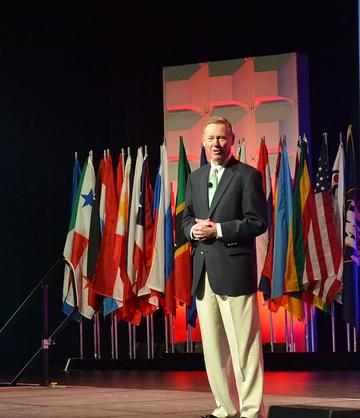
Alan Mulally
DENVER–For Alan Mulally, there was some good news: the company’s forecasting solution was correct. The bad news came in the fact the forecast projected a $17-billion loss.
What helped to reverse those losses wasn’t cost cutting or increased revenues. Instead, said Mulally, the real secret strategy lay in lessons his mother and father had taught him, which led to a changed corporate culture when it came to respecting others and creating better teamwork, all of which resulted in an enormous company rebound.
Mulally is one of the most heralded and respected CEOs in the country. Now retired–although he is a member of several corporate boards, including Google’s–Mulally spent 37 years with Boeing and then another eight with the Ford Motor Co., leading a remarkable turnaround at the auto manufacturing company that is an American icon.
Although it’s where he spent the bulk of his career, in remarks to the joint World Council Conference/CUNA’s America’s Credit Union Conference here, Mulally spent only a brief time on his career at that other American corporate icon, Boeing. During that career he was an engineer, chief engineer, program manager and eventually CEO and was involved with all of the Boeing aircraft models: the 707, 737, 747, 757, and later the 777 and then the 787, also known as the Dreamliner.
“Each airplane had a point of view about how to serve the people of the world; long range, high altitude, etc.,” said Mulally. “The biggest contribution we’ve made is to go point-to-point and non-stop. Now Boeing airplanes can fly halfway around the world (without stopping). I love airplanes, and they’re neat and exciting and sophisticated, but what I really fell in love with was that we were able to get people together around the world. I have come to understand that we really have more in common than differences.”
A Cyclical Business
The lesson Mulally said he learned at Boeing was that each aircraft is the creation of literally millions of people, as each has millions of parts. “So it’s really important that everyone knows what the vision is for that airplane and what the strategy is for achieving that vision, and that they know where you are in getting to that vision. This working together is just so important worldwide.”
Aircraft manufacturing is a cyclical business, but while Mulally was CEO it had returned to an upswing. That’s when he received a call from Bill Ford, great-grandson of the company’s namesake founder, who wanted to sound out Mulally about taking over leadership of the company. The vision through the windshield that Ford presented was not pretty. It was the turnaround at Ford on which Mulally spent most of his time.
“In 2006 he shared the situation at Ford. They had become a house of brands; Volvo, Aston Martin, etc.,” explained Mulally. “He also shared that they had really focused on larger vehicles and the world was moving to smaller vehicles. He said that the world economy was slowing down and with the agreements the company had with the unions it was hard to make money. They were losing money on every brand and every vehicle. They were a fast-follower on technology, rather than investing in being best of class. Outside of that it was going pretty well.”
Mulally then posed the question to himself that was on the thought of everyone in his audience.
“So why would I leave Boeing to come to Ford? Because I felt I was being asked to serve another global icon,” he said. “So I brought the only thing I know and that is working together. One thing Bill Ford shared was there wasn’t any one Ford; there were all these Fords all around the world. That had become a liability. Every Ford company had different product line and different marketing. We didn’t have any scale to compete. We went to work on this. We invited everyone to be on the team and set up business units around the world with really clear objectives to help create this ‘One Ford’.”

Mulally led an effort that oversaw some big strategic decisions. The company remained dedicated to serving markets around the world, but it divested itself of every brand but Ford and Mercury. It moved to have a complete family of vehicles, and decided to be best-in-class in what it did, rather than being a fast-follower.
Burning Through Cash
The strategy may have been set, but there was a significant problem: Ford was burning through cash.
“The first forecast I saw for profits in September of 2006 was a $17-billion loss—and three months later we achieved it. So it wasn’t a forecast accuracy issue,” he said, drawing laughs. “We needed a different strategy. We needed to raise money.”
The company held a large meeting in New York with more than 500 banks represented and outlined its vision for One Ford. Over the course of 12 days Ford raised $23.5 billion.
While the figures for both operating losses and loans and lines of credit were enormous, Mulally shared with credit unions that the biggest issue of all was overcoming a problematic culture at Ford when it came to dealing with problems. He said that was evident during a presentation to Ford leadership around the globe that was broadcast online. Mulally had asked the business units to color code charts that were part of their presentations as either red, yellow, or green, depending on status.
“This was counter to what was done at Ford where you never bring a problem up unless you also brought a solution,” he said. “If you didn’t you were gone. I kept encouraging people to share the real situation, and all 320 charts were green. I stopped the meeting. I said, ‘You know and I know we’re going to lose $17 billion. Is there one thing, one little thing, that’s maybe is not going well.”
Nothing But Green
Finally breaking that sea of green was Mark Fields, who was managing Ford’s operations in the America’s and who succeeded Mulally as CEO. As Mulally said he would later learn, on the evening prior to the global presentation Fields’ team conducted a business review. It had one problem with the lift gate on a Ford Edge.
“Mark said, ‘This looks like this is one of those red things Alan is talking about.’ When Mark was asked by someone there, ‘What’s the point?’ he answered, ‘I think my point is we’re going to have to trust each other, we’re going to work together to turn the reds to yellows to greens,’” Mulally shared. “That was unheard of at Ford. And he turned all three columns (on the chart) red. After all charts are green, up comes Mark’s and all are red. I started to clap. They thought it was a sign that he was to be removed from the room. I said ‘Mark, that is great. What can we do to help you out?’ Before Mark could say anything, the manager of quality worldwide said ‘I’ve seen that before and I’ll get you that info right away.’ One of coolest comments was when someone said, ‘This is Ford, we’re going to figure this out.’ That interchange took maybe eight or nine seconds, and then we went back to green chart after green chart after green chart. Weeks later Mark’s charts were yellow, and then green.
“What do you think the charts looked like the following week?’ Mulally asked. “They were not all red, but it looked like a rainbow. Right there at that moment was my most terrifying and most exhilarating time at Ford. On one hand we knew why we were losing $17 billion. But on the other hand we had broken through the culture and we were going to help each other and we were going to turn the reds into yellows and the yellows into greens.”
Turning those charts green meant that two years later when Chrysler and General Motors were in bankruptcy and needed government money, Ford took none.
Culture Shift
All of that required a separate and significant culture change at Ford, as well, said Mulally, and that change was all about personal respect.
“It’s about expected behaviors, about how we are going to treat each other, such as seek to understand before seeking to be understood, and no humor at another’s expense, etc.,” explained Mulally. “We were helping each other, because no one was perfect. You can imagine in that environment people were going after each other. I would stop a meeting and look at you. It was OK to apologize. One person was so good at violating the principles he became good at apologizing.”
Mulally said one Ford executive even asked him if he was really supposed to remove fear and intimidation from his management toolbox, and said “I don’t know if I can do that.”
Mulally’s response: “Then you may have to do it somewhere else.” That executive departed the company.
“If you set these expected behaviors in your company about how you’re going to behave and treat each other, then it’s zero tolerance,” Mulally advised credit unions. “If you tolerate it, than it’s just something you wrote on a piece of paper and you’re saying it’s actually OK. Speaking to authenticity, you have to do it. Occasionally I had to apologize. You have to stick to it and help each other.”
Ford’s turnaround has been remarkable, as its stock price testifies. Chrysler and General Motors both continue to fight to recover from their bankruptcies. Mulally, incidentally, testified in front of Congress in favor of giving those companies government support, a decision he said was the right one for the country. The failures of those companies could have taken the U.S. straight into a Depression, he said.
“We made a ton of progress. We became a profitable company. We paid back the $23.5 billion. We reinstated our dividend. We are the #1 brand in the U.S., #1 or 2 in Europe,” said Mulally. “We are the fastest growing brand in Asia-Pacific. We have the most complete family of vehicles of any car company worldwide.”