

By Ray Birch
LAKE FOREST, Ill.—Employing fewer—but highly productive—staff is the key to offering high deposit rates, asserts one economist who says CUs are less efficient than banks and thrifts in this area.

A recent report revealed credit unions, overall, are paying less on deposits than banks and thrifts.
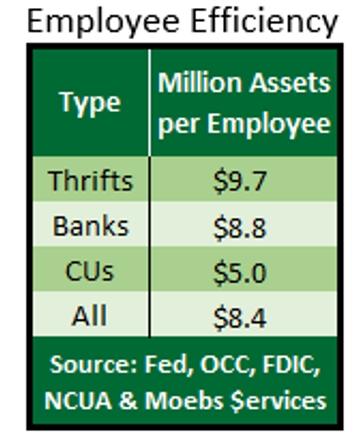
“There are many measures of employee efficiency, or less staff, but the granddaddy of all people ratios is millions of assets per employee,” said Michael Moebs, economist and CEO at Moebs $ervices. “The asset/employee ratio takes into account cash held, investments, loans, non-earning assets, checking, deposits, borrowings, capital, and the bottom line.”
Moebs said the ratio allows the comparison of large and small depositories to determine if they are well run, badly run, or somewhere between. He said data show credit unions are lagging well behind thrifts, and banks as well.
“As the table shows, thrifts have almost $10 million in assets per employee or much more than their competitors,” said Moebs. “Overall, thrifts—savings and loans and savings banks—as a group are less in total assets and deposits compared to either credit unions or banks. Thrifts pay up on deposit rates, 9% higher than CUs and 10.6% over banks. Thrifts also produce 18.7% extra interest revenue than CUs and 11.4% above banks.”
The Secret
What is the thrifts secret?
“Thrifts have fewer employees, and therefore are more efficient,” answered Moebs. “Historically, thrifts have shunned checking accounts. Thrifts have started to offer checking accounts, yet thrifts target checking to higher-deposit users. Checking at most depositories costs around 1% of assets and requires many more employees.”
Banks have 9.3% more employees than thrifts, but credit unions have 48.5% more employees than thrifts, based on similar asset size organizations, according to Moebs.
Moebs said the data clearly show credit unions are overstaffed and less efficient than banks or thrifts.
“If all three depository types have the same asset size, therefore, if thrifts havem100 people, the equivalent for banks would be 109, and for credit unions 148,” explained Moebs. “If a job function at a thrift required two full-time people, a bank would also have two full-time people but also a part-time person helping out 10% of the time, and credit unions would require three full-time people.”
The Best Strategy
Moebs said the best strategy for reducing the number of employees is to provide better pay to fewer people for greater productivity.
“If three tellers are working a branch full time and their total, equal compensation with benefits is $100,000, and one decides to leave, then the remaining two would get total compensation of $83,333, and the depository would reduce expenses by $16,667, or 16.7%,” outlined Moebs. “In the classic depository financial model there are five expense categories: interest expense, employee cost, loan and investment net losses, taxes and all other non-interest costs. For all depositories the total of all five expenses is 3.96%. Credit unions do not pay (federal income) taxes, so credit unions need to reduce their expenses about 10% to be equivalent to banks and thrifts.”

Michael Moebs
Moebs added that closely examining the most efficient asset size categories by depository type provides greater insight into the use of employees.
“Credit unions from $5 billion to $10 billion in assets are the most efficient CUs, with $7.1 million in assets per employee,” said Moebs. “The efficient banks and thrifts are those $25 billion to $50 billion in assets and have $10.2 million per employee.”
The Overall Ratio
Moebs said the asset-to-employee ratio benchmark for all thrifts, banks and credit unions is $8.4 million of assets per employee.
“Those below the asset/employee efficiency benchmark need to improve quickly,” said Moebs. “Those at or above the benchmark cannot be complacent and should look for new ways to increase productivity, since the employee efficiency benchmark is dynamic, not static. The total number of depositories peaked in 1969 at 42,108. Today, 50 years later, there are a bit less than 11,000 and still declining. Of all non-interest expenses, employee cost is critical. Fewer employees who are paid better is the gold standard for success now and in the future.”