

LAS VEGAS– Seeking to really, truly differentiate the credit union successfully? Then close the Excel spreadsheets, set your policies aside, forget the way you were taught in school, and maybe even ask the compliance people to leave the room.
That’s the advice from a former business executive turned graffiti artist and speed painter, who further suggested he can predict the future success of a CU or one of its executives by asking a single question.
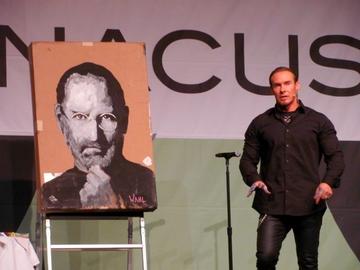
Eric Wahl in front of some of the paintings he created during presentation at NACUSO meeting.
For Eric Wahl, the path to learning and understanding into what really drives success in business came only after he said he was forced to forget everything he had learned about business. Wahl shared that path during keynote remarks at NACUSO’s annual conference, during which he speed-painted four different portraits, two of which he gave away during his presentation, and two of which were auctioned off later in the meeting.
“How can you tap into a wealth of new ideas, into the big ideas?” asked Wahl, who heads up the San Diego-based Wahl Group and is author of the book Unthink. “How can you tap back into your motto of People Helping People, when the temptation is to become transactional? How can you use this time of political and economic uncertainty, this time of overregulation, to go on the offense and brand yourself as a category of one?”
The singular answer to all the questions, according to Wahl: by digging up and remembering everything that has been drilled out of the average corporate leader by schools and business practices.
“Your consumers are no longer standardized, they are dynamic and different,” observed Wahl, who stressed throughout his remarks that as CU executives look to respond to non-standardized, dynamic markets and consumers, they are doing so with an approach that is very standardized and static. The results often don’t meet expectations.
“You have to continue to look for ways to engage your members and work smart, as opposed to working harder and harder and harder,” said Wahl. “My advice is contrary to what my fourth grade teacher said; I actually do encourage post-breakfast daydreaming.”
The Power of Crayons
Wahl, who has consulted with companies that include Microsoft, Disney and Honda, said that when he meets with corporate boards and executive teams he insists that all notes be taken with Crayola crayons as the ideal way of identifying the “next big idea and of ways to visibly differentiate from the competition.”
Wahl made clear he believes the standard educational system from kindergarten through college in the U.S, which he called the industrial factory educational system, has combined with rigid corporate structures to create a paradox.
“We have analytical, metrics-driven, problem-solving space in our mind, which is where we spend most of our time. It’s not our fault as adults or professionals, because we were taught and disciplined to become logical,” said Wahl. “We were taught to take all of our multi-dimensional ideas and then narrow them down to one standardized response; one linear, homogenous response. And it gets worse as we gain more responsibility. We were taught almost exclusively to be risk-averse. So I have been increasingly vocal that this has created a business environment that’s in paradox. We talk about the next big idea or differentiation, but when it comes time to writing a check or implementing a decision, it comes right back to historical precedent. That is no longer sufficient in increasingly competitive, rapidly changing, global economic community. It is creative skills that are needed to navigate ambiguity and master complexity.
“It’s only through tapping into the creative side of the mind that we come up with new and creative ideas that a bank never thought possible, that your valued members never knew they needed,” Wahl added.
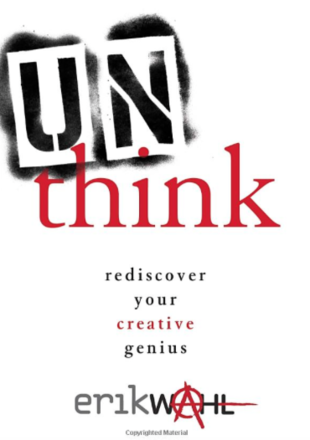
Wahl did not easily arrive at tapping the creative side of his mind. With an undergraduate degree in business, he once was what might be considered the opposite of a spray-painting graffiti artist.
“I have not always been an artist. I started paining after I turned 30,” Wahl shared. “I knew I enjoyed it as a kid, but I was told by one of my early school teachers I wasn’t a good artist because I drew outside the lines and didn’t pay attention to detail and didn’t paint the red apple red and the orange pumpkin orange. Unfortunately, I listened to her, I quit, and I didn’t pick up my brushes for another 20 years.”
Wahl said he was a fairly good student with a one-dimensional approach to learning, which he described as “very Lean 6, very operationally efficient.”
“I could retain information just long enough to regurgitate it back. I became this no-nonsense business person. If it didn’t have direct ROI on a better letter degree or advanced degree, I didn’t pay attention to it.”
A 'Speed Bump'
But then Wahl’s life hit what he called a speed bump when the dot.coms blew up in the early 2000s and took his career down with it.
“I was almost physically sick. Everything that had been programmed into my hard drive from the time I was little about what it meant to be successful, I felt like it had been taken from me,” he said. “And looking back, in retrospect, what disgusted me the most was that in this particular system of regulation and compliance I had allowed my self worth to be directly tied to my net worth. I was rudderless and devastated. I started to flail and spiral downhill emotionally.”
Wahl said it was only after he “reluctantly” bought a brush and started painting again that his worldview changed.
“I could see a lot of the challenges taking place in my life a little better,” said Wahl, whose remarks were sponsored by MasterCard. “I realized at that point I had lived so conservatively, so predictably, so logically, I wondered if I had lived at all. Please don’t take this as a battle cry to leave your positions in your credit unions. But it’s a re-reminder of the concept of searching for the next big idea. That concept of differentiating, even the concept, has been wrongly diagnosed in adults. I hear a lot of adults say I can’t even draw a stick figure. But I’ve experienced it’s a practiced skill that everyone has access to tap into, and to plug into your strategy and your communication and your members and that mission of people authentically helping people.”
As another example of taking personal risk, Wahl said approximately seven years ago he chose to no longer sell any of his artwork, whether online or in galleries, and to turn down any commissions.
“I wanted to see if I could disrupt the traditional rules of supply and demand, see if I could raise demand,” he said. Today the only artwork by Wahl that can be purchased is at charity functions where it is sold to raise money.
Following The Bread Crumbs
After sharing the risks he has taken, Wahl said he understands why many executives and organizations do not take risks.
“If you follow the bread crumbs from any unmet goal it will almost always lead back to fear of the unknown,” said Wahl. “In future opportunities in financial services and future leadership in politics, fear is going to cripple progress. What is the ROI on a good idea?”
Wahl said he believes credit unions are well positioned in the market because the “strongest form of currency is trust. Those who can build on trust and then scale it are best positioned to succeed in the future.”
“One reason for my push to get you on to social media is, even though it’s incredibly ambiguous at this point and we don’t know the platform of the future, because you have access to something banks don’t have access to,” said Wahl. “They are not nimble enough, their employees not trusted enough. As trust becomes the holy grail of financial services going forward, those that can build and amplify your brand of trust to scale in a social media marketplace are better positioned to succeed in the future. Look for ways to build the authenticity, that emotional connection, that will drive future member loyalty.”
Wahl said the ability to step back for a moment from the traditional corporate speak and words such as ROI, competitive advantage, sales, and marketing opens up to the possibility of using emotions, which in turn become the “triggers” for problem-solving and “where the game-changing ideas have a chance to blossom.”
The Paradox
For credit unions and executives that want to be successful moving forward, Wahl said the key lies, paradoxically, in failure.
“I think the question going forward for your credit union and the financial industry as a whole is how are you going to reawaken that beginner’s mind, how are you going to reignite your own curiosity and fasciation to go in search of that next big idea,” said Wahl. “I would encourage you as you go forward to not be afraid to fail. Failure is going to happen. If you’re not failing, in many ways I would say you’re not trying hard enough. You’re staying in your comfort zone. Growth and the next big idea and staying inside your comfort zone cannot co-exist. I can predict the future success of any financial institution or professional by asking one question: what is your definition of failure? Failure is not the opposite of success, it is the secret ingredient of success.”