

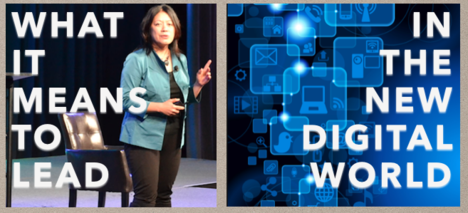
SEATTLE–There have always been consistent characteristics to leadership, but it’s also evolving and even meaning new things in the digital era.
According to Charlene Li, leadership in the digital era doesn’t mean changing how one leads, but instead the tools used to provide leadership by creating and deepening relationships.
Li, the author of Open Leadership and The Engaged Leader, and co-author of Groundswell, shared with CUNA’s America’s Credit Union Conference here what her research and work has found regarding how to provide leadership in marketplaces in which disruptions occur every day.
“Disruption an overused word,” said Li. “I think of it as how do you have a strategy to know what you will do and what you won’t do. Disruption drives exponential growth. To what extent can you as a leader and as an organization sustain that kind of disruption before breaking? I bet your capacity to lead is much greater, but the real question is do you have the passion to do it. If anyone has the capacity to do this, it’s credit unions. You have a meaningful message that people will pick up and share.”
For credit unions, where the real value in disruption lies is in the brand, according to Li. That value, she said, is only uncorked by harnessing the enthusiasm of employees around the brand “of what credit unions do.”
But how can credit unions disrupt the entire financial system with what you have to offer?
“You have to create a strategy around member obsession,” said Li. “You have to become obsessed with what members need. How do you create that obsessed organization? I think you have to develop empathy. How do you get into the shoes of each of your members? You have to think about what they need and want today and in the future.”
Creating Next Generation Member Experiences
According to Li, the next generation of communication will be about connecting with people on a personal level and the ability to use technology to create that kind of relationship, with specialized experiences for each member.
Creating a disruption strategy as a leader means creating a “movement, and that is very different from what leadership does typically,” said Li. “You have to believe. If you want to break through all the clutter to create awareness of your credit union, you have to harness that passion.”
Li reminded that no one can articulate the credit union vision better than credit unions and stressed that “it’s not just people at the very top; it’s anyone who sees themselves at the very top. Every single employee can be a leader and articulate what the vision is. It requires that you align on that vision for the long term.”
Li shared that the president of LinkedIn was once asked, “When will you stop talking about purpose and mission?” And he responded, “When people stop looking surprised when I say it. You have to say it over and over again.”
The word “entrepreneur” is frequently used by speakers and at credit union events, and Li used it, as well. But in her view, the word applies within an organization in a different way.
“I don’t mean entrepreneurs who start a company; I mean entrepreneurs who take on impossible situations and believe they can make a difference. They have the audacity to believe they can change something.”
Other leadership points and observations offered by Li:
- Diversity. “How do you practice diversity? We often talk about it. If you’re hoping to expand your membership base, this becomes a priority. You can’t lead with the same conversations, you have to bring diversity into it, and the only way to do that is to bring those diverse points of view in.”
- Counterintuitive approach. “I actually think to create disruption you have to have more structure; it’s counter-intuitive. If you tell people to just go create disruption, no one would move. But if you define what disruption you want to create, and are able to measure it, then you can disrupt.”
- How digital changes leadership. “How do you lead with digital? I think it’s much more than just using digital tools. That is not a leader. I think it’s so much easier to take a leader, an experienced, thoughtful leader, and show them how to use digital to expand their leadership, than it is to take a 20-year-old who uses the tools and tell them to show leadership. An engaged leader is someone who uses digital, mobile and social tools strategically to achieve established goals as they relate to leading people and managing organizations.”
- Three ways to be an engaged leader. Listen at scale. Share to shape. Engage to transform. “I think listening breaks down the power of distance. Listening is the foundation of leadership. Red Robin, for instance, enables enterprise listening of customers via its employees.”
To be better at listening, Li recommended credit union leaders ask themselves:
- What data to you need to be successful? Do I need to hear from members or new members or employees more often?
- What is most important for me to hear and learn from?
- What decisions do I want to make with the data.
As an example of a leader who listened, Li cited David Thodey, CEO of Telstra in Australia, who was managing the company at a time of great infrastructure change that had created very unhappy customers and, as a result, equally unhappy employees.
“He knew he had to change the company internally, because if employees didn’t believe in the company, how could they get customers to?” said Li.
Thodey sent a message to all employees asking them to respond via social media with the top “time-wasting and unnecessary processes,” and said the company would either fix them or explain why the process exists. Within one hour he had 700 responses from employees.
“What they realized was they could not go back to executive board room and hide in there,” Li told ACUC. “Instead, they put it all out in front to discuss what they were going to stop doing and keep doing. It was a watershed movement for the organization. That engagement transformed their relationship. What kind of engagement could transform the relationship you have with your employees and members?”
Transformation Is Key
How a leader becomes engaged is the “most difficult part,” according to Li. “So strategically choosing where you engage to get the biggest transformation is key.”
According to Li, the questions to ask around engagement include:
- When will you respond and how will the engagement move the relationship forward?
- How will your engagement develop and deepen the relationship?
- How will you actively develop and maintain your followers?
Every credit union needs to build a disruptive culture, according to Li, who said she’s a firm believer that “culture eats strategy for breakfast every day.”
“Confidence is built, but confidence comes with a deep sense of humility that we are still learning who we are as leaders and people,” said Li. “The hardest part in this digital age is courage, because we’re all looking over the precipice of change, and that is where leadership is most needed.”