

SAVANNAH, Ga.–What is it that really drives great human and organizational performance? It’s likely not what you think, but asking yourself and your organization two questions can help you get to the answer.
The “liberating” news, according to one person who has written and researched extensively on what makes for great performance, is that it “is not reserved for a preordained few; it is available to you and to everyone.”
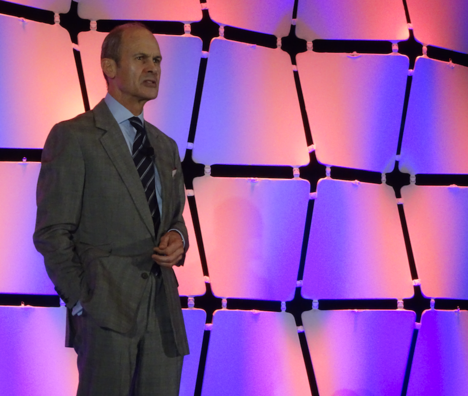
Geoff Colvin speaking to CUES meeting in Savannah.
Geoff Colvin, author of “Talent is Overrated: What Really Separates World-Class Performers from Everybody Else,” and senior editor at large at Fortune Magazine, told credit unions here that great performance—most especially as an increasing number of even-sophisticated tasks are automated–can be achieved if certain biases and long-held beliefs are challenged.
To illustrate his point, Colvin urged attendees at the CUES CEO/Executive Team Network to give some thought to what can really be learned from three recent headlines.
The first, from the New York Times Magazine, was “The Robots are Coming for Wall Street.” That story detailed how software can now immediately scan and analyze corporate reports and offer insights into what it means. If a company issues a report at 8:30 a.m., for instance, robots can analyze what it means in the context of thousands of other pieces of information and produce an analysis by 8:30:05 a.m. That same news story projected that within a decade between a fourth and a third of all employees in financial analysis will lose their jobs—and right behind them will be people in client-facing positions, who will be replaced by software, too.
The second headline, also from New York Times Magazine, was headlined “Cleaning Up.” It profiled a company that cleans offices and which is based on a different business model. This company employs people who have a hard time being hired, for one reason or another. “It’s not a philanthropy or a charity; this is a profit-making business. It hires them and pays them above-market wages, and it seems to be doing well. Here’s the interesting part: the founder and his team learned that traditional markers of success, such as education and experience and recommendations, were not tightly correlated with success. Instead, the two crucial characteristics are optimism and empathy. This is striking. Who would suppose that optimism and empathy mattered to people who clean offices. It’s important because if optimism and empathy are important, why is it no one puts those things on the resume? They can be measured, but it’s rare that anyone asks about them.”
The third headline, from Bloomberg, was “Ambercrombie & Fitch Can’t Get the Grown-ups Into the Kids’ Clothes.” This story detailed Ambercrombie’s attempt to reposition itself for consumers in their twenties. The struggles led the company’s CEO to resign immediately. “A CEO’s worst day is when he announces he is retiring immediately, and no successor is named, and the stock goes up, and that’s what happened at Abercrombie,” noted Colvin. “The reason I mention this is this is actually a larger phenomenon we see happening, and it never used to happen before. The larger point here is we are seeing one human being, by coming or going, changing the value of companies by hundreds of millions or even billions of dollars.”
A Mixed Message–At First
Colvin acknowledged that those headlines send a “mixed message—at first.”
“The first headline suggests the value of human beings is declining,” he said. “The second headline suggests there are some things that humans must do, and the way those humans add value maybe isn’t what we thought. And the third headline says that in fact human beings bring enormous value to a company.”
Given all that, how do humans add value to an enterprise, and how can they get better at the things they need to get better at?
The answer, according to Colvin, can be found in understanding where great performance really comes from. For most people, the answer is not what they think it is.
“We all carry with us deep-seated beliefs about this answer. It matters because standards are rising,” said Colvin. “There is a common tendency in that we think the opposite, that standards are declining. But the truth is in any competitive endeavor standards are rising. The most obvious example is the devices we all carry in our pockets. It’s better, faster and cheaper this year than it was last year. I’ve got a Toyota Forerunner with 275,000 miles on it. Nobody is impressed. We have to be world class great at whatever we do if we are to succeed. “
When asked where great performance comes from, Colvin said the most common response is “hard work.”
“All the great performers we know seem to work incredibly hard,” he said. “And yet that answer can’t be totally right, because we all know plenty of people who work incredibly hard for 20, 30 or 40 years, and yet they are not world class great performers.”
Another frequent response is that great performance is the result of having an extremely high IQ or a phenomenal memory. That isn’t the answer, either, said Colvin.
“And then there is what most of us believe most deeply, that (great performance) comes from innate talent, a gift,” said Colvin. And yet, he noted, the great majority of child prodigies do not become world class great adult performers.
So It All Comes Down To...
So what is the secret to great performance? According to Colvin, the research shows it comes down to “deliberate practice,” which is sometimes known as the “10,000 hour rule.”
“If total lifetime hours of deliberate practice is what made the difference, then we need to know what the deliberate practice is,” said Colvin.
Deliberate practice, he said, is not complicated, but is specific:
- It’s designed specifically to improve YOUR performance.
- It pushes you just beyond your current abilities.
- It can be repeated a lot. “High repetition changes the wiring in your brain; it counts for a lot.”
- It includes continuous feedback. “You can’t get better if you don’t know how you’re doing.”
One thing that’s true when it comes to great performance, according to Colvin, is that those who become great just keep getting better by practicing. “Every time we say someone has a ‘great, natural gift,’ maybe they don’t. We should remember this.”
But much of that applies to individuals: what about organizations?
Colvin said “all of these things can be applied in organizational settings, and with very impressive results.”
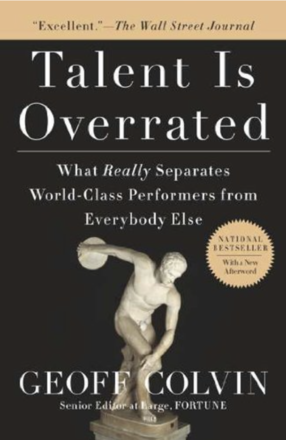
Geoff Colvin's book.
One Company's Experience
As an example, Colvin pointed to a medical products company that was introducing a new product and which opted to also put in place a new sales training program to which there was pushback.
The program involved:
- Having sales people attend classes to learn about the new product.
- Having sales people prepare presentations to teach what they had learned.
- Having sales people practice these repeatedly before managers and on video over a six-week period.
- Having sales people using the product on simulators.
“There were two takeaways here,” said Colvin. “First, the sales people complained. This isn’t what their peers do. This isn’t what they had ever done. They wanted to be out selling. Second, the results were almost off the charts. Before training, 25% of customers converted to the new product. Afterward, 95% of customers converted to new product. We see this over and over again; doing the deliberate practice activities is a lot of work—more than most are accustomed to doing—but the payoffs are more than worth it.”
Returning to his early point, Colvin noted that as individuals and organizations become extremely good at their respective disciplines, the question then becomes as the economy changes, what will we need to get extremely good at?
The answer, said Colvin, can be found in another question, in this case what he called the great question of the time: What will people do better than computers?
“Don’t ask what computer can’t do–every time we ask that question we get the answer wrong,” said Colvin. “Ask instead, what are humans most driven to do? What is it that by our nature we are going to most want to do because it’s the way we are? The economic value of humans is increasingly going to come from skills of deep human interactions.”
Where High-Value Skills Will Fall
The high-value skills of the future will fall into three categories, according to Colvin:
1. Empathy. “And that is not just feeling someone else’s pain. It’s understanding what they are thinking and feeling. The institution that is ahead of every other one in understanding the importance of deep human skills is the U.S. military.”
2. Creative problem solving together. “Our problems are too hard for one person sitting in a room. The key to team effectiveness is not what we thought; the key is the social sensitivity of the team’s members. How well do the team members read one another, and figure out what the others are thinking?”
3. Story telling. “This may surprise you. We have traditionally valued charts and graphs. We have had to make rational decisions on good use of data, and we always will have to. But analysis of data is what makes info-tech so valuable. Story telling is becoming the key human skill. We all know that if you want people to remember something, if you want to change their minds, tell them a story.”
Two Important Questions
All of that said, Colvin urged credit union executives to ask themselves these two “important questions”:
1.What do you really want? “Deliberate practice, no matter what skills you’re trying to acquire, if you don’t really want to do what you’re doing you’re not going to be able to push through and do all that deliberate practice.”
2.What do you really believe about the source of great performance? “All great performers encounter difficulties along the way. If you believe that great performance comes from an inborn gift, when you encounter difficulties you will take that as evidence that you don’t have the gift and you will never have the chance to become as great as you can be. But if you believe it comes from deliberate practice activities, you will know you can push through them.”
“What you really believe about the source of great performance is the foundation of what you will ever achieve,” Colvin continued. “The liberating message is this: Great performance is not reserved for a preordained few. It is available to you and to everyone.”