

COLORADO SPRINGS, Colo.—Is your credit union a “habit” with members? It needs to be.
In a different way of thinking about products and services, credit unions were given some interesting insights into the psychology of human behavior and why consumers make the choices they do. These factors help explain why one start-up company fails, and another creates a service that can literally touch the lives of millions of people and, in some cases, billions.

Nir Eyal speaking to CO-OP THINK Conference in Colorado Springs, Colo.
The person who has studied all that is Nir Eyal, a consultant, a teacher at the Stanford Business School, an author of pieces in Forbes, TechCrunch and Psychology Today, as well as author of the book “Hooked: How to Build Habit-Forming Products.”
It’s the subject of that book and the insights gained that was the subject of Eyal’s presentation at CO-OP Financial Services’ THINK 15 Conference here.
“What is a habit?” asked Eyal, before answering, “A habit is a behavior done with little or no conscious thought. It’s about 40% of what you do every day. I believe we are on the precipice of an age where we can use habits or good.”
Four Benefits of Habits
Habits, said, Eyal, can be very good for business in four different ways:
- Habits increase customer lifetime value.
- Habits give us greater pricing flexibility.
- Habits supercharge growth.
- Power of habits to increase defensibility.
“Everybody wants their product to go viral, but it turns out what’s more important than virality is a short-viral cycle time,” he said. “That’s how long it takes one customer, one member to tell more than one user about your product or service. If that happens very infrequently, what’s happening to all your other members? They are churning, they are leaving your member base. If it’s 1:1, you’ll never get that exponential growth curve.”
Credit unions, said Eyal, like other businesses will need to come to grips with a “cold, hard truth. It’s not ways the best products that win. Often, it’s the product that creates the habit that wins the day.”
As an example, he cited Google vs. Bing, noting that in blind tests people will choose between each approximately evenly. And yet everyone’s habit is to just “Google it.”
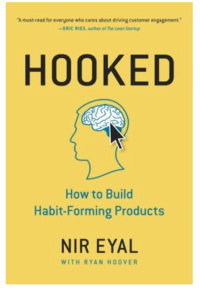
Nir Eyal's book, "Hooked."
“There are plenty of ways to bring people to your business without a habit; but if your business requires doing something out of habit, with little conscious thought, then there is a design pattern to help you form better product hypotheses.”
The design pattern, he said, involves a putting a specific kind of thought into projects ahead of all the blood, sweat and tears.
“I advocate for taking a moment to think about the principles of consumer behavior,” Eyal said. “To think about what drives consumer behavior in ways the consumer can’t describe to us.”
Speaking to the issue explored in his book, Eyal examined four basic “hooks” that comprise an experience designed to “connect the user’s problem to a credit union’s solution with enough frequency to form a habit.”
The Four Hooks
According to Eyal, those hooks are:
- Trigger. A cue to action. This tells the user what to do next and come in two different forms, external and internal. “External things you are very familiar with, billboards, ads, etc. The information on what to do is in the trigger itself. What they require is an association with an internal trigger; the information for what to do next is informed through an association in the user’s memory. With the latter, this is most frequently an emotion, and the most frequent is a negative emotion that triggers powerful internal triggers, such as being lonesome, tense, confused, etc.”
Eyal urged credit unions to understand their own members’ triggers and to ask themselves, “What can you do to scratch their itch?”
2. Action. This is the simplest behavior in anticipation of a reward., such as scrolling on Pinterest or pushing a button on YouTube. “So you have to ask yourself in creating a habit, what is the simplest behavior in anticipation of a reward? “ To answer that means understanding motivation, he said, noting the six basic motivations are: Seeking pleasure, avoiding pain, seeking hope, avoiding fear, seeking acceptance, avoiding rejection.
But Eyal said he believes what’s more important than motivation is ability, or the capacity to do a particular motivation. The six facts that increase or decrease ability, he said, are time, money, physical effort, brain cycles (“This is big in your industry, because the more difficult something is to understand, the less likely they are to do it”), social deviance, and non-routine.
“How many behaviors do we try to change in members, but it’s just too difficult?,” asked Eyal. “You think you have lots of products that need lots of explanation. What Twitter discovered was their users came with plenty of motivation, so what they had to do was make the intended behavior easier to do. Increase usability, and start sending people through the four steps of their hook.”
3. Rewards. Rewards, said Eyal, begin in the nucleus accumbens region of the brain. “All sorts of things activate this part of your brain,” he said, “Luxury goods. Sex. Junk food. And technology. For decades it was believed the purpose of the nucleus accumbens region was to stimulate pleasure; instead, it stimulates the ‘stress of desire.’ The nucleus accumbens becomes most active in anticipation of a reward, but when we finally get it, then it becomes less active.”
Eyal said there is a sure-fire way to “super-charge” this stress of desire. And then he paused. And paused. And paused some more. “This is it,” he said. “Uncertainly, variability causes us to focus and engage.”
There are different types of what he called “variable rewards.” Eyal defined those as:
- Rewards of the Tribe. This is all about social rewards. It feels good, has variability, and comes from other people.
- Rewards of the Hunt. This is the search for resources, things purchased with money, where there is uncertainly over the reward, such as gambling. “We find the exact same psychology at work online,” said Eyal. “Scrolling and scrolling is the exact same psychology of the slot machine.
- Rewards of the Self. This is the search for self-achievement. “These feel good, don’t come from other people. These are intrinsically rewarding. These are online games, leveling up reflects mastery and competency.”
4. Investment. This is where the user invests for future benefits, something that the user does to increase the likelihood coming again, and that likelidhood, said Eyal, can be increased in two ways:
- Loading the next trigger. “Invest in platform that loads an open invitation for an external trigger to be returned, which prompts me to use it again.”
- Investments store value. “This is a big deal. This is improving the product with use. Habit-forming technologies can appreciate in value; everything in the physical world depreciates with usage. But habit-forming technologies do the opposite, because of this principle of stored value. For example, the more content I put into iTunes, the better it becomes as my music library. Reputation is a form of value I can literally take to the bank.”