

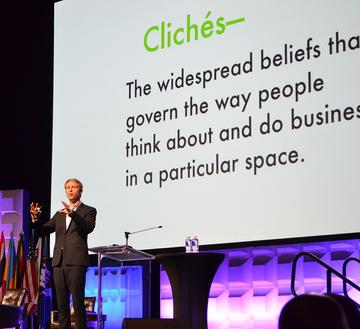
DENVER–It’s time for a little more "promiscuity" in credit unions. In fact, one expert even believes it’s time for “your ideas have to have sex with one another.”
Provocative as that may sound, there is sound science and research behind the broader point related to innovation within organizations, and why it often doesn’t occur. As an example, noted Luke Williams, when credit unions need help they often turn to other credit unions. The same holds true with CU executives, who look to their peers when ideas are needed for addressing issues.
That concept is called the Self-Similarity Principle, which refers to the bias people have to surround themselves with other people like themselves. It may be human nature, but it is also a considerable roadblock to real innovation, which requires a mixing and exchange of ideas from outside one’s own narrow universe.
“I don’t take it for granted that you have a vested interest in innovation,” said Williams. “But I do take it for granted that everyone in this room has a vested interest in growth. And if you have a vested interest in growth, then you must also have a vested interest in innovation.”
Williams, an authority on innovation in leadership, is professor of innovation at New York’s Stern School of Business, as well as author of Think the Unthinkable, keynoted the joint World Council World CU Conference/CUNA’s America’s Credit Union Conference here. It was an appropriate venue for Williams’ message, given the world of change he suggested is taking place.
“There is a relatively new idea of how growth occurs,” said Williams. “Growth used to be based on the idea of limited physical resources. It was a scarcity mindset. The important point in the current understanding of growth is that the world of things and the world of ideas do not work in the same way. Everything in the material world is subject to scarcity. But ideas are not. The recipe for a chair becomes more valuable the more it is consumed. Ideas are subject to increasing returns.”
Innovation Is Like Cooking
Williams said that when the concept of innovation is discussed many people assume it requires an innate set of personality traits. He disagrees.
“If you have ever cooked a meal you have the same ability as anyone else to lead innovation,” Williams said. “Innovation at the end of the day is about taking the ingredients you have available, and pretty much everyone else has available, and just seeking a new arrangement.”
The recipe/cooking analogy is one Williams said he is fond of.
“Currently what is happening is this,” he posited. “Imagine yourself as a cook at a table surrounded by ingredients. You have a recipe book there. I’m not asking you to use any of the new ingredients, so you don’t use them and the opportunity goes wasted. You are surrounded in credit unions with new ingredients. You are the generation that is going to take this category segment into the next generation. You are the ones who are going to use the new ingredients. It is incumbent upon you to go back to your organizations and try bold new recipes. You have to find a way to make sure your ingredients are mixing and mating with other credit unions and other industries.”
And if credit unions did not get the point he was attempting to make, Williams offered this on the importance of getting away from the Self-Similarity Principle: “You have to increase the promiscuity of your ideas. Your ideas have to have sex with one another.”
“You’ve got to realize that most of these new ideas, these new recipes, aren’t going to be as good as the traditional recipes,” continued Williams. “But that hardly means they are worthless. They are going to increase in value. So worry less about your failure rate, and worry about your rate of experimentation. The real question should be, ‘How many bold new experiments did we get started?’”
Williams said he already knew what his audience was thinking, observing that he has heard it before. “I often hear, ‘Luke, we don’t need any other new ideas. We’ve got more ideas than we can deal with.’ When I ask to see them I find they are incremental ideas. And it’s easy to see why the incremental ideas are the ones that get through, because if you’re a business leader you’re going to bet on the ideas that have worked in the past.”
For individual credit unions, or the credit union community as a whole, which have been experiencing robust growth, Williams had a strong word of caution.
“Success means complacency sets in,” he said. “And complacency is the most dangerous position for any organization. The path becomes narrower and narrower and eventually you get to the end of this path where you can’t make any more incremental changes. And then you are disrupted by something completely new. The biggest barrier I see in organizations is trying to innovate inside of their own asset base. Outsiders don’t have that constraint.”
Williams challenged the next generation of credit union leadership to find a way to lead disruptive change. And he urged those CU leaders to recognize now that the ride will not be smooth.
“If you’re really going to drive disruptive change you have to let go of the idea that this is a comfortable process,” he said. “It’s terrifying. It’s uncomfortable for you, your members, your community, because no one knows what the future holds.”
Predicting The Future
Not knowing what the future holds hasn’t stopped many organizations from investing in all kinds of ways to predict that future. It’s largely futile, according to Williams.
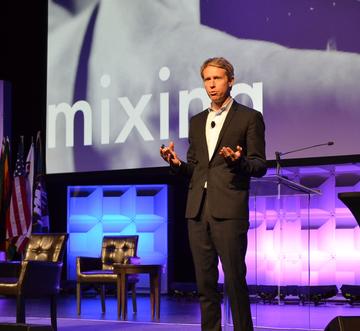
“There is far too much emphasis in organizations in getting better at predictions in a world that is getting harder to predict, and far too little emphasis on deliberate provocation,” he said. “This is disruptive thinking. It’s important to differentiate between disruptive innovation and disruptive thinking. “
The process of disruptive thinking, said Williams, is about asking questions that have not been asked before. As a framework for disruptive thinking, Williams said the following steps are involved:
- Create a disruptive hypothesis.
- Define a disruptive market opportunity.
- Generate several disruptive ideas.
- Share a disruptive solution.
- Make a disruptive pitch.
“I see too many organizations that say, ‘If I can just get more data…’ Data will get you only halfway there,” Williams said. “The other half is ideas. The only way to get from an idea to a solution is to prototype and place lots of small bets and see what works. And then you have to communicate that the benefits of making such a change are clear. This is where so many organizations fail; they assume that people will embrace the change. Disruption for disruption’s sake is just very annoying; it has to demonstrate benefit.”
The first step every credit union and leadership team must take in leading such disruption is what Williams referred to as “surface the clichés,” with clichés being the “widespread beliefs that govern the way people think about and do business in a particular space.”
'Best Practices Are Clichés'
There is another word for such clichés, according to Williams: “Best practices. These clichés keep everyone thinking the same.”
Williams said there are three filters to use in surfacing those clichés:
- What are the Interaction clichés? “Don’t think about this in terms of credit unions. Just think about things you interact with on a daily basis. If you hear specific jargon, specific acronyms, as soon as you use that label you’re hoping others think the same way. It’s important to remember that all clichés are somewhat arbitrary.”
- What are the product clichés? “Think about your offerings and the cliché features and benefits, cliché areas in which you compete, cliché demographics you serve.”
- Price clichés? “How much do we expect to charge members?”
Williams cautioned credit union execs to be careful about falling back into old habits when they returned to their home offices.
“The problems with problems is they are seductively clear,” he said. “They are screaming for attention, which means they are the only things getting attention in your organization. The richest areas for innovation are the seemingly unbroken areas, where absolutely nothing seems to be wrong. It’s critical to surface the clichés, because of the changes coming in consumer behavior that are going to conflict with deeply held convictions about how credit unions and the world in general are supposed to work.”