

SAN DIEGO–A trio of car dealer representatives shared with credit unions here their strategies with lenders, the importance of e-contracting, what they are seeing from the captives and borrowers with negative equity, what makes lending relationships work, and more.
Their insights were shared during Origence’s Lending Tech Live 24 event here as part of a panel that is a popular annual feature of the event.
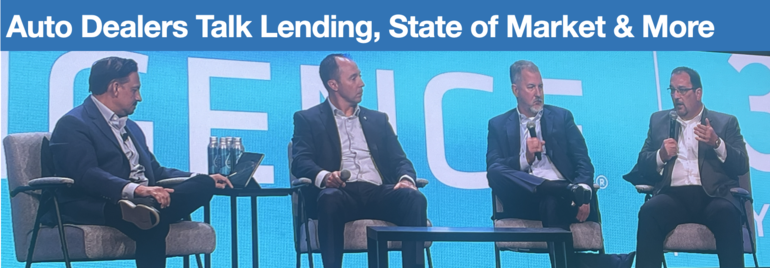
Sharing their perspectives with the meeting were:
- Cody Done, director of retail lending with Ken Garff Automotive
- Jason White, VP-financial services with Schomp Automotive Group, Denver
- Ken Ketterling, executive manager, Maita Automotive Group. (A Toyota dealership that is part of Maita Automotive Group, incidentally, was dealer number one to sign up with Credit Union Direct Lending when it launched in 1994.)
The conversation was moderated by Josh Amaton, VP-dealer client experience with Origence.
Not surprisingly, the initial questions were around the cyberattack upon CDK Global, a software provider that helps dealerships manage sales and service, that has crippled the workflow at approximately 15,000 dealerships across the United States and Canada.
Here is a look at what was discussed:
Amaton: About eight days ago, a massive disruption took place. CMK, a dealer management system that is basically a core for dealers, was under attack and is under attack. What have you seen in these last eight days and experienced?
Ketterling: CDK is our DMS system in all our stores in all aspects. We wanted everything to be seamless and CDK was that for us in so many venues. I got a call that we were down and that’s devastating. You will not find anyone who is more resilient than car dealers. We got creative. We came up with ways to make it work and to stay compliant. In some stores we created a closed loop system. We are fortunate some of the stores had connections with Techion, and they were able to help us fulfill some of the legal requirements.
But it’s been a real challenge. We don’t know if it’s true that it’s back online. Some have jumped in and gotten hacked. Next month is going to be a nightmare as we take some of this data that’s on paper or somewhere else and get it back into our system. It is a mess.
White: We are lucky we were not on CMK. But we own a software company and work with a lot of dealers on CMK. It’s forced us to question everything we have currently, what our plan is going to be and how we can better respond in the future. CDK is the unlucky one here, but it could happen to any of us.
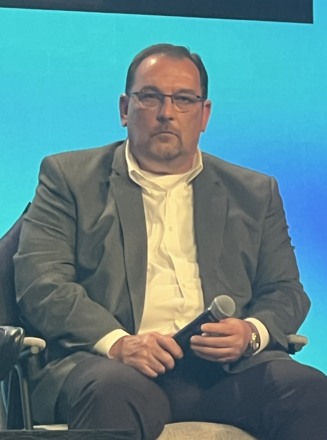
Ken Ketterling at Origence meeting.
Done: Luckily, we weren’t affected. Through an acquisition we had just transferred over from CDK to Techion. But as they said, this industry is very resilient and what we enjoy seeing is people stepping up to help others, even in the midst of all the competition out there. I think it shows a lot of class.
Amaton: What would you recommend to your strategic lenders partners? What do you look for from them in times like this?
Ketterling: None of us (on the panel) knew each other up until 24 hours ago. It doesn’t matter who you are, if you are in the automotive industry it’s about partnerships and relationships. When the chips are down like this, those are the people you rely on. There are so many places we could go to place our loans, but we prefer just a handful. We are all going to have our captives, but we do a lot of business with (CUDL) and it’s wonderful to have a relationship. Those we do know get the bulk of the business.
White: It is all about relationships. We have really strong relationships with credit unions in our areas. Those relationships win out. The trust is very important to us.
Amaton: How important is e-contracting to you?
Done: Within our business, we do between 70% and 80% outside of credit unions through e-contracting. With our captives, our banks, we e-contract, because of the importance we put on contracts in transit. What we have found is it mitigates mistakes, helps us to do our jobs better, quicker, cleaner.
White: Our group operates similarly. E-contracting is extremely importance to us. CIT and frozen capital is something we pay attention to consistently. It minimizes mistakes. We are all trying to narrow down the people we do business with. E-contracting is the standard we want to have.
Ketterling: it’s all about speed and ease. Come Monday morning I want to know every deal we did that was not an e-contract and why. The dollars today are so big you have to keep it moving. I’ll ask Cody to share the story about the lenders it has.
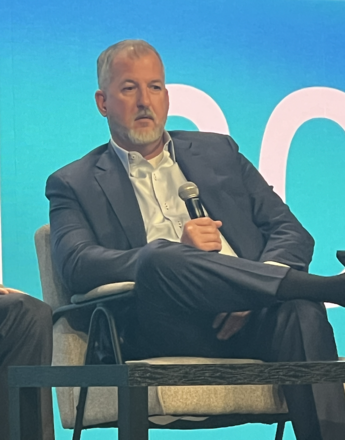
Jason White at Origence meeting.
Done: I’ve been with our group for five years now. The year prior (to coming to the dealer group) we had done business with 800 unique lenders. One of the many reasons I came to the organization was to minimize the amount of lenders we did business with so we could increase the number of deals we did and increase our relationships. We could do more with them and they could do more with us. We have done a really good job, in my opinion. We’re not there, but now around 200 unique lenders. We look to groups like CUDL to help mitigate the number of lenders.
White: We have about 200 unique lenders we do business with and our goal is to get it down into the 50s and then get it down even further.
Amaton: Each of you has relationships with Origence. Why continue these relationships with credit unions?
White: There are three credit unions in our topo 10 relationships.
Ketterling: Our business is heavily credit unions. In the market we’re in there’s a credit union on every corner. Captives are always number one. But it’s consistent that there are a handful of credit unions that have built relationships with us. They are typically three out of the top five lending relationships.
Done: I still think people do business with those who they know, like and trust. A lot of the credit unions have bricks and mortar, and some (buyers) go into the branches quite a bit. Credit unions in our markets have a very strong influence. We enjoy doing business with them. It’s what our consumers know. We want to do a better job of partnering with you, not working against you, and we hope the same in return, as well. I think that’s where CUDL/Origence comes in. It’s a unique partnership because it’s something most consumers know.
Amaton: When it comes to technology, we’ve heard for years that soon many consumers will be buying vehicles online, completely avoiding the dealership. How impactful has that been?
Done: I believe that the majority of people begin their experience buying a car online, and even more of a majority finish at the dealerships. We do less than 8% of our overall business fully digital. What we need to do as dealers is we need to have a better process of allowing the consumer to begin that process online and when they come into the store it’s more of a seamless transition, even if they want to go back online. That’s what we’re working on in our group. We don’t know that we’ve found out how to do that yet. There are still forms that require a wet signature in some states.
White: I think with complete digital transactions we are a little south of 5% as a group. We are working on software to improve the transaction online. We believe most consumers like to come into the stores. We believe most consumers like to start online, come into the store, go back online. But we’re not seeing a major push.
Most of the digital tools out there are just lead-gen tools. In the future of retailing, I think consumers are going to want to purchase online and the advancements in technology are coming, but it’s not there yet.
Ketterling: Very few people are wanting to be completely online. The customers are saying they don’t want it. They want to see the car and touch it and feel it. They want to know where the service department is and to meet those people. We have kind of given up on it. There are still some signatures that have to be real.
There are little things that the computer online can’t tell you. Take tax rates, for example. And it can create distrust if you’re giving the customer a number and they come in and find out that’s not what it is. You have not made a friend.
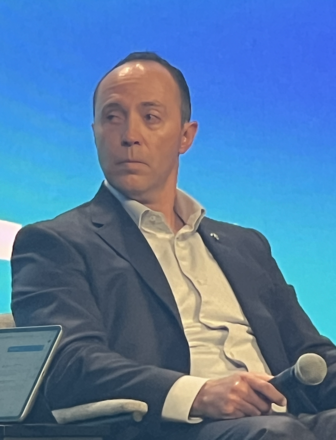
Cody Done at Origence meeting.
Amaton: What about the OEMs?
White; The manufacturers are absolutely looking to push mandates on dealers. I can tell you there are manufactures currently working on completely seamless processes from the manufacturer’s website all the way thorugh the transaction. It is extremely expensive, but I do think we will see some movement soon.
Amaton: The OEMS are really trying to make the EV process seamless and more online. People love Tesla and that process. When it comes to other brands what are you seeing?
Done: I think we’ve seen a switch in the market with more manufacturers focusing on hybrids. In our best month we did just over 3% in EV sales as a group, and that seems to hover at the same market capitalization.
I think Toyota took a real big risk and they got it 100% right (with hybrids). I think EVs is going to continue to be part of the conversation. We have literally gone down the road far enough. But until the infrastructure catches up to what an ICE vehicle provides, that’s a tough conversation.
Amaton: What was Toyota’s position in this?
Ketterling: Some manufacturers jumped in with both feet and said they would be all electric by this date. Toyota stood its ground with the hybrids. Tesla has its own crowd. But the other manufacturers, like GM, were all in, and then they backed off. So, they build, for example, a Chevy Blazer that is ICE or an EV.
What we’re finding at the dealer level is the infrastructure is not even close. In our area EVs sell well if they’re cheap. EVs are always a second car in the family, they’re not primary cars. As EVs get more expensive it really hinders the sales. Those are backing up all over the place.
White: Tesla is its own ecosystem. All the manufacturers tried to catch them, and the manufacturers aren’t making any money.
Ketterling: Nor are the dealers…
White: Quite a few of the larger groups are shipping their EVs to California and they are still losing money….We are leasing EVs at $19 a month. You could spend more at Starbucks. I’m not kidding.
Amaton: What about consumer affordability? Are there still inventory challenges?
White: That’s a brand by brand situation. Honda, Toyota are still managing inventory well. Stellantis, obviously, is on the other end of that spectrum.
From a consumer affordability standpoint we are seeing far more incentives from the manufacturers to push inventory. Inventory will absolutely destroy a dealership faster than anything, so we pay very close attention.
Ketterling: The money will always tell you what’s happening. When the incentives are big, there’s a problem. Two years ago we were selling vehicles at a $10,000 markup. Today, there are $6, $8, $10,000 discounts. It’s a major swing. So, you have to look at whatever alternatives there are. Leasing is one. Every EV we sell is a lease.
Done: I’d second that. It’s definitely brand by brand. As much as we hoped the OEMs learned something during COVID, a few went right back to their practices pre-COVID. I think some manufacturers are going to have to take some lessons to learn the lessons they should have learned during COVID.
Ketterling: As we are selling vehicles at huge discounts, we also have to be financially stable. Advances, reserves become more and more important on every single deal. Know that we as dealers are always looking at our lender body to see who is out there working with us, helping us to make a little more money here and there.
Amaton: Would you rather have: cash rebates or negative rates?
White: I would say it depends on the structure of those deals. If it’s a not very friendly flat, I’d say not very much. If it’s a cash rebate that helps us move a vehicle, we prefer that. But it’s very specific to the program.
Amaton: What about buyers and negative equity?
White: We are seeing an increase in negative carry. But I think we are going to see some things coming to roost from COVID soon.
Ketterling: When we see someone with negative equity, one of the first things people say is, ‘Is there a credit union?”’
Done; There isn’t much used car inventory out there and that has definitely helped . There was no leasing during COVID because of rates, so we’re not seeing that leasing inventory coming in. We aren’t seeing as many negative equity conversations as we thought we would.
Amaton: Credit unions are concerned over dealers consolidating relationships. What do you recommend to them to stay relevant?
White: Technology. Ease of use Credit unions are very strong in this market and are a key player in what we do and the only reason we would pull back from credit unions would be technology.