

LAKE FOREST, Ill.—Bank and credit union overdraft prices continue to rise—and total overdraft revenue continues to fall as a result, a new report shows.
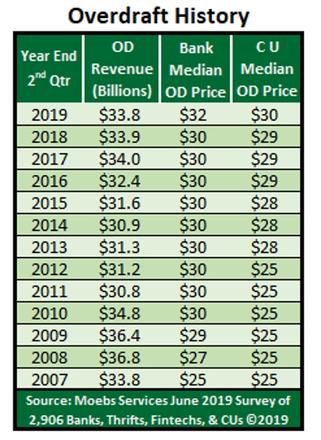
For the year ending June 30, both banks and credit unions raised their median overdraft prices—banks to $32 from $30 a transaction and credit unions to $30 from $29.
“Not unexpectantly overdraft volume fell, and therefore total overdraft revenue was down, as well,” said Michael Moebs, economist and CEO of Moebs $ervices, which conducted the study.
The Moebs survey in June 2019 found bank overdraft prices rose 6.7% in the past year, and credit unions’ climbed 3.4%. However, total overdraft volume decreased by 5.8% with banks seeing a 6.8% decline and credit unions a drop of 1.2%.
Total overdraft revenue fell to $33.8 billion from $33.9 billion the previous year.
Overall the median overdraft price for all financial institutions is $30.
Price Becoming 'Unreasonable'
“The overdraft price is becoming unreasonable, especially in the minds of consumers who are using the service less,” said Moebs, pointing to a recent study his firm conducted that revealed many banks and credit unions are not openly sharing their overdraft pricing on their websites. “Only 42.8% of all banks, credit unions, thrifts and fintech firms are showing the OD price on their website. A lack of price information on a good or service often signals a luxury item, which overdrafts are not. Overall, this lack of transparency is a big concern.”
Stagnant or falling overdraft revenue and lack of transparency in pricing does not bode well for the leading consumer financial fee-based service, said Moebs.
Moebs remains concerned because he contends almost all financial services executives think only about raising the price of overdrafts, which has resulted in total overdraft revenue remaining fairly stagnant over the past 12 years.
“Charging a lower, more reasonable fee, can increase overdraft revenue,” said Moebs.

Michael Moebs
Overdraft revenue deceased with price increases this past year, and in years 2009, 2010, 2019—with no revenue growth for the years between, said Moebs.
Same Pattern For CUs
Credit unions followed a similar pattern, with revenue unchanged in years in which they increased their overdraft price, added Moebs.
“History is telling us OD revenue will stay stagnant or decline if the overdraft price continues to escalate,” stated Moebs.
The Moebs’ survey also reveals a “chasm” between overdraft pricing and providing essential pricing information to consumers.
“The threat is overdrafts may fade considerably if action is not taken immediately,” said Moebs.
What needs to be done to maintain overdrafts as a robust and steady revenue stream at all banks, thrifts, fintech firms and credit unions?
“The price of an OD transaction needs to be reduced to less than $25 or $20,” Moebs said. “Lower prices will provide more value, produce more volume, result in more revenue and ultimately a better consumer friendly service. Also, overdraft pricing needs to be clearly communicated on websites and the same information must be shared accurately in the branches and on the phone.”