

SAVANNAH, Ga.–A “constellation of emerging technologies are coming together that will shape the complexion of credit unions” moving forward, according to one person, who said despite the dire forecasts often heard, he is pretty optimistic about what it all means for the nation’s financial cooperatives–if they act now.
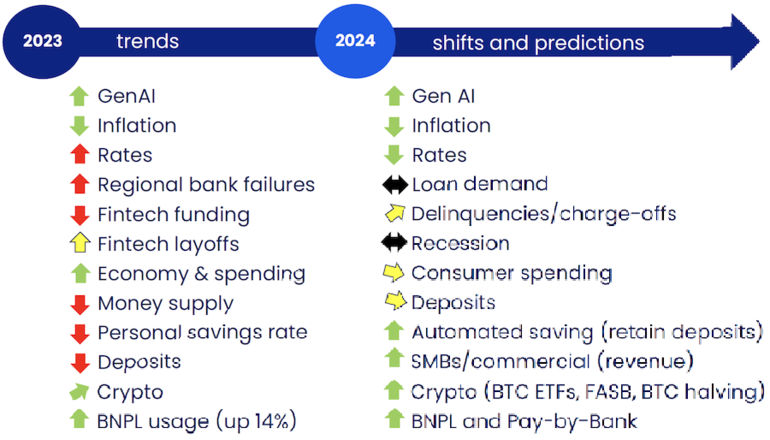
In remarks to America’s Credit Unions’ Strategic Growth Conference on the forces that will shape financial services over the next decade, Lee Wetherington, senior director of corporate strategy with Jack Henry, said 2023 was all about generative AI and trends that had already begun in earlier years, while 2024 will be all about “market shifts.”
Where We Are
Wetherington cited a Cornerstone survey finding FI execs a bit more optimistic in 2024 than prior years. 2023, he said, was largely about Generative AI and trends that had come into the year out of 2021 and 2022, while 2024 is about market shifts.
To that end, he shared the slide below related to those trends, shifts and predictions.
The top three trends that will affect financial institutions over the next one to three years, according to Wetherington, who cited research done by Cornerstone Advisors, include new technologies, a changing competitive environment and new entrants in the market.
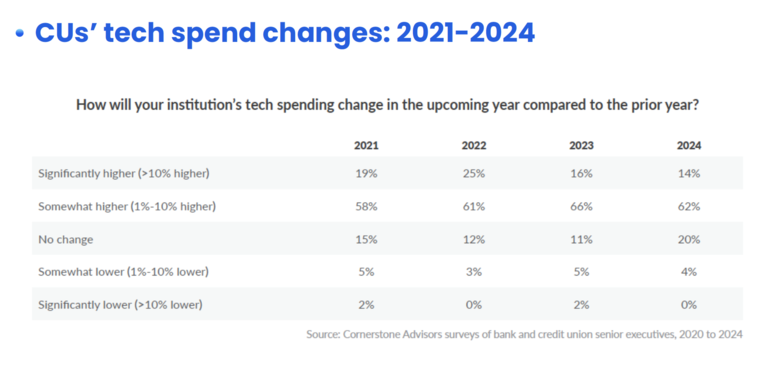
Again citing a survey conducted by Cornerstone, he said about 20% FI leaders indicated their tech spend for 2024 will be about the same as 2023, which he noted is “unusual,” but also the result of pressure on margins.
For those FIs making investments, digital account opening, call center systems and payments hubs were the top three areas for the budget.
Reduced Fintech Funding
While fintech partnerships and competition remain a hot area of interest by credit unions, Wetherington noted that fintech funding actually fell by 50% in 2023. As a category, fintechs that integrate with financial institutions saw a 72% decrease in funding.
“This is not a surprise,” he said. “Suddenly, money is not free anymore. All of those fintechs that didn’t have real business models and were just cruising along until the next funding round, all the cards fell down--unless you had generative AI in the description of what you do.”
That fintech funding trend gives credit unions more leverage now, according to Wetherington, who nonetheless cautioned that CUs must also be much more diligent in investing in or integrating with a fintech, as they might not be around in the future.
The Upstream Threat—And Opportunity
When it comes to new entrants, Wetherington said he sees both big opportunities and a big threat for credit unions—from the same development.
“I think this is a really big opportunity for credit unions, especially those with SEGs,” he told the meeting. “You have these employer-sponsored companies that come into help with 401(k)s and retirement plans, and they are starting to provide more and more services. They deduct from the paycheck before you get the direct deposit.

Lee Wetherington speaking to ACU's Strategic Growth Conference.
It's important to understand this is going on upstream of direct deposit. And it’s important if you have SEGs to ask how you can be that financial provider that provides broader services.”
Some of the new entrants, he said, include retirement plan providers, payroll players, financial wellness programs, tax-advantaged spending accounts, and net direct deposit programs.
Two Distinct Disruptions
Meanwhile, Wetherington said two distinct types of disruption are occurring. The first is the classic disruption, the “attack from below” model. That second is the “ecosystem disruption” that occurs with the introduction of a new value proposition.
“Functionally speaking, we used to define our industry by charter type. If you had a charter you were in financial services,” he observed. “But now with all the ‘as-a-service’ providers that have erased the functional boundary, we are no longer an industry, we are a loosely organized financial ecosystem that is coming into contact with other ecosystems.”
The Single Biggest Everything
Underneath all of that, Wetherington said what’s going on in the tech stack is the single biggest “problem, challenge and opportunity,” and that is “financial fragmentation.”
“Your average member has 14 financial apps. That’s any app where you can move money, store money, receive money, pay or be paid,” he said.
For those in his audience who doubted consumers had that many financial apps, he asked for a show of hands on just how many of those listening to his message had. It soon became clear 14 was not an exaggeration.
“I call this the aggregate of spot conveniences, which equals inconvenience and fragmentation over time,” Wetherington said. “It’s a problem for financial health and for your members to get an objective answer on where they stand financially at any point of time. In your marketing you are saying, ‘You should you do this or that.’ Do you know how much of your members’ financial information you have? Fifteen or 20%. You say you’re using AI because you have all their data. No, you don’t.”
What’s Behind Those Accounts?
In a landscape where a recent CEO survey found gathering deposits was their number-one concern, Wetherington urged credit unions to understand that many of what they believe to be consumer-member accounts are also small and micro-business accounts.
But that lack of recognition leads to the majority of deposits going elsewhere, often due to payments.
“One out of every eight dollars collected by small businesses makes it back to the credit union. You think you’re the PFI and you’re not,” he said. “You don’t know these accounts are small business retail members. You want to solve your deposit challenges? Solve that. Identify them and make it easy to get paid.”
Fermenting the Fragmentation
What is leading to the unbundling of the tech stack, said Wetherington, is the fact everything is headed to the cloud, which is the place to get the best algorithms, the lowest costs and more.
“The reality is the future is being built on the past in the present,” he said. “The transformation is difficult. This is about infrastructure. There’s no more tacking things on to old architectures.”
Again citing research done by Cornerstone Advisors, Wetherington said credit unions listed as their biggest concerns for 2024 cost of funds, new member growth and efficiency/non-interest expense.
To cut costs, credit union leaders said they are looking at streamlined workflows, improved efficiency ratios and improved reporting to reveal operating costs and inefficiencies.
“It’s absolutely about doing things better, faster, and cheaper. This is why credit unions are spending so much time on generative AI,” he said.
Generative AI’s Loose Lips, But…
Speaking of generative AI, he noted the technology is increasingly being used at the same time there is a fundamental change taking place in the way financial services are distributed and consumed.
While he cautioned generative AI chatbots have gotten much better, he noted “you don’t know what the hell they are going to say to your members,” he still said the technology’s ability to assist members is a “boon for the movement, where the technology is amplifying the relationship.”
The Future
“A constellation of convergences will fundamentally change the unit economics of running a credit union and increase the charter value of people helping people. That is good news for you in the short to near-term,” he said, pointing out the big cloud players are lowering costs, which also lowers the barriers to using AI by other providers.
“The large language models you play with are going to run out of nonproprietary publicly available data by 2026. What data does that leave? Proprietary data. And what is the most valuable proprietary data? Financial data,” he explained. “It’s the holy grail of data, and you’re sitting on it. But now we’re going to have an open banking rule…from the CFPB.”
An open banking rule from the CFPB is something the market needs, Wetherington stated.
“Open banking and the exchange of financial data in a secure way is the only way to solve financial fragmentation,” he said.
Pay Attention
Credit unions must pay attention to the criticality of being the “first app” out of the 15 or more apps consumers have that provide some sort of financial service.
“The only way to do that is to help the member make sense out of the other apps. And only way to do that is to bring together all that other data,” he said. “What we are going to see and are already seeing is the entire infrastructure underneath our industry is being rebuilt. This is a step change. Credit unions can and must leverage the open banking rails, real-time data and gen AI to remain effective, relevant and future ready, and to differentiate digitally on both personal and personalized service.”
The Questions
Wetherington said every credit union should be asking itself:
- How will the credit union secure first app status?
- What is the credit union’s open banking strategy?
- What is the credit union’s real-time (data/payments) strategy?
- What is the CU’s embedded fintech strategy?
- What is the CU’s path to a modern tech stack?
What to Do

In addition, Wetherington said every credit union should:
- Plug into open banking, with platforms such as Plaid, Akoya, Finicity, Yodlee and MX
- Eliminate screen-scraping. “It’s terrible from a security standpoint, user standpoint, user experience standpoint,” he said. “Plug into open banking and you will see security threats fall to the floor. Ask your digital banking provider, where are you on plugging into open banking.”
- Solve fragmentation.
- Become a financial hub.
- Become a matchmaker. “Credit unions must be platforms matching members with right fintech innovations,” Wetherington said.
- Modernize and unify the credit union’s tech stack on cloud.
“Think of the future where you can deliver personal service, faster, cheaper and more intelligently, and you can monitor what’s happening in the CU in real time,” he urged meeting attendees.