

By Ray Birch
LAKE FOREST, Ill.—A new report is out that closely examines what systematic risk looks like today, what it entails within the new financial landscape, and how it now differs from long-held approaches to risk.
The analysis looks at 91 financial institutions that have assets above $25 billion, ranking them according to potential systematic risk. The ranking includes five credit unions.
“This is a full body outline of what systematic risk is, a study which I believe no one else has performed,” said Michael Moebs, economist, CPA, and chair of Moebs $ervices, LLC, which completed the report. “With all of the changes the financial services industry has faced in the last few years—the big move to digital service delivery and now consumers’ concerns over the security of their funds and massive movement of money with taps on a phone—risk within a depository is defined differently today than in the past.”
Moebs pointed out that systematic risk is inherent in the nation’s depositories for businesses and consumers, as well as the individual or collective markets these financial institutions service.
“Systematic risk is part of too big to fail, and includes elements of diversification, volatility, concentration, and affects all stakeholders and users,” explained Moebs. “If a financial institution is identified in the systematic risk arena, it does not mean the financial institution is going to fail or has failed.”
The Core Measure
At the core of Moebs’ approach to measuring systematic risk is economy of scale (EOS).
“Adam Smith, the famous first economist, said there is increased productivity in having two workers with specialized tasks produce clothespins than one worker. More volume spreads costs and reduces cost per pin. Depositories are subject to the same principle and keep growing up to the point when the cost of a dollar no longer produces more revenue.”
In financial services, Moebs said EOS starts at about $400 million in assets and peaks at about $25 billion.
“The key to extending EOS past $25 billion in assets is to make performance—not growth—the number one strategy, or else a diseconomy of scale takes over, which systemic risk can measure,” Moebs said.
Rules of the Road
Moebs said measuring systematic risk is complex, but to simplify things he said there are some “rules of the road.” Those include:
- Systematic risk embodies cash flow, which is the heart of liquidity measures
- Systematic risk avoids accrual accounting—cash is king; adjustments must be made for paperless cash or ledger entries
- Non-dollar data is equally as important as cash in systematic risk. Price multiplied by volume equals revenue. Volume is a critical systematic risk non-dollar feature
- Systematic risk focuses on the going concern concept of General Accepted Accounting Principles. What to do with Silicon Valley Bank? Systematic risk measures both going concern and non-going concern FIs
- ≥ 30% concentration of assets is a red flag used by examiners and auditors worldwide and is an important piece of systematic risk
Six Parameters
How do these rules of the road help define systematic risk? Moebs said systematic risk can accurately be measured by considering six “major parameters.” These include:
- Size. “Size is measured in both dollar and non-dollar number of transactions, services offered, businesses serviced, and consumers helped,” Moebs said.
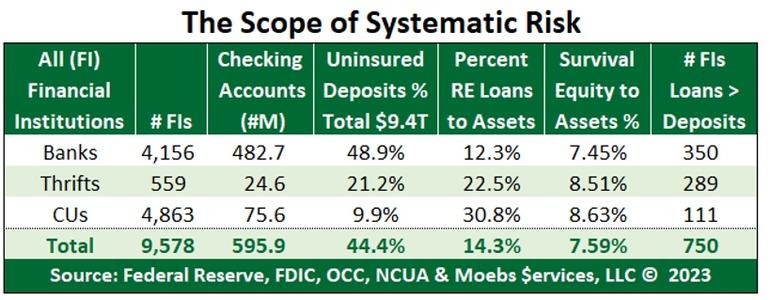
- Consumer Checking. “The checking account is the primary financial tool of the American consumer. If something happened to a depository with a million or more checking holders, the impact would be far more than the average FI with 62,000 accounts,” noted Moebs.
- Uninsured Deposits. “These are deposits above the $250,000 limits of FDIC and NCUA. Is there a reason or rationalization to carry deposits greater than the insurance threshold—such as a funding source? Risk differs greatly on the use of uninsured deposits,” Moebs said.
- Concentration. “A massing of loan or deposit types is a warning sign. All eggs in one basket is risky. As interest rates rise, so do loan delinquencies and write-offs. High rate deposits can leave overnight. Are examiners and auditors right at ≥ 30% is a red flag?” Moebs said.
- Survival Equity. “Regulatory capital has gotten very complex for Wall Street to measure. So, survival equity is used in this study. Survival equity excludes goodwill and other intangibles (no ongoing cash items) and recognizes unrealized gains/losses from market related bills and bonds,” Moebs explained.
- Loans > Deposits. “Allowing loans to exceed deposits forces an FI to seek other sources of funding. Uninsured deposits and borrowings are the principle sources. Does this action put into question the underwriting and managing of an FI’s direction?” Moebs asked.
The Zenith
The Moebs $ervices Systematic Risk Study examines 91 FIs that have assets above $25 billion. Moebs reiterated his position that $25 billion is the “zenith of EOS in financial services. “Beyond $25 billion EOS fades fast as FIs get bigger,” Moebs said.
The Key Findings

Michael Moebs
Key findings from the report:
- 31 FIs are investment banks, bankers’ banks, trading banks, security firms, or business only FIs. “The Fed uses its lending facility and discount window tools to support these FIs in times of trouble. The 60 FIs remaining pose problematic for the Fed since more is needed than lending tools,” Moebs said.
- 29 FIs have more than one-million checking accounts or more and comprise 74% of all 595.9 million consumer checking accounts. “Reliable access to checking is critical for the consumer household. If a FI with more than one million checking accounts stumbles or fails, what would the impact be in the FI’s market and even nationally?”
- 41.2% of FIs, almost 4,000, have uninsured deposits. “Recently, the FDIC started assessing fines on these deposits. The more uninsured deposits, the higher survival equity becomes. Investments need to be more liquid the more uninsured deposits grow,” explained Moebs.
- The Fed’s 10 rate hikes since March 2022 have put pressure on adjustable rate mortgages and new 30-year fixed mortgages, while business real estate loans are strained from the lasting impact of COVID and the lack of workers returning to the office
- The first line of depositor defense is equity. “Capital has become so contrived that survival equity is necessary to assess the risk by depositors and Wall Street investors; 608 FIs have survival equity less than 5%,” Moebs said.
- Does the policy of going beyond deposits to fund loans signal management is flirting with danger? “Measuring loans as a percentage of deposits identifies the number of FIs doing this; 750 FIs have loan balances exceeding deposit balances,” Moebs said.
Not Going Away
“Systematic risk is not going away,” concluded Moebs. “The policies of the Fed and Treasury since the Great Recession and COVID have reinforced systemic risk in financial services. Understanding, measuring, and regulating systemic risk is complex. Systematic risk is more than just banks with assets above $25 billion, but also includes credit unions, thrifts and fintechs, and is more than just assets.”
Moebs said the company’s Systematic Risk Analysis identifies tools and elements to measure and monitor systemic risk.
“Ultimately, systematic risk measures diseconomies of scale, not failure,” he said. “Systematic risk transparency is necessary for solutions to be effective and prevent situations like the failure of Silicon Valley Bank.”
CUToday.info readers can receive the full Systematic Risk Report of 91 FIs by emailing Mike@Moebs.com