BRENTWOOD, Calif.–Hollywood may be the place where thousands of people have seen their dreams come true on a screen for others to see, but rarely has that ever been the case for credit union members—until now.
Over several days in the Hollywood Hills overlooking Century City and Los Angeles, four couples and two individuals whose financial lives had been marked by struggles, debt and challenges seemingly so insurmountable they had led to health problems for some, came together on the set of a television series that puts the “reality” in reality show. But in this case, with coaching, sacrifice, new habits, learning about resources that are available--and with some help from credit unions--the “reality” can be a powerfully positive outcome.
That could be seen during filming of the final two episodes of season two of Opportunity Knock$, a reality series broadcast by PBS stations across the country that has support from, and that includes, credit unions working with those being featured on the program.

Following the Stories
In season two, the program follows people who have agreed to share their stories of the financial realities they face and who have worked with a coach to turn those stories around. For two days, CUToday.info was on hand as those individuals and their coaches were joined by production assistants, caterers, sound technicians, camera operators, a director, producers and all the other pieces of the crew who are part of creating a television show.
Credit unions often talk about how they “have the data” on how they improve member lives, but say what they really need is to “tell the story.” Opportunity Knock$ tells that story—in this case, six of them.
Three Opportunity Coaches
As was the case with season one—which can be viewed here-- the program features three “Opportunity Coaches” who each work with two families/individuals. Back for season two, the Opportunity Coaches include Patrice Washington, Jean Chatzky, and Louis Barajas. Ronaldo Hardy, the CEO of NACUSO, acts as the show’s host.

“The coaches guide families to build better lives,” Opportunity Knock$ explains in materials describing the program. “Along the way. viewers are inspired by the journey to learn how they, too, can overcome financial challenges.”
But before getting to those stories, in part one of this two-part series, CUToday.info talks a look at how Opportunity Knock$ came to be, why credit unions are involved, and more.
Opportunity Knock$ was created by Jamie Strayer, who is executive producer of the series. Strayer is well-known to many in credit unions for her role in creating CU Strategic Planning, a consulting firm that has assisted credit unions in obtaining nearly $1 billion in CDFI grants.

Jamie Strayer
It Began With the Kids
In addition, Strayer helped in 2008 to create the Emmy Award-winning Biz Kid$ series on PBS, which has had substantial support from the credit union community. That program, which she recently purchased to relaunch as a CUSO, focuses on teaching young adults about personal finance and entrepreneurship, as well as the importance of giving back to the community. It is produced by the creative team behind "Bill Nye the Science Guy," and is hosted by a group of young people. It occasionally features celebrity guests such as cinematic superhero Brie Larson. Each of the Biz Kid$ episodes begins and ends with a narrator reminding viewers that, “Production funding for Biz Kid$ is provided by America’s Credit Unions, where people are worth more than money.”
While on the set where the Opportunity Knock$ season two finale was being filmed, Strayer said that while still with CU Strategic Planning she was struck by research showing that “more than 40% of people are living on survival budgets. They need financial solutions more than financial education,” she said.
A Lack of Trust
And yet the research from Edelman also showed nearly half of people in the U.S. don’t trust financial institutions, which is why they turn to alternative financial providers, almost always to their detriment, and don’t talk to credit unions about their problems.
Indeed, several of the families featured during season two admitted they had turned to payday lenders, often for loans with astronomical APRs.
But even those who do seek out guidance, traditional providers often don’t offer what they need.
“When you go to your typical financial institution or credit union website, they are talking about refinancing, and HELOCS--institutional words that scare away people who need help,” Strayer said. “They say, ‘It’s not for me.”
And then there is another fear that has been well-documented among those struggling financially, which is why they also don’t go to a credit union or bank for help.
“They say, ‘I’m going to be shamed that I am doing something wrong’,” observed Strayer.
It was out of that commitment to financial solutions and removing shame that Opportunity Knock$ arose.
Seeing it With Their Own Eyes
“I thought people need to see the solutions created by credit unions and CDFIs with their own eyes and they love reality TV. So, let’s give them reality TV that’s fun and inspiring to show them solutions to help them keep their own money with a tool at home to replicate these experiences,” she said.
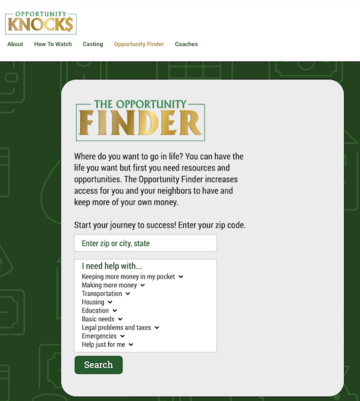
The latter is a reference to “The Opportunity Finder,” a resource that can be found on OpportunityKnocks.net that asks, “Where do you want to go in life? You can have the life you want, but first you need resources and opportunities. The Opportunity Finder increases access for you and your neighbors to have and keep more of your money.”
The Opportunity Finder was introduced in October of 2022. It was built by Jason Green, co-founder of Wave2, which offers a branch and ATM finder solution. It connects users to local resources across a spectrum of areas to which people can turn. Critical input was also provided by behavioral economists, Melina Palmer of the Brainy Business and Dr. Donna Beegle of Communication Across Barriers, a consulting firm that specializes in breaking the cycle of poverty in America. They brought their expertise on using behavioral language on The Opportunity Finder site that helped speak more effectively to those considering using the tool.
Floating a Balloon
Having already raised funds to produce Biz Kid$ and with an idea in mind for what would become Opportunity Knock$, Strayer said she “floated the balloon” and reached out to some credit unions, including BECU in Seattle, which has been a “champion” for Biz Kid$. Others providing initial positive feedback were Julie Leonard, who was previously with Suncoast Credit Union and who is now CEO of Lake Michigan CU, Jon Jeffreys, CEO of Callahan and Associates, and Enrique Delgadillo, president and CEO of BALANCE.
“They were very encouraging and said it was an idea credit unions could support,” Strayer said.
That led to a webinar among interested parties in 2020.
Life & Legacy
Inspiring the work, Strayer said she had also lost her mother, which had turned her thoughts to life and legacy. Her mother worked in the social service sector connecting people to nonprofits and financial help. Strayer asked herself, “Given the opportunity to have a scalable impact on as many lives as possible, what would I do?”
What she opted to do all came together in what she calls The Opportunity Initiative, which includes The Opportunity Finder, Opportunity Knock$ and the soon to be launched Opportunity Coach. The Initiative has received support from the National Council of Financial Opportunities, individual credit unions, BALANCE and Callahan & Associates. Strayer said she has not accepted a salary or taken any income from the project.
‘You Can’t Bore People Into Watching’
But even with that support, getting any network to pick up a television show requires a lot more than just good intentions, as Strayer explained.

Director and showrunner Brian Spoor. Photo: Erick Castro
“We started with the traditional public media style product. But we didn’t want it to be boring; no one would watch. You can’t bore people into believing someone would help them. It’s too institutional,” she explained. “So, we reached out to Brian (Spoor).”
Spoor was a veteran of reality television at the time Strayer cold-called him. He has been involved in more than 60 reality programs, including Wahlburgers, Undercover Billionaire, Big Brother and many others.
“I did not know him. A colleague identified him. He had a lot of show experience and was Primetime Emmy nominated,” Stayer said. “I said, ‘Here’s the budget; it’s a non-profit budget. Would you get involved and could you get your friends to do it for half their normal rate? I asked him ‘Would you like to do something meaningful with your life?’ He laughed, and then said he’d like to do something that would make his parents proud.”
Spoor now serves as Opportunity Knock$ director, writer and showrunner.
About the Program
There are 13 episodes in each season, each 30 minutes long. The bulk of the episodes follow the opportunity coaches as they each travelled to two different cities to meet with the individuals and families with whom they would be working.
Technically, Opportunity Knock$ is not a PBS program. It is, instead, an American Public TV program that is distributed for broadcast on PBS and PBS.org. Ninety-five percent of PBS stations are now carrying Opportunity Knock$, which Strayer pointed out is “unprecedented” for a new show. If the program—which has been honored with multiple awards–is greenlighted for a third season, Strayer noted it would provide sufficient episodes to be attractive to the various streaming services to pick up. Strayer is currently raising funds for that third season.
While the turnaround stories and positive outcomes featured on Opportunity Knock$ are commendable, the program is, ultimately, a television series, and as such must also be entertaining. That makes it critical to identify people with compelling stories others will identify with, and then to get them to sign on and to share publicly their vulnerabilities and mistakes.
How Program Finds Participants
How has Opportunity Knock$ come to identify those who have appeared in its first two seasons?
Spoor told CUToday.info the producers scoured the country looking for great stories and people the program knew it could help, including by showing them all of the resources available, especially through The Opportunity Finder.
“We looked for stories that were compelling and for good-hearted people,” he said. “We go out and find good stories. We looked everywhere and anywhere. We scoured Facebook, Instagram, Tik Tok. We had print ads, we had radio ads. People could apply online on OpportunityKnocks.net.”
Spoor explained that while the program was obviously seeking people with financial problems, it did not want to get pigeonholed into particular stories; instead, it wanted to be able to share the journeys that were most interesting.
“We asked about financial history, where you came from, how many kids you’re still supporting. If it’s good for TV, we would bring you in,” he said.
Hanging Out the ‘Dirty Laundry’
Given that there was some cold-contacting of people involved along with an explanation of what the program was about and what it was seeking, Spoor said the selection of participants was a process that could take from weeks to months, depending on the individuals involved.
And, of course, it also required courage on the part of participants to make themselves vulnerable and share their stories with a TV program. “You are putting all your dirty laundry out there for America,” agreed Spoor.
Strayer added there were also questionnaires and interviews involved as Opportunity Knock$ worked to find the right participants, people whom could be moved forward in six months.
Show Has ‘Operating Values’
And while Opportunity Knock$ is technically a reality show, Strayer said it differs from others in that it has “operating values” with which everyone is familiar, including the crew. For example, given the pressure and tension finances can bring, the show doesn’t seek to take advantage of arguments and disagreements in families when filming is occurring, and will instead wait until things cool off before turning on the cameras again.
She said the producers further work to ensure no one is exploited as the show is a “social justice production honoring the donations received.”
Overall, said Strayer, for all participants there is a “sense of relief that you are not alone.”
Indeed, since the program debuted Strayer said Opportunity Knock$ has been having its desired outcome, having connected more than 50,000 people to 17,000 nonprofits since season one.
She added there has also been one outcome of The Opportunity Finder that has been “completely unexpected”--more than 300 women have been connected with domestic violence shelters.
A New Tool to Help

All of the participants in Opportunity Knock$, of course, benefit from having a coach work with them one-on-one. To bring that kind of benefit and guidance to more people, with season two another new solution is being offered virtually: The Opportunity Coach, powered by LifeCents and funded by a $500,000 grant Strayer secured from the Wells Fargo Foundation.
The LifeCents platform is already in use by the Veterans Administration and others and has been tailored to Opportunity Knock$ to create The Opportunity Coach.
Paging Dr. Finance
Virginia-based LifeCents said it “empowers people to live happier and healthier financial lives by helping them to acquire the knowledge, build the habits and gain the confidence they need to make smarter, everyday financial applications.”
The company’s CEO, Blake Allison, who was on hand for the filming of the two final episodes, described the solution as a platform that acts like a “physician for their financial health.”
The Opportunity Coach measures financial health outcomes using research-based rubrics. Strayer described the measurement of financial outcomes as the “missing ingredient” in credit unions’ efforts to help members.
The Opportunity Coach is interactive and allows and encourages users to ask questions, but it is not a chatbot, said Allison. “It’s a chat experience. We ask questions, they answer, and we provide responses based on question. It’s highly personalized.”
‘Extraordinarily High Rate’
Plans call for integrating The Opportunity Finder into The Opportunity Coach so people have access to additional resources.
“When we recommend something in The Opportunity Coach, there is a 50% conversion rate of people actually activating,” said Allison. “That’s an extraordinary high rate.”
The goal is to have 20,000 interactions with The Opportunity Coach by year-end.
“The idea here is people are watching a program where people have professional money coaches and they ask, ‘What about me?’ Now, they will have access to a virtual coach,” he said. “There are opportunities through relationships to connect people to coaches and organizations so they can get one-on-one help. It’s a high-tech, high-touch model that works. It’s scalable and personalized and effective.

Blake Allison
The Flip Side
“On the flip side, by reaching (the goal of a high number of users), it will establish one of the largest data sets on financial health,” Allison continued. “Many are based on a single-point-in-time survey, but you’re not able to see how they progressed over time in knowledge, habits and mindset.”
According to Allison where the “huge miss” lies in financial wellness initiatives is in overlooking the steps that need to be taken to hit a long-term goal.
“If I’ve been a couch potato and say, ‘I’m going to run a marathon,’ and I have said that year after year, but this year I get off the couch, I set up a training schedule, and I am eating better, how many miles have I run? Zero. This is action on foundational things.”
The Coach also provides an agenda for users rather than just a pull-down menu, as they may not know what they need.
Allison added The Opportunity Coach is licensable, and can be 100% white-labeled to any credit union that wants to add the offering, which Strayer is working on as a CUSO with Jean Chatzky and Callahan and Associates.
The Participants
In part II of this series, CUToday.info will feature the five couples and one individual who are being featured in season two of Opportunity Knock$.
Below, are descriptions of the participants as described by the program:
Tanda & Donnell, Washington, D.C.
Coach: Jean Chatzky
Credit Union: Skypoint FCU, Germantown, Md.
“Tanda & Donnell are service-minded individuals who happily give of themselves without concern for the financial burdens they’ve taken on,” Opportunity Knock$ stated. “Donnell is an Army veteran that works as a recruiter and has opened a nonprofit to help other veterans become entrepreneurs. Tanda is a high school biology teacher and an entrepreneur herself. Despite their incomes, the cost of living in their area and a massive credit card problem have left them short on cash and not enough saved to give them peace of mind.”
Nicole, El Paso, Texas
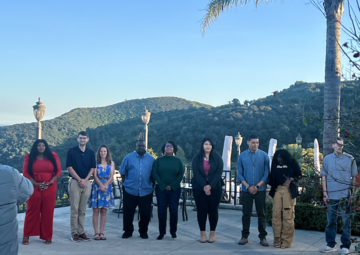
Participants in season two of Opportunity Knock$ on set and meeting for the first time.
Coach: Louis Barajas
Credit Union: Raiz Federal Credit Union, El Paso
“Nicole has been through some dramatic life changes in her 31 years,” Opportunity Knock$ explained. “Her marriage to a military man ended two years ago, and she and her kids have moved back to her hometown of El Paso to be close to her family and the support they provide. As grateful as she is for the help, she yearns to be the independent woman she once was. She works as a receptionist to make ends meet but wants to provide more for her children.”
Lynette & Omar, Seattle
Coach: Louis Barajas
Credit Union: BECU, Tukwila, Wash.
“Naturally upbeat and grateful for what they have, Lynette and Omar dream of owning a home and building generational wealth for their children. When they were in between jobs, they lived on credit cards and predatory payday loans to make ends meet,” Opportunity Knock$ stated. “With an apartment that is disintegrating and three college-bound girls, they need help fast.”
Maegan & Wesley, Columbus, Ohio
Coach: Jean Chatzky
Credit Union: Telhio Credit Union, Columbus
“Maegan and Wesley live with their three children in Columbus, Ohio. They both work part-time jobs to minimize the expense of childcare but without full-time work, they are living paycheck to paycheck and multiple accounts have gone into collections,” the producers said. “An even bigger challenge, they are two months behind on rent and could face eviction leaving their family of five homeless.”
Bobbye & Wesley, Baton Rouge, La.
Coach: Patrice Washington
Credit Union: Pelican State Credit Union, Baton Rouge
“Bobbye and Wesley live in Baton Rouge, La. with their three young children. Bobbye has been a stay-at-home mom while Wesley works in retail management,” Opportunity Knock$ explained. “As sole provider, Wesley’s paycheck is not enough to cover their bills, and time is running out for them to keep a roof over their heads and food on the table. They have maxed out credit cards and two mortgage payments due in a month with no additional resources in sight.”
Erika, New Orleans
Coach: Patrice Washington
Credit Union: New Orleans Firemen’s Federal Credit Union
Charmingly energetic, Erika is a cancer survivor and entrepreneur with a big heart, big dreams and big debt. Five hours after her last chemotherapy treatment three years ago her father passed away from cancer himself. Their combined struggle wiped out her savings and she now supports both herself and her mother by working as a front desk concierge in downtown New Orleans. They live separately and splitting her time leaves no room for a personal life. Erika gives makeovers to other cancer patients and plans to create a non-profit to help amputees and patients get free glow-ups to raise their spirits in the toughest times.”