SCOTTSDALE, Ariz.–“Entrepreneurial thinking” is needed more than ever in credit unions, according to one expert, who says the key lies in one word and may run counter to how many CU leaders think and plan.
It further requires credit unions to think in different ways about “risk,” the result of which will be to actually “de-risk” an organization, the same expert said.
Dr. Cheryl Kiser speaking to Filene meeting.
Speaking to Filene’s Big. Bright. Minds. event on the subject of “The Entrepreneurial Mindset as a Driver of Growth,” Dr. Cheryl Kiser of the Institute for Social Innovation at Babson College said the most fundamental aspect of being an “entrepreneur” in any type of organization is all about “mindset” and about creating, rather than reacting to a changing market.
“Many people think entrepreneurs are born; they're not born, they actually learn a mindset,” she told the meeting. “At Babson we did the research and started to understand that it wasn't just how entrepreneurs acted; it was actually how they thought and how they acted.”
New ways of thinking and leading have become imperative, according to Kiser, because the world is increasingly defined more by uncertainty than predictability, which has become the current state for everyone.
Shift Required
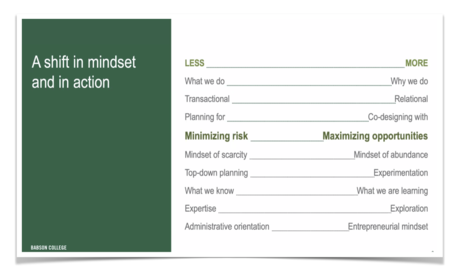
“Being an entrepreneurial leader…does require a shift” from “less of” some things to “more of” other things (see chart), according to Kiser.
That includes moving from “minimizing risk” to “maximizing opportunities,” Kiser emphasized, acknowledging credit unions and financial institutions are generally pretty risk-averse.

“The CEO of IBM one said ‘I want IBM to be more about not knowing it all, but learning it all’,” Kiser related.
That means learning less from expertise and more from exploration and having less of an administrative orientation and more of an entrepreneurial orientation,” Kiser told the meeting. “Entrepreneurship is not an outcome; it is a mindset and habit for navigating uncertainty, solving problems, managing complexity and creating what you desire. Entrepreneurial thought and action is a method comprising two logics for creating the things that really matter to you by taking swift, confident and smart action when faced with the unknown.”
Puzzles & Quilts
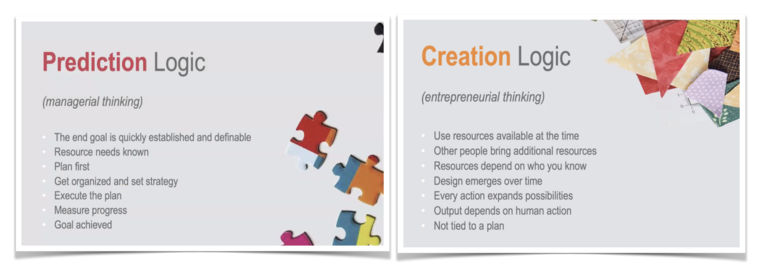
The metaphor Kiser used for describing those two logics—prediction logic and creation logic--was to compare a puzzle and a quilt.
“The puzzle is managerial thinking, administrative thinking. All of us do it because it is the core logic of every educational institution and every organization. We do this really well in this room. The end-goal is quickly established and definable, resource needs are known. The quilt is very different. It's called creation logic. Resources depend on who you are and who you know, the design emerges over time, every action expands possibilities and output depends on human action. You're not tied to a plan… because you have no idea what people are going to bring each day to the quilting table.”
Which is more important?
“You actually need both. We call it cognitive ambidexterity,” Kiser explained. “You sort of have to know when you have to get data, plan and act, and when you have to act to learn and build.”
It may be difficult for some to embrace, Kiser agreed, but this kind of entrepreneur mindset requires “creating when you don't know what you're creating.”
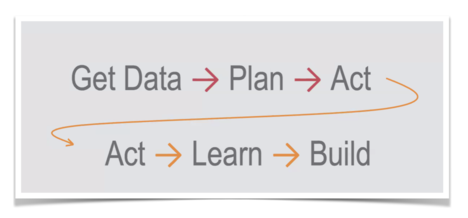
This is all about moving from getting data, planning and then acting, to acting, learning and building, according to Kiser.
It Begins With Desire
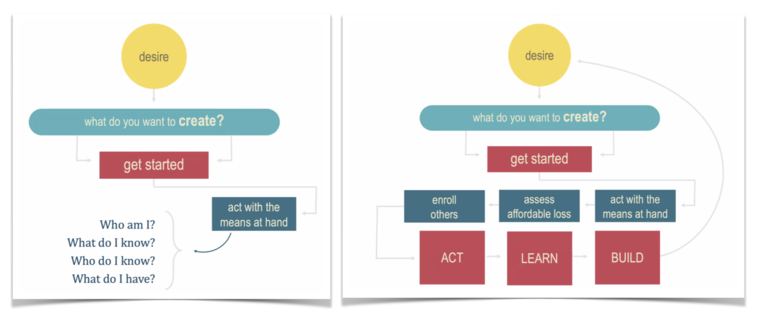
It’s a method Kiser said begins with desire, as she outlined in the slide below.
“The first thing you do is you start with desire. Desire is not a passion; desire summons different energy…You start with desire and then something that you want to create, something you want to start,” Kiser explained. “That’s enough. That's all you need. Then you act with your means at hand. You look at it as both as an individual and within your organization. Who am I? Who are we? What do I know? What do we know?
“I do a lot of work with CEOs of foundations and not-for-profits…and I will always say to them, ‘Start with what you have.’ And they will say, ‘We don't have anything.’ And I say, ‘What do you mean you don't have anything? Of course you have something.’ When people start reflecting on who they are, what they know, the resources they have at hand, I have them map it on a big board and it's amazing what they see.”
Kiser said too often individuals and organizations focus on what they lack instead of the abundance they have.
The Wrong Focus
“I know risk is a big word in this room because we're all trying to minimize it, but I want to move you away from that,” Kiser recommended. “I call it affordable loss and it's not just a fancy term for risk to get away from…When you try to do something inside of an organization there is a fear that if I fail I'm going to be that narrative, that story within the company that says, ‘See, Taylor tried to do this and you remember what happened’…As leaders, your role is to actually facilitate your organization being almost like an incubator on the inside. If you are really good at assessing what you're willing to pay to play, you actually de-risk your decision.”

This is the step where it’s critical to enroll others, according to Kiser.
Four Conversations
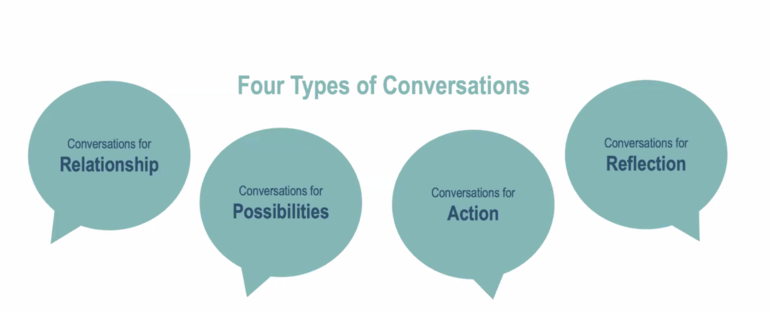
According to Kiser, there are there are four conversations that are always going to be had, as outlined below.
“Most of the time we're not always aware of what conversation we should be in,” she said. “I encourage you in all of the work you're going to do to open the aperture by building a relationship, because you may not know what you don't know.”
Falling In the Right Kind of Love
Kiser said one important thing she has come to learn in her work in research is that “I always fall in love with the problem I'm there to solve, but I do not fall in love with my solution. There is an incredible opportunity for entrepreneurial leaders. It allows you to have experimentation and to learn and every time you go through this you now know something nobody else knows. You also know something more than your competitors know. That’s what we call intentional iteration, as opposed to failure. We always say it's not what you're going to do now, it's what you're going to do next. That’s what all good entrepreneurial leaders think about.”
Acting as An Entrepreneur
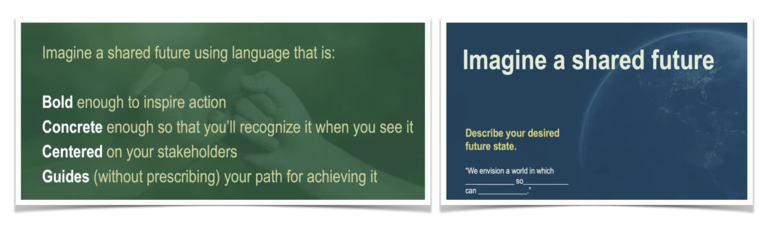
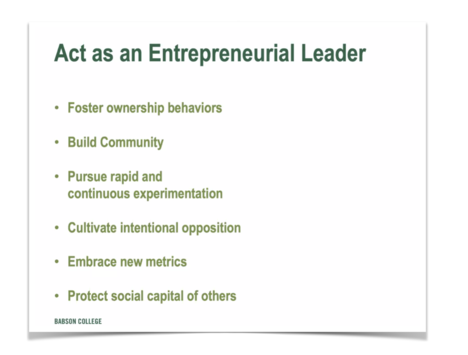
Kiser spent extra time on the slide at right, saying in the case of credit unions it’s especially important in order to “stay true to your promise. That's what's really different for credit unions from a lot of other businesses. As individual credit unions it's also important to really look at what do you promise in your particular community. What’s the promise? It's a commitment to do something specific for someone, something that matters to them.
“When building new partnerships or collaborations or trying to do something very different with your social impact, what you really want to do is have people really understand what you're promise is, and then you want to make sure that when you talk about it or you're communicating it that it's bold enough to inspire action.”
Very Much Needed
Action by credit unions is especially important now, according to Kiser.
“It really is a time of shift and it's a really important time,” she said. “The communities you're in need you now more than they ever have, but it requires a whole lot of thinking. It require you to change your promise; it requires you to actually look at what needs to be true for that promise today to be livable and powerful for the people you're engaging.”