QUITO, Ecuador–As part of an International Credit Union Week look at credit union activities around the world, CUToday.info today turns its focus to Peru and Ecuador, where credit unions are seeking to provide assistance to at least some of the more than five-million people who have fled hyper-inflation and an oppressive political regime in neighboring Venezuela.
As the World Council of Credit Unions noted, despite rich natural resources, Venezuela’s economy has been in decline since 2013, leading to hyperinflation, high unemployment, food scarcity and rapidly deteriorating social services, adding that economists interviewed by the New York Times have called the crisis “the Worst Outside of War in Decades.”
Part I in this series focused on Ukraine and can be found here.
The UN International Office of Migration estimates there are one-million Venezuelan refugees and migrants in Peru and more than 450,000 in Ecuador.
“Understanding the need for rapid assistance to Peru and Ecuador,” the World Council said that with funding from USAID, it is working to implement an “ambitious and innovative approach aimed at providing economic opportunities and financial services to assist both the newly arrived Venezuelans and their host communities.” Initiated in June 2020, the three-year Economic Inclusion Project aims to support 100,000 Venezuelan migrants and refugees in Peru and Ecuador to achieve socio-economic security.
According to WOCCU, to reach its goal the Economic Inclusion Project has adapted and implemented entrepreneurship (objective one) and employment (objective two) with training programs targeted at migrants and refugees considered above the level of immediate vulnerability.
The Third Objective
In addition, WOCCU said it has also been working with its trusted network of credit union, NGO, and private sector partners to extend new or adapted financial products and services to vulnerable Venezuelans and local populations, which is objective three.
“In response to the significant impact that gender disparities have on economic independence and stability, EIP has integrated gender inclusion into the three objectives outlined above,” the World Council stated. “Additionally, EIP delivers critical GBV prevention and accompaniment. This approach assists survivors of GBV in accessing the support and assistance necessary to ensure that they are able to participate in EIP activities, promoting the economic autonomy of survivors.”
Additional Efforts
As CUToday.info has reported, other efforts in the region have included:
- Officials with World Council of Credit Unions’ Economic Inclusion Project and the Central Bank of Ecuador signing a cooperation agreement to coordinate activities aimed at promoting financial inclusion among the Venezuelan migrant and refugee population, as well as vulnerable local residents in Ecuador. The agreement was signed in 2020.
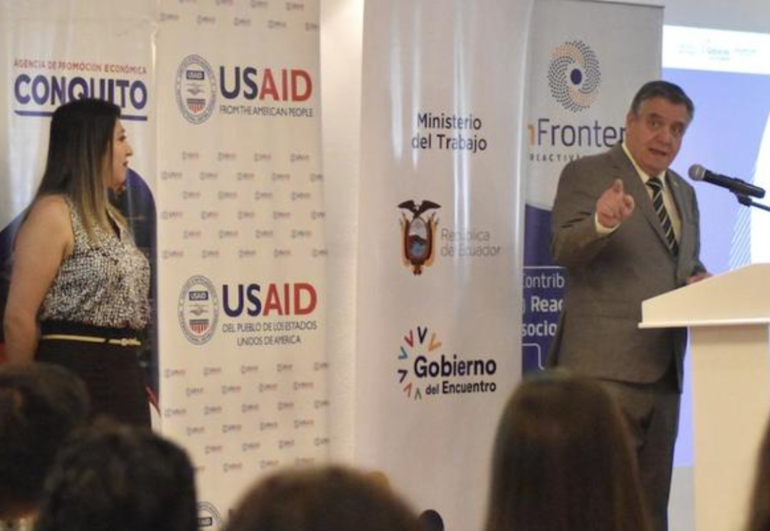
- Saying they have a goal of facilitating effective and inclusive employment solutions for migrants, refugees and local residents, USAID, WOCCU and the Ecuadorian Ministry of Labor, CONQUITO and Program Sin Fronteras have joined together to develop “The Guide for the Hiring of Human Talent in Ecuador.” Details on that program can be found here.
Below, Patricio Donoso, Ecuador's minister of Labor, speaking to event.