

GARCZYN, Poland–If you want to see the faces of the Ukrainian orphans U.S. and Polish credit unions have been helping, you need to exit the two-lane road in a rural area of Poland, turn onto a rough, single lane that eventually surrenders and becomes gravel, cross over the railroad tracks and drive deeper into the forest. And there you will find them.
One-hundred-nine children of all ages from two to 19 who were hurriedly evacuated from Ukraine shortly after Russia dropped bombs just 30 kilometers from where they were living in Chmielnicki, were transported to where—they did not know.
But now they know it as Garczyn, the abbreviated version of their new home’s formal name, Powiatowe Centrum Mlodziezy w Garczynie.
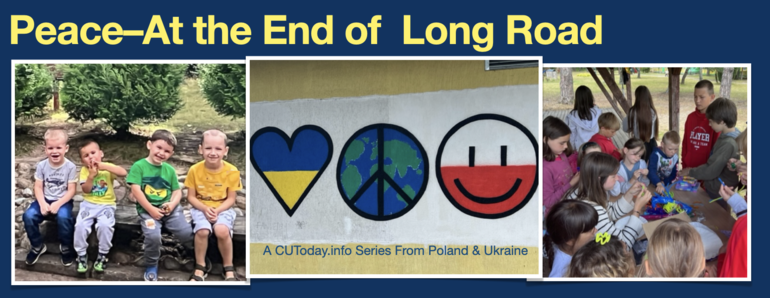
CUToday.info joined representatives of the Via Stella Foundation, the joint U.S./Polish foundation that was created shortly after the war began to help Ukrainians in their home country and Ukrainian refugees in Poland, as they visited the orphanage to deliver gift cards and games and to get an update.
The Via Stella Foundation has previously provided support to the orphans living at Garczyn, helping to fund breakfast for the kids and now underwriting Ukrainian language lessons so the children will be educated in their native language (Polish and Ukrainian are basically similar, which has eased the communication challenges for all refugees).
Garczyn was formerly a summer camp of the kind popular in Europe, at which Poles and their children would spend their holidays and relax, engaging in various games and swimming and sailing on the adjacent lake that is one of Poland’s deepest.
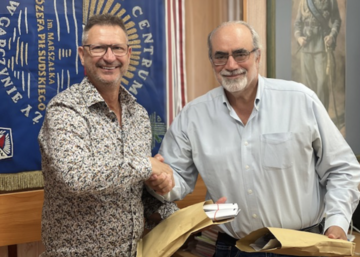
Wieslaw Baryea, left, accepting gift card donation from Brian Branch.
But the 45-acre camp’s role changed literally overnight when the orphans in Ukraine some 1,110 kilometers away were evacuated eight days after the Russians invaded. The children were in an orphanage near both types of military facilities and a nuclear plant that are often targeted by the Russians.
A New Kind of Director
Today its director is Wieslaw Baryla, a former teacher who had been the camp director for four years when his life similarly changed overnight and he found himself the newly minted head of a camp for orphans escaping a war.
Offering an overview and update on the camp, Baryea met with several members of the Via Stella Foundation, who in their day jobs work for Poland’s CU trade association, the National Association of Credit and Savings Unions. They were joined by Brian Branch, the former CEO of WOCCU, who teamed with Sue Mitchell, CEO of Mitchell, Stankovic & Associates, and Rafal Matusiak, president & CEO NACSCU, to create the Via Stella Foundation.
The visit to the orphanage is part of a week-long series in which CUToday.info is visiting with CUs, individuals and others in Poland and Ukraine who are benefitting from the Via Stella Foundation and its donors.
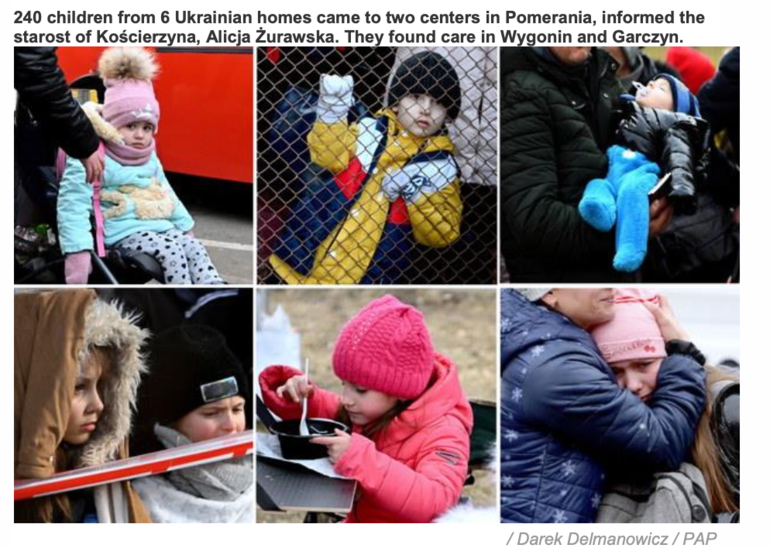
Photos of children on day they were forced to leave Ukraine.
A Scramble to Respond
According to Baryla, the camp had to scramble to accommodate the children who arrived to find a facility that lacked a kitchen to feed them after the organization that had been leasing the camp took the equipment with them.
But with support from the county and from donors, the camp was transformed, especially given the resources available. Approximately $100,000 was spent to purchase equipment that can now feed the more than 100 children along with the teachers, workers, counselors and others, such as the occasional reporter from the United States, who have made Garczyn a part of their lives. In all, there are approximately 40 adults working at the camp, in addition to volunteers.
“It is safe and quiet here and the children have a daily routine,” Baryla said, his comments translated by the NACSCU staff.
What Happened With Parents
According to Baryla, approximately one-third of the children have no parents, while others lacked parents who could provide care or who had given up their parental rights. In some cases, their guardians had to go to war. In another, the mother of three children travelled to the camp to retrieve her children who were 2, 10 and 12, because a father of three children does not have to serve in the military in Ukraine.
Unfortunately, said Baryla, those children have been separated and are now in three different places. “Some adults needed the children, just not for love,” he lamented.
“It’s very sad for kids to return to Ukraine,” Baryla continued. “They were way more stressed (when they return) than they were when they came here in the first days of the war.”
When the children arrived, many were quite small—the youngest was 11 months—and some had special needs. Nine women accompanied the 100-plus children from Ukraine.
According to Baryla, the local community of Koscierzyna responded with donations of food, toys and clothes.
“There was not enough food at the beginning and not the kind of food for small kids,” said Baryea. That lack of food was one of the immediate needs the Via Stella Foundation sought to fill. After commercial equipment was installed in the canteen building, seven people from Ukraine were hired as cooks in order to prepare dishes familiar to the children; four of those seven remain.
The current population includes approximately 19 preschoolers, eight children of kindergarten age, 26 who are seven to nine, and the remainder who are older. Eighteen are in high school.
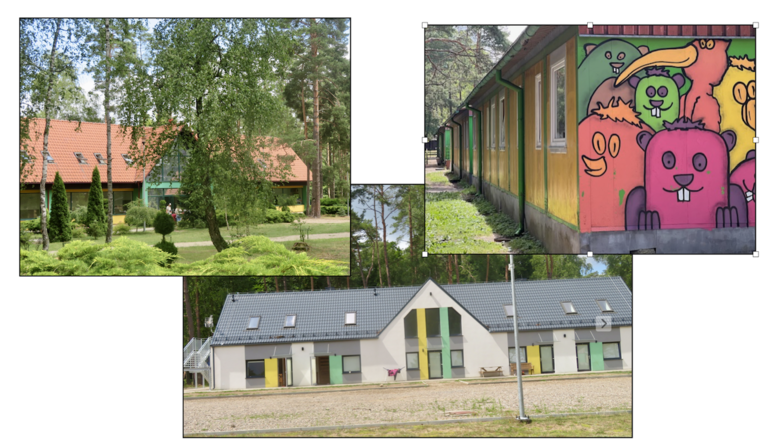
Buildings that include dorms, meeting space at camp for orphans.
100 Kids, 1 Van
Transportation continues to be a challenge, as the children are spread across four schools, one of which is close by, the other four kilometers away. Poland has taken pride in opening its arms to the refugees, including enrolling kids in public schools.
The camp has purchased a van, but tasks such as getting a child to things like doctors’ appointments have proven complicated. Baryla showed CUToday.info a handwritten ledger in which there were more than 450 crowded entries for use of the van.
In the beginning the children attempted to learn online through the Ukrainian educational system, but the camp lacked any laptops/tablets, and had no Internet connection. Today, it has 60 tablets and uses StarLink to access the Internet. In addition, many of the kids have cellphones.
The European Union has also since underwritten the cost of a new building at the camp, the upper floor of which will be used for the youngest children. The bottom floor has rooms for the older children. There is also a building with a large common area.
A Place to Socialize
“It was very necessary to have a place where the children could be together and socialize,” said Baryla. “It is very good for the (mental state) of the children. It is a new start. It’s important for the small children to know the language and culture of Ukraine.”
Most of the children speak both Polish and Ukrainian, although the youngest children can only write in Polish.
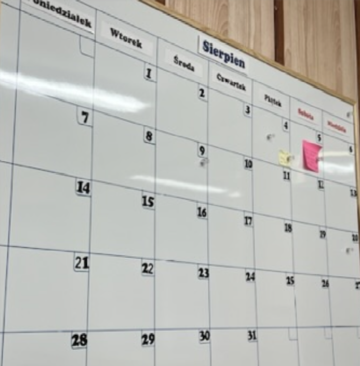
Due to lack of funds, camp calendar for August is mostly empty.
The camp and the Via Stella Foundation have worked to attempt to bring activities to the children, such as the games that were brought along on the day of the visit.
There have also been some larger investments. There is a new gym and a fireman who volunteers his time to act as a trainer. There is a new playground. Lions Club International has paid to have a hair stylist visit, as well as instructors in other activities.
On the lake, swimming, sailing and kayaking are available.
But for all those activities, funds have gotten tighter and Baryla showed a summertime calendar on the wall that was mostly empty of entries showing what was planned for the children. He smiled a bit and hinted at some creativity in trying to work with government officials to get funds.
“We are trying to find activities,” Baryla said. “We would like to have a program where a child gets to go away and do something special.”
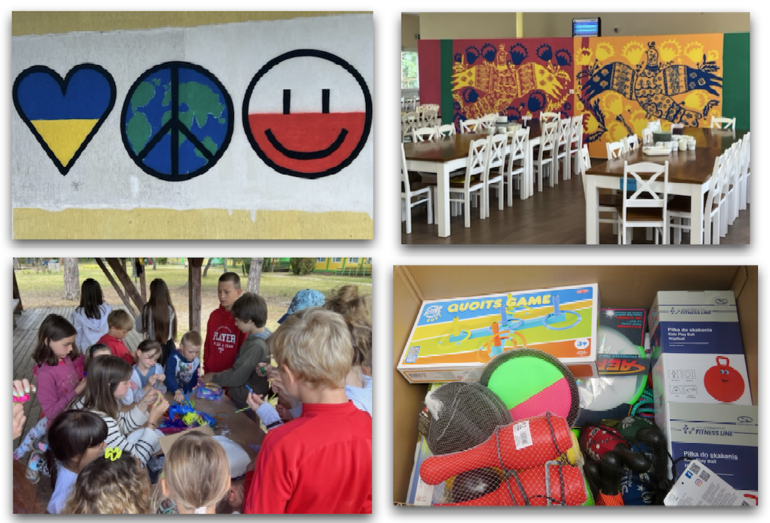
From upper left, clockwise: Painting outside canteen; inside of canteen, where everyone dines; toys donated by Via Stella Foundation; children making crafts.
Special Day May be Cut
One activity that may be a victim of the tight budget is a celebration of Ukrainian Independence Day on Aug. 24. The children and the camp celebrated the event in 2022 with yellow and blue balloons and decorations, games, a show by the children, Ukrainian food and Ukrainian entertainment.
“It is important to remember their country,” Baryla observed, before noting the event is likely to cost the equivalent of several thousand dollars.
As part of the 2022 event, the kids signed Ukrainian flags that were sent to the front.
Children & The War
The war isn’t something that is discussed much, according to Baryea. But he said the children are in a good state of mind.
“In the beginning they did not know why they were here or how long they would stay,” he explained. “They each brought just a small box and nothing else.”
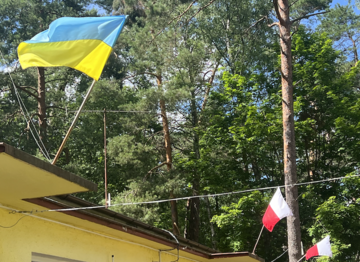
Flags of Ukraine, Poland fly at camp office.
All of the children have grown bigger and heavier since arriving, he added.
“They did not observe the war trauma. They did not see the destruction from the war. They don’t talk about the war, but they have phones and the Internet and can get the information. But they are happy; they smile.
“I’m not sure how they will feel when they go back,” he continued, sharing scores of pictures of the children on his laptop as he spoke. “I am afraid that without Ukrainian school, all who go back will be treated like strangers.”
Baryla said some of the children have indicated they want to return, while others want to stay.
“It depends on their age. The teenagers, especially, see the difference in the lifestyle between Ukraine and Poland. They see the quality of life.”
Not Always a Happy Birthday
One of the most difficult moments comes when a child turns 18 and ages out of the system. Two will hit that milestone this year. It’s also difficult on the staff and volunteers, who are, for all intents and purposes, their parents. One woman who gave the Via Stella Foundation reps a tour of the grounds said she has grown particularly fond of several of the children and isn’t looking forward to the day they leave.
But they will all eventually move on. No new orphans are expected, and Baryla said the camp will likely become a home to refugees from other places, such as Africa.
Until then, the children will do what children do, growing up in an uncertain world but also in a place where the love for the children was evident. CUToday.info also meet with volunteers from several church groups, including the U.S., who are helping at the camp.
It's Gotta Be the Shoes
The gift cards presented by the Via Stella Foundation are for shoes. Previously, the same type of shoes were bought for all the kids, but as might be expected, that didn’t prove popular with either the kids or the adults. For the latter, it reminded them of the days Ukraine and Poland were under Soviet control and everyone wore similar shoes—and they were all ugly.
Instead, the children will be able to go to the store and pick out the shoes they want, courtesy of credit unions in the U.S. and Poland. The cards will be distributed as rewards and prizes, such as for doing various jobs around the camp (while CUToday.info was on-site, some of the children were charged with cleaning up after lunch, clearing dishes and sweeping floors).
“It’s an element of upbringing,” Baryla said. “They have to earn it.”
Information on the Via Stella Foundation is available here.