

By Ray Birch
LAKE FOREST, Ill.—It isn’t just the economic slowdown that has led to an historic decline in overdraft volume—consumers are thinking in new ways, too, according to one analyst, who is urging credit unions to reexamine their options.
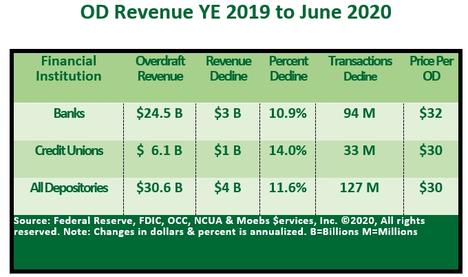
The degree to which the coronavirus pandemic has impacted and the resulting fee income for financial institutions is clear in second quarter data, which reveals a big drop in overdraft transactions and revenue.
In all, overdraft transactions falling to their lowest levels in 15 years, with the decline hitting credit unions harder than banks, according to a new report.
Overdraft revenue among all financial institutions fell $4 billion in the first half of 2020. Over that same period OD transactions fell to fewer than one-billion for the first time since 2005, according to the latest Moebs $ervices overdraft study.
The overall median overdraft price stayed the same at $30.
Voting With Dollars
“Many will say this is a result of the coronavirus,” said Michael Moebs, CEO and economist at Moebs $ervices. “Yes, it is, but also the American consumer and small businesses are voting with their dollars and saying price is very important.”
More than 11 million people are unemployed and many are working from home due to the pandemic.
“The SBA Paycheck Protection Program and super-charged unemployment benefits have helped the consumer, but more is needed. Banks and CUs have issued waivers to loan payments and fees,” Moebs said.
The percentage decline in overdraft revenue was higher at CUs (14%) than banks (10.9%), largely due to credit unions waiving more fees than banks, as they stepped up during the health crisis to support their account-holders more so than banks, according to Moebs.
Consumers Rethink Things
Moebs asserted the COVID-19 health crisis is causing users to rethink prices on everything.
“Evidence with overdrafts rests with the depositories who charge less than $25 per OD,” asserted Moebs. “This group of banks and credit unions are increasing or breaking even with overdraft reveneue…COVID affects basic economics (price and volume) dictating when the price drops volume will increase. Lower prices increases volume and revenue goes up.”
Examining the study, the chart (above) shows what is happening to overdraft revenue and why, said Moebs.
“The first three columns show revenue is declining substantially. Overall overdraft revenue has declined in both actual dollars and percentage,” he said. “The transactions column shows transactions are falling. Price stays the same. Yet the chart’s missing piece tells the story. Overdraft limits, not shown, have also stayed the same, our study shows.”
Moebs said his report indicates overdraft limits have stayed at $500 per user since 1998.
“So, if price is high and limits impose a cap on supply, revenue has to decline,” Moebs explained.
Moebs also noted consumers have more money in their checking accounts now—credit unions hit record savings growth levels in Q2—and that has provided a cushion to avoid overdrafting.

Michael Moebs
The Options
What can credit unions do to increase revenue while also helping the member?
Moebs said there are several immediate options:
- “If $30 remains the price, what about increasing limits? If underwriting is in good shape this will help the bank or credit union, and it’s a win for the consumer too,” said Moebs.
- “If limits cannot be changed, then what about lowering the price? Concerned about the loss of revenue? Then test this move by sunsetting the lower price until the end of the year or when a COVID vaccine becomes available. Or even test the lower price with just a few branches,” he said.
- If price and limit changes are an obstacle, then use relationship pricing to waive fees, stated Moebs.
“Again, if price and limit present challenges, refinance the consumer’s vehicle loan or mortgage,” Moebs said.
Some Recommendations
“Finally, do what hundreds of depositories have done and lower the price and increase the limits and watch this very closely—stop if it does not work,” Moebs recommended. “But the Moebs OD Study found this approach works.”
Moebs reminded the difficulties FIs are facing during the pandemic—the surge in deposits, the decline in net interest margins lower asset rates, and employees being furloughed and laid off.
“So fee revenue, a tried-and-true income source, can reinforce the bottom line. If overdrafts are a large part of fee income, then redesign ODs to make both users and the financial institution winners,” Moebs said. “As Americans take the health risk to get back to work and the economy is turning around, fee revenue will change again.”
Several Predictions
Moebs said his company’s research projects the following:
- As Americans are getting back to work in the third quarter of 2020, overdraft fee revenue will move back to normal levels.
- If retailers can be even more creative with online purchases for the holidays, OD revenue could improve further in the fourth quarter.
“ODs will pick up, too, in the last half of 2020 if banks and CUs become creative in pricing and limits,” added Moebs.