

ORLANDO, Fla.–It’s no accident the Navy’s Blue Angels flight demonstration squadron rarely has an accident.
And that’s despite flying as fast as 700 miles per hour in formations in which the jets are just 36 inches apart.
There are lessons to be drawn from the Blue Angels’ success in the ultimate in high-pressure scenarios that credit unions and CU leaders can apply to their own operations and relationships with members, according to John Foley, the former lead solo pilot for the Blue Angels. Today Foley runs his own managment consulting firm.

“People at the top have a thirst to get better,” Foley told the joint annual conference hosted here by the CUNA Operations, Sales & Service Council and the CUNA Technology Council on Sunday afternoon. “But what about the top 10th of the top 1%. Not everyone is willing to pay the price. But to get there something else has to kick in, and I think it’s the mindset. There are hundreds of thousands of pilots, but only six of us got to wear the Blue Angels helmet. Three of us were new every year, plus there was a 33% rotation rate on the support team. Every three years the Navy says you will rotate, so we as a team had to adapt to that. How to handle excellence under change was our challenge. I think it was a culture of excellence and a culture of caring. I think that’s what sets you apart from your competitors. You truly care for your members.”
It's Not About the Air Show
Part of that culture with the Blue Angels, he said, involved meeting with its “customers” every day, especially at air shows. But entertaining at air shows wasn’t the purpose of the Blue Angels, according to Foley.
“We knew our job was to inspire, not to fly air shows. It wasn’t about recruiting, I always felt like it was about having people be great at something,” said Foley, who shared that Blue Angels pilots can lose up to six pounds in sweat during a 45-minute air show. “Think about all the credit unions here. The values you hold are very strong and connect back to you.”
Foley grew up in Germany the son of an Army officer and saw his first Blue Angels show when he was 12. But he misunderstood who the Blue Angels were, and applied with the Air Force (the Blue Angles are Navy) with a goal of becoming a pilot. He was rejected. “That was not part of the plan,” joked Foley.
Foley was more successful in joining the Navy and being selected to attend Annapolis. He became a fighter pilot, struggled in some aspects of the job, and worked hard to become a better pilot. He was selected to fly the jets that were featured in the Tom Cruise movie Top Gun. But that wasn’t the pinnacle of his career, according to Foley.
“I was selected for the Blue Angels and my life changed. Those next three years were precious,” said Foley.
Why Some Outperform, And Others Don't
It wasn’t until he exited the Blue Angels and entered private business—Foley attended Harvard Business School and earned three masters degrees—that he said he really began to examine what he calls the “high-performance zone.” In private enterprise after the Internet bubble had burst in the early 2000s, Foley was put in a position of deciding which companies to bet on.
“As part of that I began to analyze why some of these companies outperform others, and some don’t,” said Foley. “Why do some credit unions outperform others? I reflected on that. And I thought about a time in my life when I outperformed, and that was the Blue Angels.”
A methodology of any kind, said Foley, is basically about strategic management, and its four components: vision, plan, execution, and feedback loop. “The 1% do that, they just do it better,” he said. “In the top 1%, we don’t talk about vision, we talk about beliefs.”
Foley offered credit unions four steps to making the “high-performance climb.”
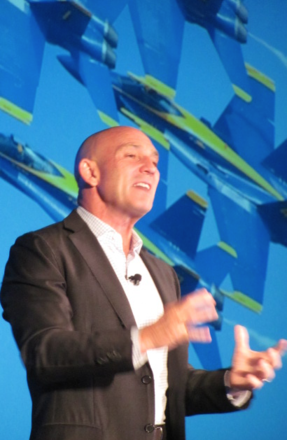
John Foley speaking to CUNA Councils' meeting in Orlando.
1. Belief. In this case, belief can be either limiting or liberating, said Foley. “This is the top of the pyramid. We don’t perform at our highest potential level, we perform at our highest belief level. For me, I had to raise my level of belief when I was on the Blues.”
That included learning the difference between being scared and being not afraid, a process that comes down to what he called the four P’s: Process “The Blue Angels had a process and a way to do things and had since 1946. You also have processes and systems.” Product. “With the F-18, you have a tremendous product.”) People. “It’s all 128 individuals, not just the pilots.” Purpose. “This is the most important one. I would suggest you need that fourth P and it has to be larger than yourself.”
2. Briefing. Prepare, focus, and communicate, counseled Foley.
“We had a briefing every day. I do a 15-minute briefing with my team every morning. Focus is the key; if you learn how to focus you can direct that into anything and you have real power. There are techniques to get your minds sharp. Check your first thought for the next 60 to 64 days. You can train yourself to wake up happy. The #1 quality of people who are happy is gratefulness. Every day I do a ‘glad to be here wakeup,’ and I think about what am I grateful for in the moment? I woke up this morning thinking I would get to share something with people who make a difference in people’s lives. The brain likes to remember things. I then try to go forward in my day and think about others, not just myself. Turns out if you do that for 60 to 64 days you will start new grooves in your brain. The area of the brain that lights up when you’re grateful is right where the area of the brain is for perception.”
Foley urged credit unions to borrow a concept from the Blue Angels that involves finding a “centerpoint.”
“A good question to ask of your own team is ‘What is your centerpoint?’” said Foley. “What you are really asking, ‘What is most important to you right now?’ See if it’s what you were thinking. The power of the question isn’t the answer, the power of the question is ‘Is it what you were thinking?’ For you all, the centerpoint should be the member. And you ask what is it going to take to have that great member experience. All the elements have to come together.” (Foley calls his company CenterPoint Companies.)
Foley told credit union executives that they have many levers to pull as managers, but if there was just one to pull before all others he said it is to “focus on trust. If you increase trust, I guarantee you execution will follow. There is a challenge to that strategy though, which is that trust means different things to different people.”
3. Contracts. These aren’t the written, commercial contracts, said Foley, but instead the intrapersonal contracts people have with one another, including credit unions with their members. The components of “contracts” include trust, execution, commitment, said Foley. “If you want to decrease your emails and voicemails, agree that if someone is where they are supposed to be, they don’t need to tell you,” said Foley.
4. The Debrief. Or, as Foley likes to call it, “the Glad-To-Be-Here Debrief.” That is based on a Blue Angels mantra of expressing gratitude at how fortunate each member of the team is to be a part of the Blue Angels.
“Here’s my commitment to you. I guarantee you that ‘glad to be here’ will take on a different meaning to you. It was a mantra in the Blue Angles. We always reminded ourselves how blessed we were to have the jobs we did. It was a pretty cool job. But it also reminded us of the talented people we were lucky enough to have around us. “If you can get glad to be here in your team’s DNA, it’s a tremendous difference maker.”
Foley noted that a Blue Angels debriefing lasts twice as long as the time in flight. During those debriefings each team member acknowledges any mistakes made and takes ownership of getting the fix made.