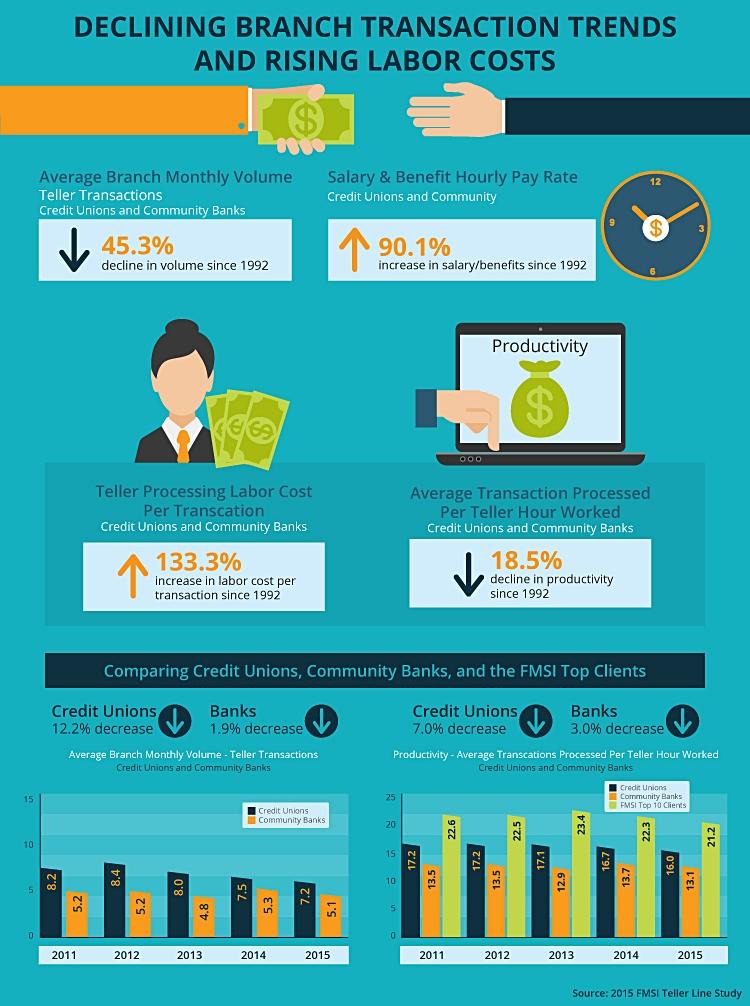
ALPHARETTA, Ga.—A new study indicates that it may be time to begin reducing branch staff and closing low-performing offices, as the number of FI locations has finally exceeded the growing population’s ability to support them.
That key finding from FMSI’s 2015 Teller Line Study, which also suggests that while mobile is a threat to branching’s future, it is not the key reason branch traffic is a larger concern now. The study predicts that mobile won’t kill branches, it will simply transform them into being “sales-centric” as opposed to being “deposit centric.” (see infographic below)
Historically, despite transaction volumes continuing the year-over-year declines (45% since 1992), FIs have not had to worry about staffing branches because branch activities were always growing—in part to a growing population and economy, the study states. Instead, FIs looked where to add new branches as new housing developments were created.
“Management was convinced there wasn’t a lot of money to be saved in closely managing teller staffing. Today’s environment has changed greatly from those boom days, and the trends in this study suggest the market is now over branched—a situation that many institutions have mostly ignored,” FMSI said. “Coupling the decline in the ratio of population to branches and the recent decline in bank branches suggests that the market is starting to correct itself from being ‘over branched.’”
People To Branch Ratio Down
FMSI’s analysis found that the ratio of people to the number of branches has declined from 9,340 in 1970 to 2,970 in 2014.
“This staggering metric is a result from a nearly 300% growth in the number of branches since 1970 while the population growth was nearly half of that,” the study said.
Branches are declining, down nearly 5% as of June 2014, from the all-time high of 99,550 locations in 2009 according to the FDIC. “However, FMSI suspects this trend having to do more with the market correcting itself from an over-branched environment, as opposed to alternative channels replacing the branch.”
Regardless, online and mobile banking are on the rise with no signs of letting up, FMSI emphasized.
“While some would say technology will eventually lead to the death of branch banking, FMSI predicts, instead, a complete transformation of the branch—with retail locations ultimately becoming much more sales-centric than deposit-centric.”
The complete transformation of the typical branch to a more sales-centric operation will not happen in the near future, the study said.
“Today, the significant majority of interactions in the branch are still simple deposits and withdrawals. While branch transactions do continue to drop year-over-year the significant portion of transactions taking place between account holders and front-line staff members will not disappear any time soon—as the more traditional segments of the population remain in society. The reality is, no matter how simple the other channel technologies are, there will always be some that will never adopt it.”
Branch Traffic In 20 Years
If the rate of decline as recorded by the FMSI Teller Line Study continued out another twenty years, there would still be an average branch transaction volume of approximately 3,500.
“Nevertheless, at some point in the future these simpler transactions will almost certainly completely migrate to more efficient channels when the future generations replace the older population segments of today,” FMSI said.