KYIV, Ukraine–Indicative of what is going on in his country, one person offering an update on credit unions and the people in Ukraine was only able to do so after scrambling to find electricity and an Internet connection. But as he made clear, those are only minor challenges and the country and its credit unions are resolved to keep moving forward despite the daily attacks from Russia to keep helping those who never expected the kind of help they are getting from CUs.
During a webinar hosted by the World Council of Credit Unions titled “How Central and Eastern European Credit Unions are Supporting Ukraine,” Pawel Pelc, coordinator of the Regional Credit Union Center for Central Europe in Poland, and Ivan Vyshnevskiy, deputy chief of party with the USAID/WOCCU Credit for Agriculture Producers (CAP) project in Ukraine, shared what is occurring in their respective countries as the war approaches the one-year mark.

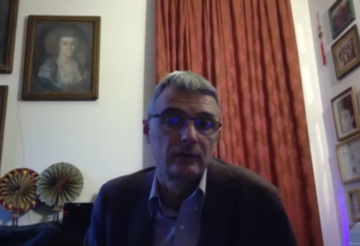
Ivan Vyshnevskiy addressing webinar.
Russia’s attack on Ukraine has led to millions of refugees, tens of thousands of lost lives, enormous economic disruption and the likely demise of a number of credit unions in Ukraine, several of which are operating/were operating in Russian-occupied territories.
Vyschnevskiy, who lives in Kyiv now and who has not left the country since the war began, was late in joining the webinar after he had to move to a public place to find electricity and an online connection. He said it can be a “struggle” to find both, but then added that he was “happy to be alive and to be with you.”
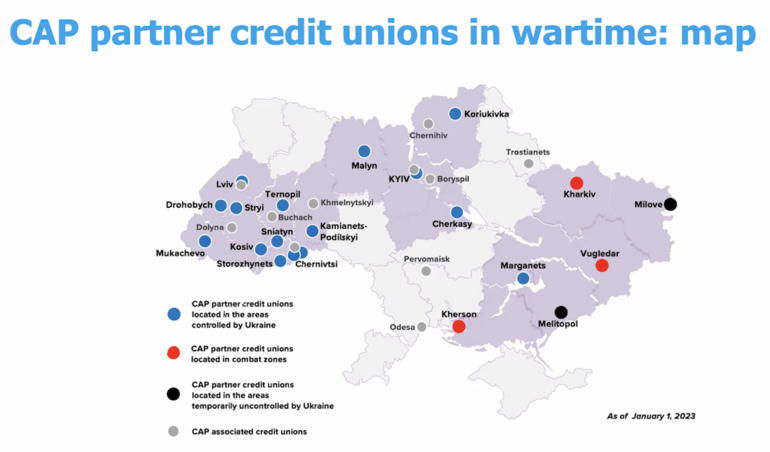
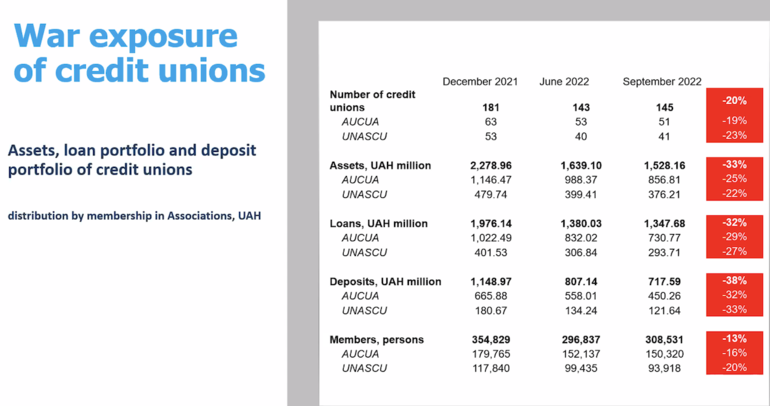
As the chart below shows, Vyschnevskiy said there are still two credit unions attempting to operate in Russian-occupied territory, and another in hotly contested Kherson that is now back under Ukrainian control. Yet another CU is struggling to continue to operate in Kharkhiv, which has also been a fierce combat zone.
‘Everyone is Alive’
“A few of our partners were in occupied territories for short periods and, fortunately, everyone is alive and these credit unions are trying to write business in the best way,” said Vyschnevskiy. “You also have to take into account that credit unions in other areas are affected by the war as well because of rocket attacks every day. And a lot of credit union members have been called to the army.”
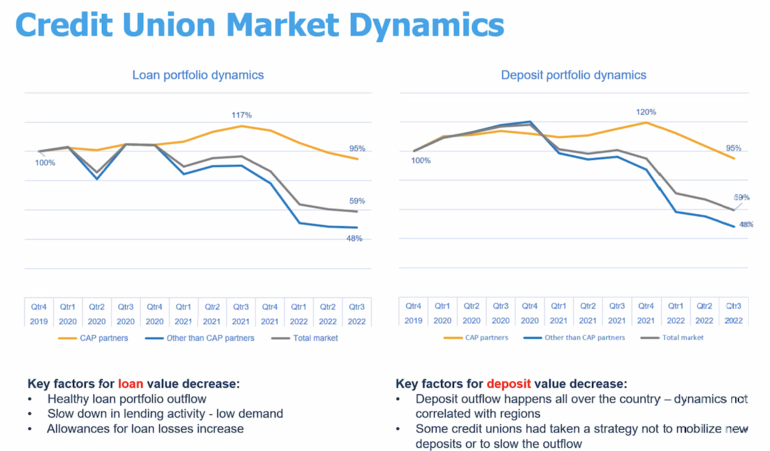
Not surprisingly, all of that has led to the balance sheets of credit unions in the country to suffer across the board, although Vyschnevskiy noted those CUs aligned with the CAP project have performed better than others (see chart, below).
There are two CU trade groups in Ukraine—the All-Ukrainian Credit Union Association and the Ukrainian National Association of Saving and Credit Unions—and Vyschnevskiy said the CAP project has been working with both.
He added the CUs hold weekly meetings and share information when they can.
“The sharing of information is very important,” said Vyschnevskiy. “It’s about what to do, what not to do, with members and borrowers. We see the credit unions that are united in associations are stronger, and fewer of these credit unions have left the market in Ukraine.”
No Government Support
Vyschnevskiy explained credit unions in Ukraine do not have access to government-supported programs, as the chart below shows. He said support from the Worldwide Foundation’s Ukrainian Credit Union Displacement Fund has helped provide financial and commodity support to farmers through credit unions, as CUToday.info has reported.
“It means that credit unions are in a situation where they can only get support from another credit union,” Vyschnevskiy explained.
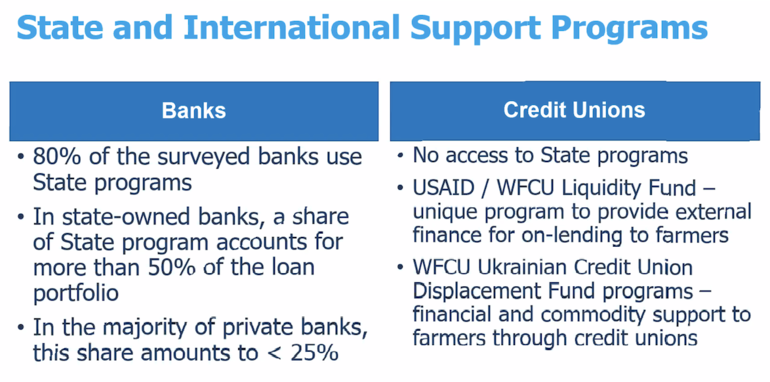
In addition, the USAID/WFCU Liquidity Fund has been active since April 2022 and has disbursed more than $1 million through credit unions, including 502 agricultural loans that have been refinanced.
“A lot of micro-borrowers received financial support,” said Vyschnevskiy.
The Displacement Fund
The Worldwide Foundation’s Displacement Fund has gone toward:
Credit Union Operations
- $300,000 allocated to support day-to-day operations of credit unions in wartime Ukraine
- $55,000 allocated for purchase of power generators for credit union business continuity during blackouts in Ukraine
- $40,000 disbursed to support All-Ukrainian CU Association’s daily operations
Food Security and Agricultural Production (Supported by CAP Project)
- $100,000 for the fuel disbursement program for credit union member farmers
- $100,000 loan reimbursement program for CU member micro-agriproducers
- $50,000 to provide shelters and humanitarian aid for Ukrainian internal refugees; 8,000 refugees have received aid.
To date, 1,031 CU members have had 10% of their agri-loans reimbursed, totaling approximately $74,000, said Vyschnevskiy, adding the goal is to provide Ukrainian small agri-producers and CU members with diesel fuel, which is in scarce supply.
What Wasn’t Expected
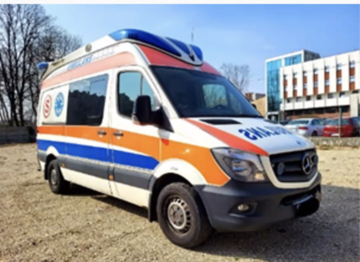
An ambulance purchased by Polish and American donors for use in Ukraine.
“No one ever expected to receive support from their credit unions,” he said. “We are showing credit unions are staying with their members and are different from commercial (banks) and are family with their members.”
Credit unions are also dealing with a situation in the country in which approximately four-million people have relocated internally, according to Vyschnevskiy.
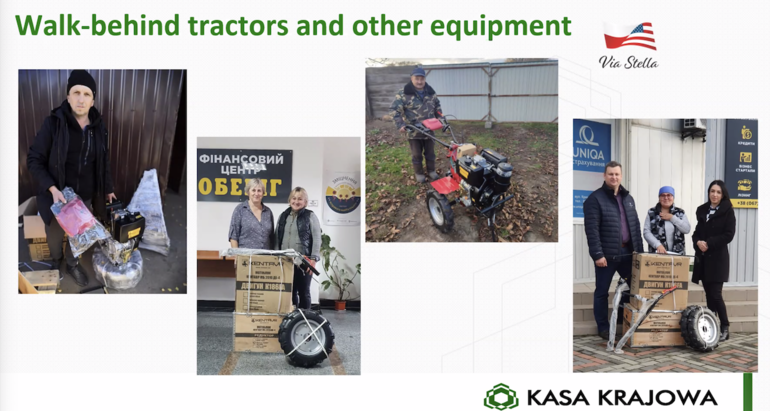
The cooperation between the CAP project and Polish and U.S. credit unions has helped provide agricultural equipment for member farmers of two CAP partner credit unions from liberated areas in the north of Ukraine who were working to resume their agricultural business activities after heavy destruction and looting by the Russians, Vyschnevskiy said. Some of that support has come via the Via Stella Foundation, which was set up by Polish and U.S. CUs.
“People understand this is support from the people for the people. They say ‘if someone shares with us we will share as well.’ We will support as well,” said Vyschnevskiy.
What’s Ahead in Ukraine
Looking forward, Vyschnevskiy said it is expected there will be a:
- Further decreases in deposits due to lower incomes. “People have much less money than before the war.”
- Further decreases in lending if no external financing is provided
- Growth of internal refugees in communities. A “challenge” is that many people do not have and cannot make long-term plans, said Vyschnevskiy
- Higher regulatory requirements related to Ukraine and the European Union
- Decrease in the number of active credit unions in the market.
How to Support Ukrainian Credit Unions
Vyschnevskiy said the best way to provide support would be to provide:
- More external finance from international donors for specific programs, such as agriculture, MSMEs, refugees, and women in business
- Methodologies and recommendations on how to attract refugees to credit unions and serve them. “This is a new problem for credit unions. These are new clients. They don’t have links to the communities, but theoretically they could be long-term members, so if anyone has any examples of how to serve these members it could be very important”
- International advocacy before the regulator promoting the principle of proportionality in credit union regulation.
On that latter point, Vyschnevskiy noted the National Bank of Ukraine is the regulator of credit unions in the country.
“It is very important to convince them that credit unions are a different entity, have a different nature of business and it’s important to help credit unions to survive, it’s very important to implement proportionality. Yes, we need regulation, but it needs to be relative,” Vyschnevskiy stated.
Vyschnevskiy thanked everyone and every credit union that has supported Ukraine and its credit unions. “It’s only thanks to your different types of support that Ukraine exists as a country today,” he said.
‘Every Day the Situation Becomes More Difficult’
Asked by the webinar’s moderator, Greg Neuman of the World Council of Credit Unions, how the people of Ukraine are holding up under the Russian attacks, Vyschnevskiy answered, “To be honest, every day the situation becomes more difficult. There has been adaptation. Electricity is a problem. We are challenged but we are solving. No one can predict when the next attack when happen. In these communities every day someone is killed. It’s very difficult.
“To be honest, after the victory a lot of persons will require psychological support. When you don’t talk to someone for one or two months, the next time you see they have changed a lot,” he continued. “Also, inflation is going up 70% or 100%, but retired people have same level of state pension. That’s why not just important to support the army but also others, such as aged persons. A lot of credit union members are pensioners. It’s why people are withdrawing deposits for daily life needs.
Pawel Pelc during WOCCU webinar.
The View from Poland
Separately, from Poland Pawel Pelc, coordinator of the Regional Credit union Center for Central and Eastern Europe, shared an update from that country, which borders Ukraine and which has seen what has been estimated as more than nine-million Ukrainian refugees cross its borders. The country has opened its homes to refugees and, as CUToday.info has reported, its credit unions have been active in numerous ways in helping the refugees to adjust.
Those efforts have included buying ambulances for Ukraine, taking in five families, buying school supplies for children, and more.
“There are so many refugees in Poland but you do not see any camps. They are in homes in Poland and I think that is very important,” said Pelc. “Credit unions in Poland are part of this activity.”
Poland’s credit unions, its national trade association, U.S. credit unions and the Via Stella Foundation have also purchased walk-behind tractors and other equipment for farmers in areas that were formerly occupied by Russia, in addition to purchasing generators.
Pelc said the people of Poland remain committed to the cause.
“There is still a need for the support,” he said. “In Poland there is no other topic that is more important than the war. The people are still ready to support.”