

LAKE BUENA VISTA, Fla.–Ten-time NFL Pro Bowler and Hall of Famer Barry Sanders told credit unions that what made him successful really isn’t all that different from what can help others to achieve success.
Sanders, one of the most acclaimed football players in history, won the Heisman Trophy while in college before moving onto his record-setting career as a professional. But he is almost as famous for what he did off the field, retiring early in 1999 while still at the top of his game—he ran for more than 2,000 yards in his ninth season--after 10 years in the National Football League. He was just 30 when he left the game.
Sanders appeared before the NACUSO Network Conference and participated in a Q&A during which he talked about his career, leadership, and more.
Acting as moderator was Seth Brickman of Q-Cash.
Here’s a look at what was discussed:
Q: When did you know you wanted to play in the NFL and what do to prepare?
Sanders: I was always a big fan of the game and from as early as I can remember I was watching TV with my dad, college or pro football. I never thought about being a professional at a young age. I just wanted to make my middle school or high school team. It would have probably been in college where I thought I may have a chance to play professionally. You see a few guys you played with or against and who weren’t big-name guys who made NFL rosters, and I was like, ‘Wow.’
In terms of preparing, around that middle school time frame I realized I’m a little smaller than a lot of kids and I need to get on the weights. I would lift and exercise and run wind sprints with my older brother. Again, it was just so I could keep up with the kids in my town or my team.
Q: What was it like to transition like from college football to the NFL?
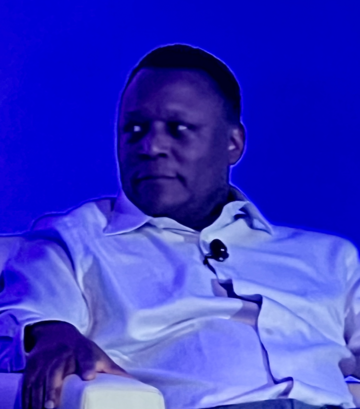
Barry Sanders, speaking to NACUSO meeting.
Sanders: I did my best to prepare. I don’t know that I was ever fully prepared. It’s kind of interesting. My last year of college was my junior year and even toward the end of my junior year and even after winning Heisman trophy, I was planning to go back to college. My dad pulled me aside and said ‘Son, you’ve got to be out of your mind to think about going back to college.’ That’s when I thought he might be right. No one went to the NFL as a junior then; some went to the USFL.
There were some growing pains and it was tough to get ready mentally to go to the NFL. Physically, I just did what I always did and took care of my body as best as I could. I had to go from being a fan of those guys to competing against them.
In college, football or a college sport takes a lot of your time, but you’re still going to class and mixing with students. In the NFL it’s all football. That was an adjustment.
Q: You go from being at the pinnacle to being the new guy in the NFL. How does that go?
Sanders: That transition is interesting because you win the Heisman Trophy, you’re voted the best player in college football, and in the NFL in a lot of ways it’s like starting over again. Your teammates want to see if this guy is legitimate. They know you got paid a lot of money; is he worth it? And then there are the guys you play against and it’s the same dynamic. I loved that part. I loved being able to prove myself. I love that competition. Once I was in the NFL it was about doing everything I could to be the best.
To me, there was no higher calling when I was a kid than being a running back in the NFL. And that’s how I felt as a player.
Q: This room is full of up-and-coming leaders. Is there anyone in your life who made an impact?
Sanders: For me, there were so many people. I’m grateful I had a great, solid foundation with my family and mom and dad. We had 11 kids and they supported us in whatever way they could. I never felt like I had to go without anything I really needed.
There were coaches along the way I remember. I’m still in touch with my high school coach, who my senior year changed me from wingback to running back. He was so different than most coaches I had. With most coaches there is this distance, I’m the coach, you’re the player. But he had a very funny personality and quirky sayings. He was upbeat. He loved being around kids. He was the one who convinced colleges I was worth recruiting.
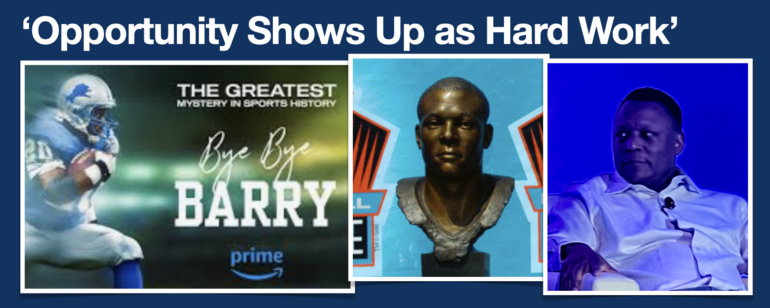
Q: You’re a 10-time All Pro, Hall of Famer. When you hear about those accomplishments, what do you think of? You said, ‘Sometimes opportunity shows up as hard work.’

Amazon is currently featuring Barry Sanders' career in the documentary 'Bye Bye, Barry.'
Sanders: That quote is something my dad always said. I don’t think what I did is any different from the industry you are in. It’s those things you do every day. When you’re 21 and you feel like it’s going to last forever, but I knew I couldn’t take it for granted. It’s very competitive, like what you do. You have to fight for your place. It’s not a given. There are a lot of people who would like to be in your position.
Q: Tell us about your views on leadership?
Sanders: I think it’s about being accountable back to the people you are leading. It’s about being able to be there and doing everything demanded of you so people see you working as hard as anyone else. A great thing about leadership is seeing it as a service, and it’s not something everyone is cut out for.
Q: Credit unions are underdogs against the big banks. What did it feel like going to an underdog team?
Sanders: I can relate to the underdog story. When I got to the Detroit Lions in 1989, I don’t know how many years it had been since they had been to the playoffs. For me, I saw it as a great opportunity to come to a team that had not been a perennial winner. There was a challenge to it. You have to change your mindset when you walk into an environment like that against the best in the world. It’s about the daily fight.
I also realized you are not just fighting against your opponent, but yourself. How hard or smart are you working?
My habits served me well. I saw so many guys get to the NFL and it was like a destination for them and nothing more to do. For me, it was a beginning. We didn’t win a Super Bowl, but I think we changed a narrative. We made it to multiple playoffs. We definitely showed great improvement. It had to do with a mind change and not getting distracted. One thing I pride myself on was that I prioritized my performance and what would allow me to be ready on Sunday.
Q: You were recently featured in the documentary “Bye, Bye Barry” on Amazon. Tell us about that.
Sanders: It took a lot of convincing from my agent to do it. I’m glad I did it. We filmed for about nine months as the crew followed me and my family around. It features a lot of the people who were important to me. It allowed me to tell my story and talk about retirement.
When I retired in 1998 I thought it would be a good idea to get away from the craziness and the media storm, and I went to London. So, Amazon recreated that, but this time we took my four sons.
My dad passed in 2011 and they dug up a lot of footage of him. He always had something to say, whether you asked him or not. He was a big part of my story.