


LAS VEGAS–Seeking to disrupt markets and be innovative? The key lies in “enchantment,” according to a person who knows a little something about a product that has enchanted hundreds of millions of people.
A so-called product “evangelist” (in fact he is credited with coining the word for what he does), the well-known Guy Kawasaki shared with credit unions at CUNA’s America’s Credit Union Conference here the keys for using “enchantment” to influence and persuade people. Kawasaki was the original marketing evangelist with Apple Computer, working with Steve Jobs when the company was introducing its Macintosh computer line in the 1980s. He would leave the company and then return to lead it during its Renaissance. He is now chief evangelist for another software company, Canva, as well as a Mercedes Benz brand ambassador and an executive fellow at the UC Berkley Haas School of Business.
Kawasaki offered thoughts in support of enchantment ranging from why a “Duchenne smile” is important to what separates bakers from eaters to why it’s important to both “enchant up” and “enchant down.”
To achieve enchantment, Kawasaki said the following must occur:
Achieve Likability
“If you want to influence a business or industry, you have to be likeable,” said Kawasaki. As an example, he said Virgin Airlines CEO Richard Branson asked him if he flew the airline, Kawasaki said no. So, Branson started polishing Kawasaki’s shoes with his jacket, and “that is the moment I started flying.”
“A smile is a key piece of enchantment,” said Kawasaki. “A great smile is called a Duchenne smile, and it’s in the eyes. The best evidence of a Duchenne smile is crow’s feet.”
Kawasaki also urged his audience to accept others for what they are. “You can intuit when people don’t accept you for what you are. What I learned about enchantment is you have to accept people for what they are. You should also default to ‘yes.’ Ask how can I help you? The upside to defaulting to yes far exceeds the downside.”
Achieve Trustworthiness
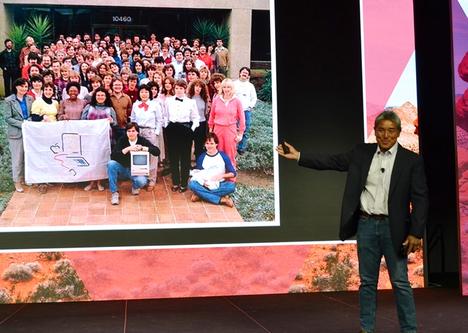
Guy Kawasaki stands with the Macintosh team at Apple in the mid-1980s. Steve Jobs is at front, center
Trustworthiness and likability are not the same thing, stressed Kawasaki. The key to trustworthiness, said Kawasaki, is that you must trust your members before they trust you. The onus is on you.
“Think of yourself as a baker, not an eater,” said Kawasaki. “An eater sees the world as a zero-sum game. A baker thinks I can bake more pies or cakes. Bakers don’t see other people’s gains as their loss.”
Agree on Something
Kawasaki, who said Apple was floundering until it finally agreed its future was in desktop publishing (which he called a “gift from God”), told credit unions, “My message to you is find something to agree on with your members.”
Innovate
As an example of how innovation seldom occurs in established industries, Kawasaki pointed to ice harvesters, who were the only source of ice for many centuries. But those providers were eventually disrupted by manufactured ice companies, and those manufacturers were in turn disrupted by refrigerator companies. “Ice harvesters didn’t become factories and most manufacturers didn’t become refrigerator companies,” he said. “Most companies define themselves in terms of what they already do as opposed to the benefits they provide. You provide certain benefits, financial services, peace of mind. That’s the business you are in, whether it’s brick and mortar or an app, it should not matter.”
In getting to the “next curve,” Kawasaki said credit unions should ask themselves if they are “DICEE”: Deep, Intelligent, Complete, Empowering, Elegant.
Launch in an Enchanting Way
The key to launching a product or service is to tell a story, according to Kawasaki. “Everybody tells the same story. When you introduce something new, tell a story about how people are going to use this and how it’s going to change lives.”
In the process, he said a credit union should “plant many seeds: using social media, and make sure to always have salient points. “Try to focus on the stuff people understand. Don’t say calorie, say instead, ‘If you eat this bag of chips you have to run 20 miles.’”
Overcome Resistance
As an example of overcoming resistance, in this case to toys, Nintendo repositioned its toy as an educational robot that could teach robotics.
Another way to overcome resistance, said Kawasaki, is to provide social proof. “Show the world that lots of people are using your credit union. “As an example, he pointed to the white ear buds of the iPod, which became noticeable. And when you bought an iPod, you contributed to the social proof.
He further encouraged credit unions to use “a dataset to change a mindset. You want to change people’s thinking when they are assuming they know what’s true.”
Make Your Enchantment Endure
To make enchantment endure, Kawasaki said, an organization must build an ecosystem. “An ecosystem means it’s not just you; it’s you and all the partners you could work with. In an ecosystem, everyone is pulling for the same success; if they succeed, you succeed, and if you succeed, they succeed.”
Invoke Reciprocation
This is the concept of “I know you would do the same for me.” He recommended credit unions read Robert B. Cialdini’s “Influence: The Psychology of Persuasion” to understand more.
Present
“If you truly want to be enchanting, you need to pitch, present and to speak,” said Kawasaki. To do that, he said, a presenter should customize the introduction (including using pictures), and sell the dream.
Use Technology
Step number one in using technology, according to Kawasaki, is to remove the speed bumps to the organization and to getting access to the credit union.
Provide Valuable Content
Use social media well and provide value,” said Kawasaki, urging CUs to provide information in areas where they have expertise. “I think social media should always be about providing value.”
As an example, he pointed to the model used by National Public Radio.
“Nobody likes the NPR pledge drive, not even NPR,” said Kawasaki. “But people tolerate it because they provide such great content. Provide your members with all this great content, and then, every once in a while, hit them with your pledge drive.”
Enchant Up
“The key to enchanting your boss is to drop everything when your boss asks you to do something,” said Kawasaki. “I’m not saying this is fair, I’m just saying this is how it works. Then prototype fast, which also gives you time to revise. And deliver bad news early. The faster you deliver bad news, the better it is, because then you have more time to prepare. You can always surprise people with good news. You can deliver that any time you want.”
Enchant Down
“Enchant the people who work for you,” recommended Kawasaki. “If you really want people who are enchanted as workers provide a MAP: mastery; autonomy and (higher) purpose. Suck it up–you need to be the kind of boss who does the dirty jobs so they know you aren’t asking them to do anything you wouldn’t do.”