

LAS VEGAS–What does Google actually do, and what are its plans? And what can it offer CUs? Credit unions here Googled those answers by asking Google itself.
In the process they also received some reassuring news from an executive with the company: asset size is increasingly irrelevant in serving consumers, provided the credit union is leveraging how consumers are interacting with them.
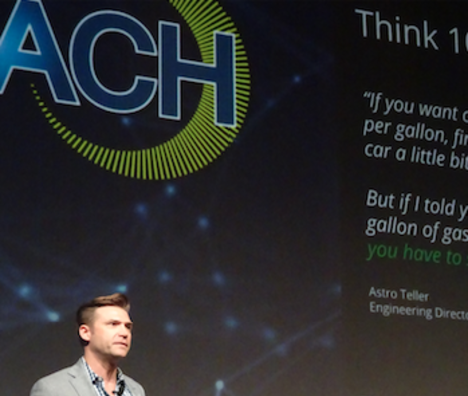
Lauren Hudziak speaking to REACH meeting.
At the core of Google and its parent company, Alphabet, is a model that calls for “dismantling mental models,” according to Lauren Hudziak, a solution architect with the company. In remarks to the California and Nevada leagues’ REACH Conference, Hudziak used Roger Bannister as the personification of what the company sees as its mission.
He noted that conventional wisdom had long-held that the four-minute mile was physiologically impossible for a human being—until 1959 when Bannister, a medical student—broke the barrier. How long did the record last? Forty-six days. And within one year more than 100 other people did it.
How? “He dismantled this mental model,” said Hudziak. “Now it’s table stakes. This is what we like to do at Google.”
To frame that in different terms, Hudziak quoted Astro Teller, engineering director with Google X, who has observed, “If you want cars to run at 50 miles per gallon, fine, you can retool your car a little bit. But if I told you it has to run on a gallon of gas for 500 miles, you have to start over.”
Hudziak said Google answers approximately 3.5-bilion different questions every day through its search engine and other solutions and does so by searching 130-trillion unique URLs and providing an answer in about a quarter of a second.
What The Internet of Things Means
The amount of data available grows each day, often exponentially, and often the result of the growing Internet of Things.
“What the Internet of Things is doing is taking all the information around us that is now in analog form, and it takes all those little bits of information and collects them in a digital format and aggregates them,” Hudziak said.
While it may seem to be interacting with everyone on the planet, Hudziak said Google is not the best known brand on earth. Instead, he said, that honor goes to Lego, which he said frequently dismantles the mental model but does so in much the same way its bricks and components fit together.
“Invariably, one word comes up in talks about Lego: ‘System,’” he said. “For us, it’s the notion of taking these various pieces of technology and doing with them whatever makes life interesting, whatever satisfies your creative itch. That’s what Google is trying to do, only we do it through digital technology. They all start to form this digital tapestry that’s around us all the time but which exist in separate silos. And if we can do it, we can create this platform for life. Taking these pieces of technology and helping you improve what you do in your life and then getting out of the way at the same time, that is exactly what Google is attempting to do.”
What Google is further attempting to do, Hudziak said, much like other providers, is to take the “wealth of technology and add artificial intelligence so technology can anticipate what you will need. It’s a holistic approach to providing an enhanced experience.”
Google This: What About Security?
But all of that raises an enormous issue, conceded Hudziak: security. That’s especially true when some very personal information is stored in the cloud.
“(Security) is something Google has done for a long time and we haven’t made a lot of hay out of it,” he said. “Can your data truly be safe in a cloud-based environment?”
Most people and credit unions likely believe information stored on an on-premise server is safest, yet Hudziak noted that’s exactly where breaches such as those at Target and Home Depot took place, on in-store POS systems.
The challenge with the thinking, all these POS systems for instance, is they are all on-premise systems.
“There is no 100% secure, perfect system,” he said. “But we cannot let ‘perfect’ be the enemy of the ‘good.’ A cloud-based system has the potential to be as safe as an on-premise system. “
Hudziak noted credit unions are “ripe” for cyber attacks.

Lauren Hudziak speaking to REACH.
“So for this type of environment we have to figure out how to protect this and do it in a way that doesn’t burden you,” he said.
The approach at Google, which literally builds everything from the ground up, such as the concrete beneath its data centers, is to take that different “mental model” when it comes to security, according to Hudziak.
“We encrypt the data and we do something we can only do because we’re cloud-based,” he said. “We take the data and we do ‘sharding’; that is, we break it up and then spread it across different data centers. So even if data is breached you have a fragment, you don’t know who it belongs to, and you can’t even read it. This data moves all over the planet and it’s replicated. And we drill for everything: Zombie attacks, alien attacks…”
On a personal data level, Hudziak said everyone should be protecting themselves with two-factor authentication. “If you have it, do it now. It’s probably the single easiest thing you can do that will have the most profound impact on your digital security,” he told the meeting. “We as human beings are really crappy at remembering sophisticated passwords. You are lazy and use the same password for everything. This two-factor authentication adds the thing that you have to the thing you know.”
How Google Can Help CUs As Businesses
Having addressed security issues, Hudziak returned to some questions credit unions have for Google: in particular, how can CUs leverage Google to help their businesses.
“The most common question I get is ‘How do I get on the front page of search?’ How far are you willing to go in the search before you abandon the search? For most people, it’s page two.”
He offered these keys for search engine optimization:
- Content is key.
- Be engaging. Write for a person, not a computer.
- Use important keywords.
- Leverage backlines (internal and social media)
- Use language in lieu of images
- Keep up to date.
He recommended credit unions wanting more information visit www.google.com/webmasters.
When it comes to using Google AdWords, Hudziak said credit unions would be best served by using AdWords Express, which is designed to be local.
“The question you want to ask is how do I appear prominently in results of the people I am actively attempting to capture,” he explained.
He said credit unions should be careful about using just demographics to target people, saying that data doesn’t tell “the whole story.” For example, he said a credit union could target a person born in the 1940s, English, who has been married twice, has two children, is a dog lover, is wealthy, and who vacations in Alps. And those criteria could deliver Prince Charles and Ozzy Osbourne.
Thinking About Mobile
Beyond that, he said credit unions must ensure their websites now work across multiple devices, especially mobile. “Most people use a variety of screens,” he said. “Your website should work on all of them.” For more resources, he pointed CUs to www.google.com/think/multiscreen.
“If your website isn’t optimized for mobile, you are doing yourself a great disservice,” he cautioned. “You cannot just squeeze down your website.”
Finally, he said credit unions must recognize that Apple Pay and Android Pay and other mobile pay solutions are much safer than other payment forms, and that “younger people are becoming very, very comfortable with this.”
“I think the credit union industry is at unique point of inflection,” said Hudziak. “This type of technology lets you speak to people on a level they understand. You don’t have to be a behemoth organization to interact with them in the way they expect. I used to choose a bank based on where it had locations. Now all I care about now is how does the app work.”