

TUCSON, Ariz.–Credit unions gathered here were told if they really want to grow and prosper, they need to be thinking in terms of “costovation.” The best part: it’s usually cheap to do.
That was the message from Stephen Wunker, who has authored a book of by the same name, and who founded in 2009 New Market Advisors, which consults with a number of well-known brands.

Stephen Wunker speaking to Co-op THINK conference in Tucson.
In remarks to Co-op’s THINK 23 event here, Wunker outlined just what “costovation” is about and why credit unions—especially long-term leaders at credit unions—need to be thinking in a new way. According to Wunker, companies that use the costovation model build leaner, lower-cost businesses that “customers love.”
“We are in a difficult time as businesses, and costs matter. But there is good news,” Wunker said. “There is this orthodoxy that cost efficiency and innovation are opposites. That is not true. Done right, they can be partners.”
Throughout his remarks Wunker cited examples of companies that have happened upon the costovation model with great success. Among them: Planet Fitness, which has grown to 10 million customers.
“Planet Fitness is basically just cardio. But it leads the industry in customer satisfaction for a measly 10 bucks a month, compared with Equinox, which can be $100 a month,” said Wunker. “How do they do so well and delight their customers? Planet Fitness ripped up assumptions about the gym industry. It focused on customers most gyms ignore--the casual exerciser. It’s a no judgement zone. People who are not in tip-top shape are utterly fine going to a Planet Fitness. They don’t want pressure. Those fancy free weights at other clubs often attract the fitness freaks, the meatheads--that’s not what the casual exerciser wants. They want to feel comfortable. They have a pizza night. They really understand who their customer is. That’s a very cheap model to operate. There’s not much complexity.”
Wunker said Planet Fitness is an example of creating innovation that meets or exceeds customer expectations with less, not just with straightforward cost-cutting.
So, how do organizations achieve costovation? There are three steps, according to Wunker.
Fresh Perspective
“I imagine many of you have been in your credit unions or financial services for a long time. That’s great and useful in many ways,” said Wunker. “But it’s not always helpful in taking a fresh perspective. It’s not great for answering what do members really want. It’s not great for a fresh perspective on what matters to them.”
Relentless Focus
Wunker cited Legal Zoom as an example of relentless focus. The company is about simple contracts that can be executed online. “That’s it. People ask to change documents, but you can’t do that,” said Wunker.
Willingness to Blur Innovation Boundaries
According to Wunker, a lot of organizations innovate around the way they are organized, function by function by function.
“The customer doesn’t particularly care how you are organized,” he said. “You need to blur boundaries in ways that other companies won’t do because that is inconvenient for the way they are organized.”
An Example
One example shared by Wunker: United Healthcare, which discovered many elderly people are most worried about a loss of mobility. In response, the company partnered with Lyft on free rides, recognizing it’s cheaper to get someone to a doctor ahead of an issue that might instead require expensive hospitalization later.
“They did something more, too. This is not a commodity, this creates something personal,” Wunker told the THINK meeting. “And this doesn’t cost United a lot of money. For a minimal investment it creates a differentiated experience for the consumer. Everybody wins, because it’s willing to step back and rethink what it is.”
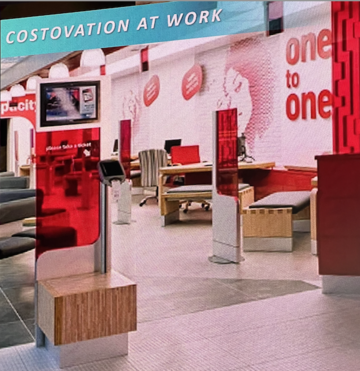
Capitec Bank branch.
An Example Closer to Home
Another example cited by Wunker was drawn from financial services: Capitec Bank in South Africa, a country in which the big four banks dominated the economy. Wunker explained Capitec was an upstart, chartered in 2001 by executives from the liquor industry.
“They looked at the big four and said, ‘This is terrible. We hate them all.’ They may have been four dominant institutions, but they were not four popular institutions,” said Wunker. “So Capitec tore up all the assumptions and created a focus on the historically unbanked or underbanked, people excluded historically by apartheid. They created a service and price proposition, with fees about half the cost of one of the big four banks. They are far and away the number-one bank in the country in terms of number of accounts, with 18.1 million customers and ROE of 26% in 2022.”
The Branch Difference
What else did the bank do differently?
Wunker showed a picture of a Capitec bank branch where there is no security guard, even though crime is a problem in the country, because there is no cash at a Capitec. If a customer wants to deposit or withdraw cash, they must go to an ATM. There are no teller stations; instead, there are benches with room for two people, the MSR and the customer to look together at a screen (see photo at right).
“One other thing they do that facilitates cross-sell is when you open an account you get a Capitec One account that includes four things: ability to transact, four savings plans, insurance, and a personalized credit plan. This is in the app; people can cross-sell themselves. It’s a super low-cost model to run. It’s profitable. They know their customers, they know how to delight them.”
Seven Signs
So, is costovation right for your credit union? According to Wunker, there are seven signs that an industry is ripple for costovation, as outlined below.
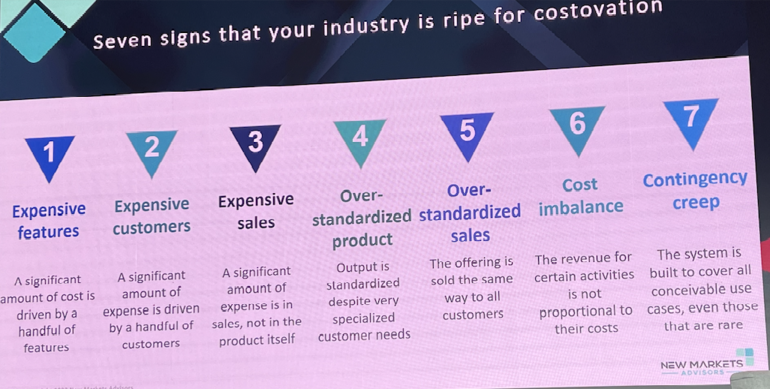
Given all that, Wunker said there are also five opportunities for costovation. Those five ways involve the core offering, how you perform and deliver it, how you market and sell it, your business model, and our partnerships.