By Ray Birch
LAKE FOREST, Ill.—Deposit rates are changing more quickly than at any time in history, reveals a new study whose author asserts credit unions need to become extremely savvy about deposit pricing or risk losing funds needed to support lending.

Another issue management must recognize:, the expense-to-asset ratio has become more important than the bottom line for financial institutions, the study’s author adds.
Gone are the days of causally changing rates as the economy fluctuates, said Michael Moebs, economist and CEO of Moebs $ervices, which has conducted an extensive study of deposit rate changes.
“CEOs of banks and credit unions must be as savvy about pricing deposits as the bond issuer is in pricing a bond. Put yourself in the same chair as those in the U.S. Treasury pricing Treasury bills and bonds,” recommended Moebs.
Drastic Change
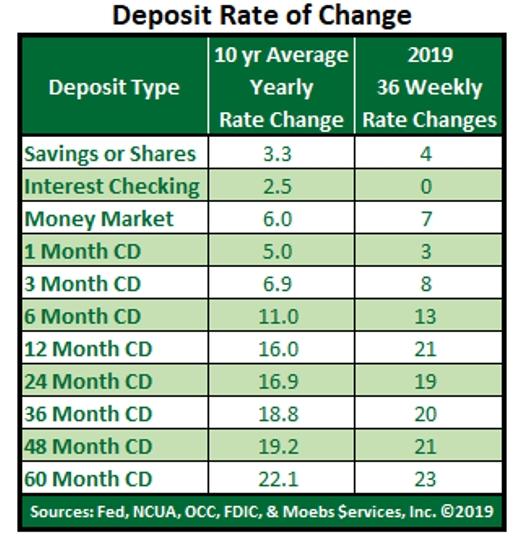
Moebs pointed to how drastic the frequency of pricing changes has become over the last 10 years.
“When the government controlled interest rates on deposits from the Great Depression until 1988, it would change rates once every couple of years and as a result the deposit market was hidden from the economy. Not anymore,” said Moebs. “The deposit rate market is active and changes often.”
Deregulation led to financial institutions being given the authority to control their rates, noted Moebs, whose Deposit Rate Change Study shows deposit rates among financial institutions surveyed for the 11 deposit types have changed 1,301 times in the last 10 years.

Michael Moebs
“This is very different from even a decade ago when rates changed only 100 times in 10 years,” said Moebs, whose study included 2,906 financial institutions. “It’s taken FIs more than 20 years to get this straight.”
The Findings
Among the findings in the new Moebs’ deposit study:
- The most active rate changes occur in longer-term deposits—60-month CDs average about two monthly changes
- Savings and interest-checking rates change the least, or about once every four months
- In the past 10 years deposit rate changes show 33.3% were increasing and 66.7% decreasing
- In 2019 only interest-checking and one-month CDs are below average in deposit rate changes from the 10-year norm
- Among all the changes, there has been 40.3% rate increases, mainly in the first part of 2019, followed by 59.7% rate drops in recent weeks
Consumers Driving Changes
“Deposits rates now reflect economic conditions just like bonds,” said Moebs.
Moebs observed that what is likely a strong contributing factor to all of the rate changes is a consumer that is shopping the deposit market more competitively than at any time in history, largely due to Internet tools that allow rapid price comparisons.
“Competitive rates on deposits is just as important to the saver who is riskless and wants deposit insurance, as to the investor who will take risk and wants the best bond price at the lowest risk,” stated Moebs.
Importance of Expense-to-Asset Ratio
Moebs said with rates changing often, the expense-to-asset ratio becomes more important than the bottom line for FIs.
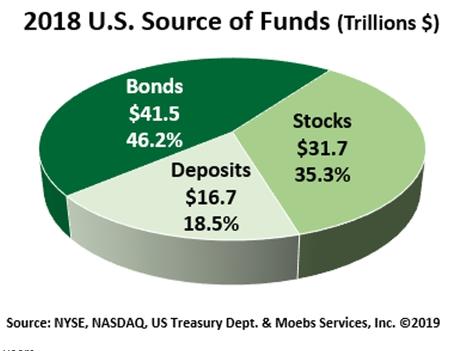
“The lower the expense-to-asset ratio the more leeway there is to price deposit rates higher and be the most competitive,” he said.
“A key result of this Deposit Rate Change Study,” said Moebs, “is the lack of recognition of how depositories are now playing an important role in the economy and influencing whether or not the U.S. is headed toward recession.”
Examining the individual types of markets, deposits now rank high, said Moebs (see chart at right).
“The New York Stock Exchange ranks first, followed by the Treasury bills and bond market, then deposits,” he said. “Following behind deposits are NASDAQ, corporate debit, mortgage bonds, municipal bonds and the rest.”
Deposits would rank second, emphasized Moebs, if the Federal Reserve would use money supply as an “open-market tool, instead of just relying on price. The long-term, average money supply growth is 7%, yet the Fed’s year-to-year change in money supply for the past 10 years is less than 5%. Deposits are no longer a hidden financial resource, but a large factor in monetary policy. The Fed needs to recognize the significant role of deposits and use its money supply tool to impact economic growth.”