

WASHINGTON–The captain of the first American Women’s Everest Expedition said every leader needs to be “relentless” when it comes to one thing, and every organization must be “failure tolerant.”
Alison Levine, who joked that when she’s asked, “What’s your Everest?” she responds, “Um, Everest,” shared during an “Ed Talk” with an opening session of CUNA’s GAC here what she has learned in successfully tackling some of the world’s great adventure challenges. Levine has summited the highest mountains on all seven continents and skied to both the North and South Pole (known as the Adventurers Grand Slam).
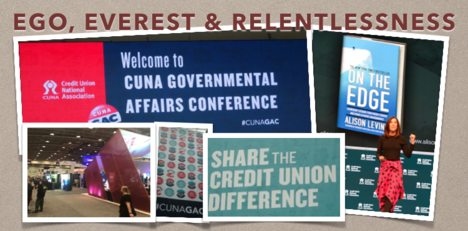
Levine was selected to captain the American Women’s Everest Challenge in 2002 (with sponsorship from Ford, which was looking to promote its Expedition). In selecting her team, she said she spoke to Duke basketball Head Coach and USA Men’s Basketball Head Coach Mike Krzyzewski, who told her that what he looks for in putting together a team is “ego.”
Lesson from Coach K
“And I thought, right, you don’t want that. And he said, ‘No, you want ego.’ He explained when he’s recruiting a team there are two kinds of ego. First, performance ego. People who are good and who know they are good. The second kind of ego is team ego. He wants people who collectively feel proud of what’s accomplished as a team. They are prouder of the name on the front of the uniform, not the one on the back.”
In 2002 Levine and the other team members took two month leaves of absence to attempt the grueling Everest climb. That climb requires 10 days of hiking just to get to the base camp at 17,585 feet, where several days are spent just to acclimate to the climate. Then it’s on to Camp 1 at 20,015 feet, and then a hike to Camp 2 at 21,500. That’s followed by a hike back to base camp. Then back to Camp 1, then back to Camp 2.
Starting Over Again
“And then you come all the way back to base camp. You spend a few days, before hiking to Camp 1 and then on to Camp 2. Finally, there is another nine to 10 hours to hike to Camp 3 at 23,621 feet. And then all the way to base camp,” explained Levine. “And the reason is you have to let your body get used to the altitude, process called climatization. You have to move up the mountain slowly. The catch is anytime you’re above 18,000 feet your body is starting to deteriorate and your muscles get weaker. That’s why you have to come back down low to eat, sleep and regain some strength.
“It is not just physically challenging, but psychologically it’s incredibly frustrating, as well,” Levine continued. “But you have to remember that even though you are going completely backwards, you are still making progress. For whatever reason we tend to think progress has to happen in one direction. But sometimes you have to be willing to backtrack. Look at it as an opportunity to regroup and regain some strength. Backing up is not the same as backing down.”
The Ice Fall
Among the challenges in climbing Everest is what’s known as the Khumbu Icefall, where there are ice chunks the size of small buildings that are constantly shifting and which require the crossing of dangerous and deep crevasses.
“The Khumbu Icefall is where I learned one of the best lessons of leadership and life: Fear is OK, it’s a normal emotion. Complacency is what will kill you,” said Levine. “Fear is a useful tool; it keeps me awake and alert. Fear is fine, as long as it doesn’t paralyze you. But complacency will do you in every single time. You have to be able to react quickly when you are in environments that are constantly changing.”

Alison Levine speaking to opening session at GAC.
Levine noted she got sick several times on the ascent, but stressed that even if “you feel like hell, you still have to get out there and do your job. Every member of a team, regardless of tenure or responsibility, has a responsibility to everyone on the team to getting a goal.”
Levine told the meeting that no leader can ever expect any team member to be willing to do anything the leader won’t do. “It’s not about you. It’s about the people around you. You do what you have to do for your team,” she said.
Not For Control Freaks
Levine called Everest a “really, really, really” bad place for control freaks, given the peak’s proclivity for storms. But those storms are temporary, she said. “If you want to survive storms, you have to be willing to take action based on the situation at the time, and not on some plan. While planning is really important, what you have to remember is whatever plan you came up with, your plan is outdated as soon as it’s finished when you are in these environments that are constantly changing.”
Levine and her team eventually reached what’s called High Camp at 26,000 feet, also know as the Death Zone to humans, where five to 10 breaths are required for every step taken.
Levine led her team on the attempt to summit Everest and was just a few hundred feet from the peak when they were hit by a storm. That required a hard decision—and Levine led the team to turn around and go back down the mountain.
“A single person’s poor judgement can bring down the entire team,” she said. “When the conditions aren’t right, you cut your losses and walk away.”
She reminded the descent is just as dangerous as the ascent, sharing a saying in climbing, “the climb is not over until you walk into the door of your house.”
“Getting to the top is optional, getting down is mandatory,” Levine said.
Never Again, Except…
Levine had told everyone once the team returned that she would not ever attempt to summit Everest again. But challenged by a dear friend who would die at a young age, Levine made a second attempt in 2010. And once again she found herself in a storm.
“We cannot control the environment. We can only control our reaction,” she said. “Sometimes you don’t need absolute clarity to just put one foot in front of the other.”
And despite risky weather, on May 24, 2010, Levine reached the summit at more than 29,000 feet.
“People ask, ‘What was it like?’ It just wasn’t that big of a deal. You’re only there for a few moments. It doesn’t change the world,” said Levine. “What matters is raising kids who can change the world. Treating the people around you well. Letting other people on the team know you care about them. That’s what builds trust and loyalty. Standing up there isn’t what counts. It’s about what you learn along the way and what you do with it.”
Failure Tolerance
Levine said society is simply not “very failure tolerant. And that’s too bad. A lack of failure tolerance prevents people from taking risks. When you’re going to try really hard things and set ridiculously high goals and truly embrace the spirit of innovation, you have to give your teams the freedom to fail. You never know who is going to follow in your footsteps and benefit and achieve really great things.”
And what has Levine learned more than any other thing makes the biggest difference?
“You have to be relentless about putting one foot in front of the other,” she said.