

WASHINGTON--A round-up of news from the last day of CUNA's GAC.
Warren Continues Attacks on Big Banks; Vows Fight Over CFPB
WASHINGTON—The six years since the financial crisis have done little to erode confidence by the creator of the CFPB that it was and remains the right decision.
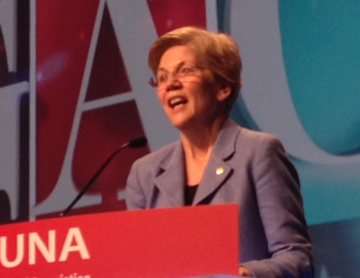
Sen. Elizabeth Warren at GAC.
And, as Elizabeth Warren also made clear, she will be blocking every attempt by Republicans to thwart the agency.
In forceful remarks, Sen. Warren (D-MA), like many of her predecessors at CUNA’s GAC, opened with praise for credit unions. “As one Wall Street scandal after another has unfolded, credit unions have been the bright spot,” said Warren. “Credit unions did not break this economy, and when the economy faltered they did not turn their backs on the families and businesses.”
Warren said she was at GAC “because we share a goal. We want to build a level playing field.”
The senator told credit unions she pushed hard for creation of the CFPB, which was mandated by the Dodd-Frank Act, after watching families end up in financial trouble as the result of “fine print and legalese that covered up the real cost.”
“The price of financial services sums up this story,” said Warren. “A generation ago the price of financial services was pretty easy to see. But boy, did that change over time. While credit unions continue to provide clear, high-quality service for millions of Americans, a different form of pricing became prevalent elsewhere. Too many others offered attractive prices on the front end. The cost and the risk became harder to see, and fees and costs on the back end is where they made their money.”
On top of all that, said Warren, “When it all started going down the drain, the big financial players got billions of dollars in bailout money—in other words, the game was rigged. When I set up the CFPB, I wanted to level the playing field for credit unions and other small financial providers.”
Calling credit unions a “great player in helping” to set CFPB “on the right path,” Warren said that she is worried now that “memories of those hard times are starting to fade. The Republican congress and others are taking aim at the protections put into place.”
Those protections, she said, have led to the return of some $5 billion to consumers.
“Republicans want to blast holes in Dodd-Frank so the biggest banks can profit from their too-big-to-fail status,” said Warren. “I will not support changes that hamstring CFPB and I will not go back to a world where big financial institutions can make billions of dollars by cheating their customers. And I will not support any changes that are pitched at helping small institutions when they are really aimed at helping the biggest FIs in the country make more money.”
Warren continued to take aim at big banks, saying that if reform is what they want, then it’s time for “real reform,” including eliminating “the multi-billion subsidy that goes to too-big-to-fail institutions. When their executives break the law, let’s put them into jail in the same way we do when other people break the law.”
It's All About The 'Ohana'
WASHINGTON—For one congressman, when it comes to credit unions it’s all about Ohana.
Rep. Mark Takai, a freshman representative from Hawaii, noted he was one of seven candidates at one point who were considering entering the race for the seat he now holds. He still remembers the date he met with credit unions, Nov. 13, 2013.
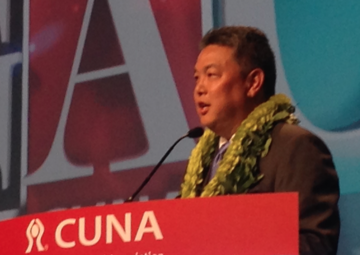
Rep. Mark Takai at GAC.
“You guys committed to me. You committed $5,000 very early in my campaign,” Takai told CUNA’s GAC. “In the last quarter of 2013, I raised about $102,000, so your contribution was about 5%. I’ll never forget the support of the people who brought me here. “
Takai said the Hawaiian word that comes to his mind when he thinks of credit unions is “Ohana,” which means family.
“And family means we don’t leave anyone behind,” he said. “I firmly believe you are part of my Ohana, and I hope I am part of yours. I have belonged to credit unions since I was a kid. I joined the University of Hawaii FCU. And then Hawaii State FCU when I was in the (Hawaii) Senate. Credit unions have been part of my family. I mean, I love you guys.”
Indeed, Takai shared his CU membership number with the audience, in the event anyone wanted to send a donation.
While Takai is now in the U.S. Congress, as a former state official he urged credit unions to go back home and “get to know your lawmakers and county council members. It’s very important to meet people and talk to lawmakers before you have an ask or have a crisis in front of you. Get to know the people you don’t know yet. And here it is also the same. It’s also very important to go to the Hill. It’s important to talk about your issues. Get to know the staffers and develop those relationships.”
Takai said he has co-signed on all of CUNA’s legislative priorities, and that he will be a “champion” for CUs.
CFPB Exec Tells CUs It Takes Their Concerns Into Consideration
WASHINGTON—Before what was likely a skeptical audience, an official with the CFPB here repeatedly emphasized that the Bureau is well aware of the special status of credit unions, and that it consistently takes that into account in its rulemaking.
Zixta Martinez, assistant director of consumer affairs with the CFPB, told CUNA’s GAC that “The bureau is well aware credit unions were not the cause of the credit crisis, you were not selling off risk. Rather, you upheld sound underwriting standards and voiced your concerns over risk in the mortgage market long before the crisis.”
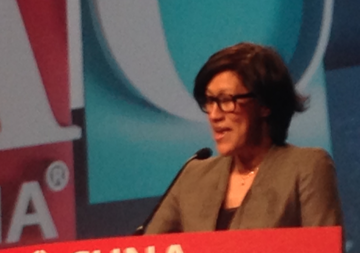
Zixta Martinez addresses GAC.
Martinez said the CFPB, which was formerly established in July 2011, is taking into account the input of credit unions and others in the recent changes it made to its qualified mortgage (QM) rule, in which it made provisions for smaller lenders such as credit unions to get special treatment. She further cited the creation of the CU Advisory Council as another means of listening to feedback and gathering input.
All those messages about softening the rules for credit unions were followed by a reminder that effective Aug. 1 the CFPB’s Know Before You Owe mortgage disclosures kick in. That means a single page form must be delivered to mortgage borrowers three days after filing an application, and a single page form must be provided to borrowers three days before a mortgage closes.
“We understand the new rule involves significant changes to business operations and technology platforms. We want you to be involved in implementation,” Martinez said.
She also urged credit unions to look to the TILA Regulatory Implementation page on ConsumerFiance.gov to find tools and guides.
Martinez also touched on:
- HMDA Requirements. Martinez said CFPB is tweaking the data it collects. In 2012, it collected data from 7,400 lenders representing 18.7 million apps. “While the HMDA data is the leading source of information on the mortgage market, it has not kept pace with the market’s evolution. It did not include data about certain features that contributed to the mortgage crisis, such as ARMs,” she said. New data collected will include property values, total points and fees charged, debt-to-income ratios, credit scores, and more.
- Financial Education. Martinez said financial ed is a “critical part of our mission, and that’s more than just the nuts and bolts of financial literacy. We want to help people to make better financial choices.”
- Arbitration Agreements. As CUToday.info first reported here, the CFPB has been giving scrutiny to the kinds of arbitration agreement language written into credit card contracts and other products.
“The results of the study are to provide a basis for important policy decisions the CFPB will be making,” said Martinez. “We will be meeting with stakeholders, including CUNA, after they have had a chance to read the report. It is our hope this sheds light on financial behavior throughout the financial markets.”
Credit Unions Doing Good Work? Prove It
WASHINGTON—There is likely no place where credit unions spend more time talking about their value to the country and American consumers than CUNA’s GAC here. Yet when credit union reps are asked to support that value, that relevance, they can almost never do so. That needs to change, one person told the meeting.
“Credit unions are so proud of that work, but not one credit union in the research (conducted by the Filene Research Institute) measured that impact in any tangible way with data and numbers and was able to tell that story with hard data,” said Molly Bell, chief engagement officer with Filene. “Why does that matter? It matters on days like today when you go out there and talk to your elected officials about why you’re different. Stories tell the difference. But you also need tangible data about how you’re changing members’ lives. Get up on the rooftops and shout it out: ‘Yes, we are cooperative institutions.”
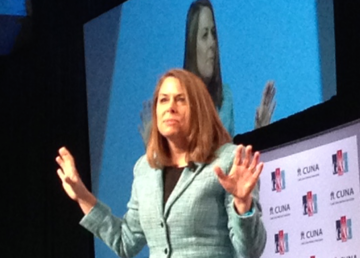
Molly Bell of Filene speaking to GAC.
Being a cooperative, added Bell, is a message that really resonates with younger generations.
Speaking of Millennials and the technology that is prevalent in their lives, Bell noted, “Technology is a beast. Credit unions have a really hard time keeping up. Disruptive change is all around us. But it’s that evil thing we have to figure out. What matters is the member-facing piece of it. What they see and how they interact with you.
Bell urged credit unions to "pool your resources on the technology that’s behind the scenes. Filene has done seven research reports on collaborating. If we are going to survive as an industry, think about what that means and how you better bring impact to your members.”
Bell shared with the audience a quote from Bill Gates, who said, “We have a tendency to overestimate what’s going to happen in the next three years, and underestimate what’s going to happen in the next 10. Our challenge is to look forward at how we are going to remain relevant to an American population that needs us desperately.”
Nussle: Quit Using The Phrase 'Tax-Exempt'
WASHINGTON—New CUNA CEO Jim Nussle returned to GAC’s stage on the meeting’s final day for a Q&A with the audience. Here’s a look at the questions and how Nussle responded:
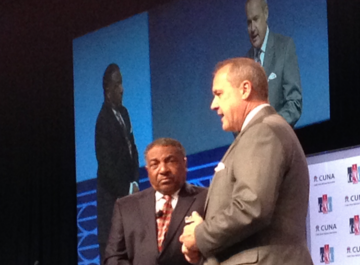
GAC moderator Paul Barry, left, with CUNA CEO Jim Nussle.
Q: We like to be the good guys, it’s in our DNA. But in speaking with members of Congress, one of them said other members of Congress fear the bankers. How do we balance that, so people fear the repercussions of not agreeing with credit unions without losing who we are?
Nussle: I’ve never believed in operating from fear. I believe in operating from strength. Strength comes from your members. I don’t know how often I have to say that. If you hired me because you think I personally am going to change everything from an advocacy standpoint, you should hire someone else. I’ve got to figure out, if I’m good, how to get you to do it. It’s the Tom Sawyer principle of getting everyone else to paint the fence for you. We need more fence painters.
Q: What about the tax exemption?
Nussle: Let’s not call it tax exemption. Let’s call it non-profit tax status. Words do matter. I think on Capitol Hill when you talk of an exemption people think we’re getting some sort of special break, that being tax exempt means we’re exempt from what everyone else does. That’s not what this is about. I think that gives us the opportunity to talk about how we do it and who we do it for. How we communicate on these issues is important. We have this tax status because of how we do it and who we do it for.