

By Ray Birch
WASHINGTON—In the national debate recently over federal security clearances and who should have them, what many may not know is that several current and former executives with NCUA also have such clearances.

The debate has intensified in recent weeks following a move by President Trump to revoke the security clearance of former CIA director John Brennan and Trump’s additional threats to also strip several other former national security officials of theirs, as well.
Former NCUA Chairman Dennis Dollar, who still has his security clearance, spoke with CUToday.info and offered his perspective on the situation. He also addressed why he needed the very highest level security clearance during his last term at the agency.
“Following 9-11, there were threats to the banking system that came quite regularly and the need to track terrorist dollars was a high government priority, so much so that the heads of the federal financial regulatory agencies had regular encrypted conference calls, guided by the Treasury Department, to report on those issues and to try to prepare in case there was action that needed to be taken,” he said.
Encrypted Conference Calls
Dollar explained that receiving his top-level security clearance was directly related to the World Trade Center attacks, and by the time he left NCUA in 2004 the Office of Foreign Assets Control was in place and the confidential, encrypted weekly interagency conference calls on possible threats had stopped. He noted that all NCUA board members and their staffs—then and now—have some type of clearance, although typically it’s not top level.
“Remember that 9-11 came closely on the heels of Y2K where there was real concern about the vulnerability of the banking system to outside attack and a real fear that some terrorism funding was moving through U.S. financial institutions,” said Dollar. “In order to participate in these calls that I can assure you took place under the most secure situations possible, every agency head had to apply for, be vetted for and receive the highest security clearance available—a higher level of security clearance than the standard level I had received from the background check when I went on the NCUA board originally. It was quite a process, but the times demanded it.”
‘Never Crossed My Mind’
Dollar said he never realized that his security clearance did not expire when he left NCUA in 2004, until all of the recent publicity about officials keeping their security clearances and possibly profiting from them in the business world after they left government service.
“It never once crossed my mind to try to capitalize on my security clearance after I left NCUA,” Dollar said. “In fact, I assumed that I left my security clearance with the keys to my NCUA office when I left the agency in 2004. As far as I was concerned, I did.”
Dollar said he sees no reasons for government officials keep a top secret security clearance after the person leaves office.
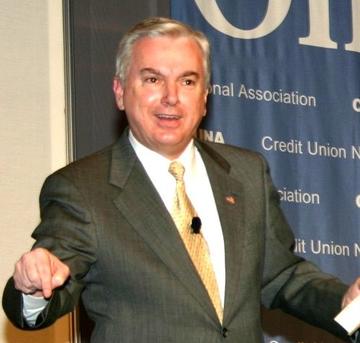
Dennis Dollar
“Maybe an ex-CIA or ex-FBI official might be an exception for a period of time. We are still bound by a confidentiality agreement after we leave government service for the things we learned while we held office. However, we typically aren’t—or shouldn’t be—accessing any government secrets after we leave office. Situations change in the lives of officials, as do their duties and responsibilities when they leave government service. Keeping a top-level security clearance after an official leaves government seems to be asking for potential abuse. A former government official should not be able, as I see it, to commoditize a top-level security clearance in the business world after leaving office.”
A Need to Renew Clearances?
Dollar said he understands there are times when former officials are consulted by current office holders about events in order to seek their opinion and counsel.
“In those cases, if top secret information is going to be revealed to a former official, the individual should be required to go back through some renewal of the security clearance process and be reviewed as to whether there might be new conflicts of interest with their post-government work,” he said. “A security clearance should not be a lifetime entitlement or award, never to expire even after an official leaves government service.”
Dollar emphasized that he always thought his security clearance had expired.
“I assumed mine lapsed, as it should have, when I left NCUA as it was no longer necessary for me to have it and would only create the potential for conflicts when I went into the business world,” said Dollar, who is principal at Dollar Associates in Birmingham, Ala. “If I needed another after I left NCUA for some official reason, I should have been required to apply for one and go through the background check again. A security clearance is not a right that one has for lifetime simply because he or she qualified for one years ago in another situation, setting or position. I considered my security clearance to have expired when I left government service, and I still do. And I am perfectly fine with that.”