By Ray Birch
LAKE FOREST, Ill.—What will ultimately happen with the economy as a result of the pandemic may be difficult to predict, but signs foreshadow what may lie ahead—including potential capital issues for credit unions, according to one economist, who is sharing with CUs one deposit strategy to consider.

Michael Moebs says deposit growth will continue and credit unions will need to find ways to better manage shares to maintain adequate levels of capital. Moebs’ comments are part of a week-long series in CUToday.info looking at the second half of the year, and beyond.
“Forecasting for the next three to six months, and especially into 2021, with the coronavirus is very difficult,” said Michael Moebs, economist and CEO of Moebs $ervices. “Yet accurate forecasting rests on a foundation of known facts: the election, COVID-19, money supply, economic velocity and interest rates.”
Moebs said the direction of the economy will certainly be impacted by the results of the presidential election in November, adding that for now there is considerable economic uncertainty.
“And that uncertainty will spill over into 2021, no matter who is elected to lead the country,” he said.
What is also uncertain and what will impact the ability of the U.S. economy to bounce back is the duration of the pandemic.
A Look Back
“Looking back to the 1918 Spanish Flu gives keen insight into the coronavirus,” said Moebs, who said comparing pandemics shows:
- The 1918 pandemic killed over 50 million of the world’s two-billion people, or about 2.5%. “In 2020 worldwide about 750,000 have died with over 166,000 in the U.S, or about 0.01% worldwide,” said Moebs.
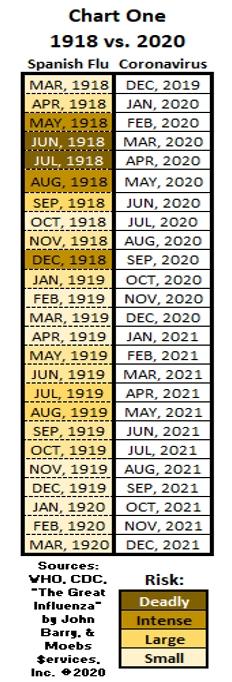
- The Spanish Flu came and left in about 25 months (see chart 1). “COVID-19 appears to be playing out the same way,” stated Moebs.
- The H1N1 1918 virus’ first therapeutic drug came with penicillin in 1928, or eight years after the pandemic subsided, and a vaccine came 87 years later in 2007. “For the 2020 virus, relief will be much sooner, yet forecasting is subject to the creation of therapeutic drugs and/or vaccines,” said Moebs.
- Just like COVID-19, the 1918 pandemic caused severe economic hardship. “Which was quickly overcome, as demonstrated by the Roaring ’20s after the Spanish Flu,” said Moebs.

“So far the U.S. unemployment rate is 16.5%, or about half of unemployment rate three months ago, and the stock market is hitting new highs,” noted Moebs.
Saving the Day?
Can the Federal Reserve’s actions save the day? Moebs said the Fed is focusing on the supply of money and not price.
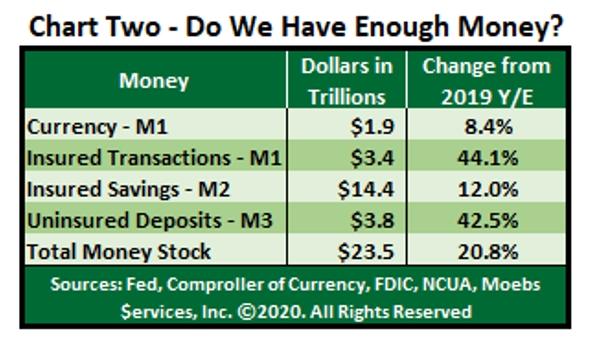
“The Fed is pouring money into the economy in unprecedented ways in its 107-year history, including during the Great Depression. In all markets—mortgages, stock market, commodities—the Fed is maintaining liquidity,” Moebs said. “Most importantly, the Fed pumped $3.7 trillion into the U.S. money system (see chart 2).”
For insured transactions, $1 trillion flowed into demand deposits accounts (DDA).

Michael Moebs
The Big Winner
“The big winner in flow of funds was interest bearing DDA which took 67.9% of the new money,” explained Moebs. “This is just the opposite of the normal funds flow. Insured savings, holding at $14.4 trillion, or 61.3% of all money supply, got $1.6 trillion more. Most of the flow went into depository savings and money market deposit accounts (MMDA). The big loser was CDs—down 24.6% or $141 billion.”
Uninsured deposits got 42.5%, or $1.1 trillion of new funds, with institutional money market mutual funds receiving an additional $916 billion.
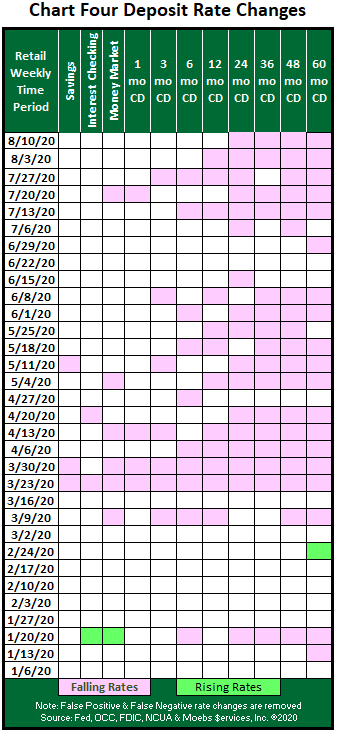
“High deposit growth is almost beyond control,” said Moebs. “With COVID-19 causing unforeseen behavior changes with consumers and small businesses, FIs must watch closely their capital positions, bottom line, fall-off in fee income, and increase in compensation expenses. The Fed wants more lending, but deposit growth is in overdrive forcing FIs to reduce deposit rates.
“Falling deposit rates continue putting CDs in a free fall over to short money.”
What It Means
All this means that credit unions need to “plan wisely,” said Moebs. “Capital is key—to maintain and increase—especially in a crisis. Pick one deposit rate, like a MMDA or six-month CD to increase, and cut all others until deposit growth calms down. Use COVID-19 to sharply reduce non-interest costs quickly. Sunset fees—for a limited time—to help the member and to increase fee volume while maintaining the bottom line.”