

PURCHASE, N.Y.–Thanks in part to social media, evolving traditions could mean future lending opportunities for credit unions around Valentine’s Day (even if the Cost of Loving Index shows a slight decrease in related costs this year).
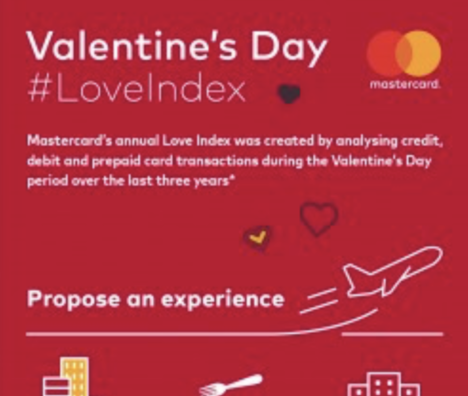
According to new research released by Mastercard, increasingly people around the world are saying “I love you” by investing in experiences over material goods.
The new data shows sentimental spending has increased by 6% since 2015, with the number of transactions up by 17% during the Valentine’s Day period, the company said.
The annual “Mastercard Love Index,” which was created by analyzing credit, debit and prepaid transactions across the past three Valentine periods (Feb. 11-14, 2015-17), reveals that the most popular way to a lover’s heart is through their stomach, as dining out for “date night” takes the top spot with 40% share of spend, and 75% share of transactions in 2017.
Whisking away a partner for an unforgettable travel experience (via air or train) also saw a significant rise as the number of transactions increased by 23% in 2017, accounting for 22% of total spend over the most romantic time of the year, Mastercard reported. Indulging in a hotel stay remains a firm favorite, with 27% share of spend.
“The data supports the rise of the ‘experience economy’ as happiness clearly comes from creating lasting memories – worthy of posting on social media – instead of purchasing ‘things,’” Mastercard said.
'Perfect for Avoiding Those Awkward Moments'
In addition, Mastercard said contactless technology – “perfect for avoiding those awkward moments when the bill comes” – has been gaining momentum as the value of transactions rose by a massive 311%, and a 203% increase in the number of transactions since 2015.
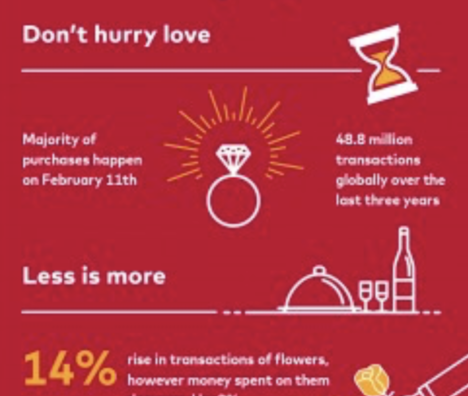
“In fact, the amount spent via contactless rose across all categories with the highest increase across air and train travel (1064%), jewelry (453%) and flowers (446%),” said Mastercard. “Conversely, money spent on traditional Valentine’s gifts such as flowers decreased by 3%, although the number of transactions increased by 14%, showing that although flowers remain a symbol of romance, a single stem means more than an elaborate bouquet.”
Similarly with jewelry, spend decreased by 9% but transactions increased by 10% (vs. 2015), Mastercard found.
The study, which looked at shopper behavior in more than 200 territories around the globe, identified further purchasing trends.
Other Findings:
- The data suggests that we are getting ahead of the curve when buying gifts. It’s no longer left until the last minute, as the majority (30%) of Valentine’s purchases are made on the Feb. 11 (48.8 million transactions globally, over the past three years). Just over a quarter (27%) of all transactions (between Feb. 11– 14) were made on Valentine’s Day itself.
- The trend for online shopping continues, with an enormous 136% increase in the number of e-commerce transactions from Valentine’s Day 2015 to Valentine’s Day 2017.
“Spoiling your loved one on Valentine’s Day shows no signs of slowing down. Our data suggests that while people still purchase traditional gifts, the move towards putting on a great experience trumps all,” said Ann Cairns, president of Mastercard International.
The 'Cost of Loving Index'
Meanwhile, good news for lovers this year: the “Cost of Loving Index” has actually declined a bit for Valentine’s Day in 2018.
The Index, compiled by Houston Asset Management, a Houston-based investment advisory firm, has been tracking prices of nine popular Valentine gifts since 1990. This year it reveals an overall decrease of .24%, the company said.
"The last time the total cost of gifts decreased was seven years ago. While a quarter of percent drop in the total gift prices may not be very significant, at least it means more money in the pockets of gift-givers, and we all love that," said Bob Frater, CEO of Houston Asset Management.
The company, which acknowledges its Cost of Loving Index is an unscientific list, compiles the prices for each particular item being sold at the same store or online from year to year. This year, it found the prices for five gifts are unchanged, three gifts went up and only one showed a price decrease.
A romantic four-course candlelight dinner for two serves up about 6% less in 2018, Houston Asset management said. "As may be expected, the cost of the fancy dinner has fluctuated the most throughout the years," said Frater.
Where consumers can expect to spend more, said Houston Asset Management, is for date night with the price of movie tickets to a first-run show up by almost 9% this year. Other price increases include the cost of a sentimental greeting card at 19% more, and paying 5% more than last year for a one-ounce bottle of the iconic fragrance Chanel No. 5.
The five Valentine gifts that are unchanged in price from 2017 include a bottle of Simi California Chardonnay ($30); a dozen long-stemmed roses delivered ($140.73); a designer silk tie ($175); Victoria's Secret lingerie ($68), and a satin heart-shaped box of Godiva chocolates ($100).
The National Retail Federation's annual survey of Valentine spending reports that 55% of U.S. adults will spend an average of $143.56 on gifts for loved ones, family, friends and pets this year.
Neither organization offered comment on the potential cost of forgetting Valentine’s Day this year.