

By Ray Birch
LAKE FOREST, Ill.—As state governments, Washington and consumer groups focus on checking account pricing and overdraft fees, which type of banking institution is the least transparent with these charges?
It’s banks, according to a new study from Moebs $ervices, which also concludes the practice is costing banks market share and a lot of money. Meanwhile, the study suggests fintechs continue to be the winners when it comes to checking growth.
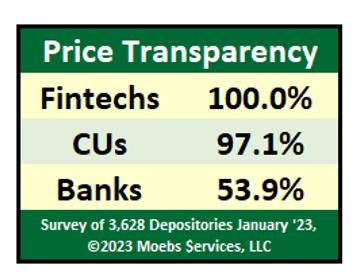
The study, too, shows that fintechs are the most price transparent (see chart).
“For 66 years, since 1956, ABC has broadcast ‘To Tell the Truth.’ If banks, credit unions, and fintechs were contestants and were asked, ‘Does your website tell the truth about pricing, checking accounts, and overdrafts?’ who would really be telling the truth? It would be a tie between credit unions and fintechs, and certainly banks would be seen as fibbing,” said Michael Moebs, economist and CEO at Moebs $ervices.
‘Amazing’ Differences
Moebs $ervices comprehensive Price Transparency study included 3,628 of the 8,401 depositories (43.2%) offering checking and overdrafts. The company defined pricing transparency as making consumer overdraft prices and checking fees available online.
“Even more amazing than the significant differences in online pricing availability between providers is the lack of price information bankers were willing to share when called,” said Moebs. “Over half the banks we called initially refused to share prices over the phone and instructed the new customer to come into a branch to discuss fees and open a checking account. Would the same banker order a pizza for delivery and not ask the price?”
Moebs said fewer than 3% of credit unions or fintechs had to be called due to transparent pricing on their websites.
Raised Eyebrows
In addition to the potential for eyebrows to be raised by consumer groups and regulators over the lack of transparency, Moebs said not being clear with pricing costs financial institutions money. In addition to obtaining price information on checking accounts and overdraft services, the study explored the cost to banks for not revealing price on the website.
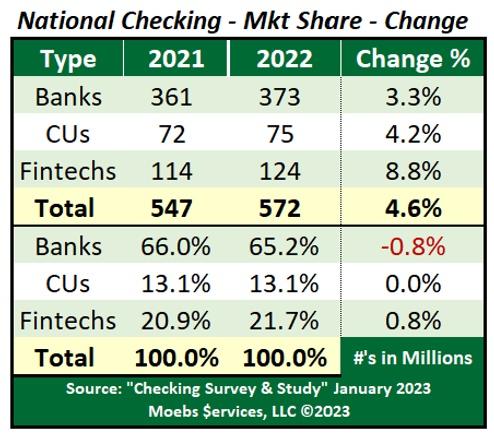
“This was accomplished by measuring consumer checking account growth for depositories individually and collectively on a national market share basis. And the results are startling,” said Moebs. “The bankers may claim adding a net 12.4 million checking accounts from 2021 to 2022, or 3.5% increase, was a success. Yet, the growth in checking accounts at banks lagged overall national checking growth at 4.7%, or 25.8 million accounts—and they lost ground in their overall share of the market.
“Credit unions would counter they expanded checking more than the banks at 4.1%, or 2.9 million,” continued Moebs. “Again, credit unions were below the national growth rate of 4.7%, and their share of the market remained stable.”
The Fintech Threat
Moebs said consumers not being able to easily discern bank checking pricing led more of them to choose credit unions and fintechs for their daily banking needs, which were clearer in their pricing.
“The conclusion is banks lost some growth, credit unions broke even, and the fintechs took the growth and more,” said Moebs (see chart), pointing to Walmart, which increased checking accounts by 9.1%.
Moebs suggested that his company’s latest study underscores the checking threat presented by fintechs.
“Yes, the credit unions broke even, growing enough to maintain their nationwide market share at 13.1%. Meanwhile the fintechs increased market share by 0.8% nationwide, which is exactly what the banks lost,” said Moebs.
Can’t Ask the Milkman

Michael Moebs
Moebs emphasized the era of choosing a checking account by convenience of location is dying quickly.
“The convenience is now shopping for your new checking account online. Our parent’s era of having milk delivered by the milkman and asking the milkman the price is over,” said Moebs. “The era of going to the store to shop and learn the price in-person is declining. Shopping and buying groceries online with clearly marked prices with choices and even free delivery is now. It’s clear, banks and credit unions must become transparent with pricing on the website or face dwindling growth and loss of business to competition.”