

LAKE FOREST, Ill.— Since 2000, overdraft prices at banks and credit unions have adjusted upward at a pace higher than the rate of inflation—and CUs are the biggest drivers—according to a new report.
That trend has developed even as one analyst continues to stress that a lower price actually drives greater revenue.
“In 2000, the median overdraft was $18. A price less than $20 was not controversial then and it is not today,” said Michael Moebs, economist and CEO at Moebs $ervices. “According to the Minneapolis Fed’s Inflation Calculator, the current price of an overdraft today should be $25.”
But according to the latest Moebs $ervices Overdraft Study, the median price of an overdraft is $30.
“The current price of $30 matched with the inflation-adjusted price of $25 is 20% more for a service that has not changed enough in value or cost to warrant this price,” said Moebs.
Clear Difference
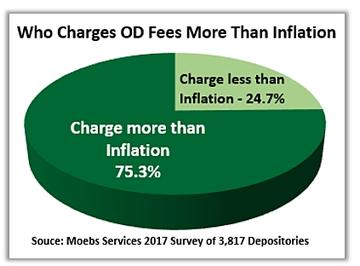
The latest Moebs Overdraft Study found that 75.3% of all financial institutions charge an overdraft fee greater than the inflation-adjusted OD price.
“But looking at banks and credit unions separately, there is a clear difference between who is priced higher than inflation,” said Moebs.
In 2000 banks and CUs charged $20 and $15 for an overdraft, respectively. Therefore, the inflation adjusted price for banks today is $27.82, while credit unions are at $20.86 per item, explained Moebs.
Using the inflation-adjusted price for each type of institution, the Moebs study found about 26.4% of banks are priced less than or equal to the inflation-adjusted OD price. However, only about 7.7% of credit unions are priced less than or equal to the inflation-adjusted OD price, with a current median price of $29 per item.
The pricing behavior between banks and credit unions is also evident when comparing the 2000 price to the current price, said Moebs. Banks increased their price 50% from $20 to $30 in 2017. Whereas, the credit unions nearly doubled their price from $15 in 2000 to $29 in 2017, or 93%.

Michael Moebs, Moebs $ervices
“Credit unions have an image of being more consumer friendly. When looking at the history of overdraft prices, credit unions have been increasing their price at a much quicker rate and now are almost on par with banks,” noted Moebs.
“Basic micro-economic theory states lower price increases volume. With overdrafts, the question then becomes: how far can the price fall to stimulate enough volume to increase revenue? Those financial institutions with an OD price of $25 or less are producing more volume, which increases revenue over time,” said Moebs.
Moebs pointed to the overdraft success of community banks with less than $100 million in assets.
“They have maintained their OD price at $25 for the past seven years, while their current fee income—dominated by overdrafts—is 0.22% of assets,” said Moebs. “In comparison, the Too Big To Fail banks have a price of $35, while bringing in the same fee income of 0.22% to assets. On a relative bases, community banks are maintaining an inflation-adjusted OD price and making just as much money due to volume with a much more consumer friendly price.”
Complex Issue
Moebs said the issue is “complex” since the subject has never been addressed before and that almost all CU executives and bankers never think to adjust data for inflation.
“The key is that an OD price below $20 is never contentious. The $20 price point is true today as it was 17 years ago,” said Moebs. “Beyond this point the price gets elastic, especially after $25—the current inflation adjusted price. This means after $25 volumes will fall—as they been doing for several years now.”