

By Ray Birch
WASHINGTON—Will credit unions see regulatory relief from the recent Appeals Court ruling that the CFPB’s structure is unconstitutional?
Washington insiders say that depends on the outcome of the 2016 elections and the willingness of Congress to take action on the CFPB. The full story on the ruling can be found here.
Experts acknowledged to CUToday.info that at this point it is difficult to predict how much—if any--regulatory relief may be afforded credit unions by the decision, saying that a final decision on the matter will come in a year or two from the Supreme Court, following an appeal from the CFPB.
Earlier this month the Consumer Financial Protection Bureau’s structure was deemed unconstitutional, according to a ruling by the U.S. District Court of Appeals here. The 2-1 ruling came in the case PHH Corp. v. CFPB. The court found the CFPB’s structure to be unconstitutional because it is headed by a single director—Richard Cordray—rather than a multi-member board, and that the position is not accountable to anyone. Credit unions have for several years been calling for Congress to make the change and install a five-person board.
Observers are split on whether the Appeals Court ruling—even before the case is settled—may have an impact on the CFPB’s thinking, particularly Cordray’s decisions regarding CUs.
Shines Light On Issues
What the Appeals’ Court ruling does is shine a light on problems with the CFPB’s structure, said CUNA Chief Advocacy Officer Ryan Donovan.
“This clearly identifies that there is a defect in the structure of the Bureau and that it will probably take more action from Congress to fully address it,” Donovan said. “Congress has put in place a very powerful director and given the Bureau more independence than what is allowed Constitutionally. That is a structural defect in the CFPB we have been talking to Congress about for several years.”
Former NCUA Chairman Dennis Dollar said the CFPB has always been on “shaky ground” Constitutionally.
“That’s because there is a single regulator with no board accountability for far-reaching policy, which has the effect of law and yet has no budget accountability to Congress whose lawmaking authority they have assumed,” said the Dollar Associates principal. “Very few banks or credit unions were willing to put their names on the line to take the matter to court. But a handful of brave souls got the nerve to bring a suit a couple of years ago, and the results thus far are quite positive to shake up the hard-charging overreach of the CFPB.”
In this case, PHH brought the suit and challenged the constitutionality of the agency as part of an appeal of the fine assessed the company by Cordray.

Ryan Donovan, CUNA
Looking down the road, Geoff Bacino, CEO of Bacino & Associates, believes the impact for all financial institutions from the ruling could be “huge.”
“In the court case they addressed the CFPB’s authority as if the Bureau were a fourth branch of the government. That said a lot,” noted the former NCUA board member. “They recognized that the agency has a lot of power and a lot of oversight.”
Court Ruling Language
Bacino’s reference was to some of the language used in the court’s ruling.
“Because the CFPB is an independent agency headed by a single director and not by a multi-member commission, the director of the CFPB possesses more unilateral authority – that is, authority to take action on one’s own, subject to no check – than any single commissioner or board member in any other independent agency in the U.S. Government,” the court said in its ruling.
Bacino noted that the CFPB said it “respectfully disagreed” with the court’s decision, which Bacino said indicates that the Bureau will appeal the decision.
Bacino said that, ultimately, in a final ruling, that the courts may be reluctant to rule that the CFPB is unconstitutional in terms of its actions.
“Because, if they did rule the Bureau’s actions unconstitutional, everything the agency has done would have to be unwound. And the court does not want that—that would be hundreds of decisions and where do you go from there? But the court could place limits on their actions, place limits on their budget . . . and could strongly recommend a board be put in place. I can see a CFPB board coming out of all of this.”
Congress could also get involved and try to fix the issue, said Bacino.
“But thus far Democrats have not shown any inclination to give in and the Republicans are screaming for abolition, and that won’t happen either,” he said. “Unless both Republicans and Democrats decide to get together and make some common sense reform or changes, I don’t see anything happening before this is decided by the courts.”
Supreme Court Final Arbiter
Dollar, too, sees the Supreme Court as the final arbiter of the Constitutionality question, but said the Appeals Court ruling puts the CFPB on the defensive if the GOP, “which has never been high on anything coming out of the Dodd-Frank Act,” maintains control of both houses of Congress this November.
“The result will be interesting to watch with Republican majorities, if they hold, in Congress on the offensive to reign in the CFPB while, at the same time, the CFPB is playing defense with a strategy of offense in imposing fines and making enforcement headlines,” said Dollar, a Republican who is the youngest person to ever be elected to the Mississippi statehouse. “Who wins? That will probably be determined by who wins the White House and gets to tilt the Supreme Court through his or her nominations.”

Geoff Bacino
Bacino said it is possible that the Appeals Court decision might have a more immediate effect on the CFPB, before the courts make a final ruling.
“Will this decision have an impact on how people approach the CFPB now? Could you look at them as being a little weakened right now and therefore make you want to negotiate a little harder in terms of a final settlement? I don’t know,” said Bacino.
But Bacino thinks that since the Appeals Court case did not involve credit unions that there will likely be little change in how the Bureau, and Cordray, in the near term continue to make decisions that impact the movement.
Timetable Uncertain
While some experts think the court case and a final decision will drag out into 2018, Bacino is not so sure.
“The timetable for this to play out may be shorter than most people think,” said Bacino. “Unfortunately, the courts move slowly. Now I am not a lawyer, but I have watched a handful of these cases go through the courts, and based on what I have seen that would indicate a year, if not two years. That said, I have funny feeling that any judge understanding the potential implications of this case would want to fast track it a little.”
Bacino believes there is a solid chance the Appeals Court decision will stand, saying if that happened credit unions, as well as banks, would see regulatory relief.
He said that if the decision stands that the CFPB would likely pay much greater attention to giving credit unions exemptions under new rules, recognizing how the co-operative financial structure and CUs’ attitudes toward their members differ with big banks’ structure and their actions toward their customers. Since the CFPB’s inception in 2011, credit unions and their trade associations have continually asked the agency to recognize the structural difference in credit unions, but feel that to date Cordray has only paid lip service to those requests, providing few exemptions for CUs in the Bureau’s rulemaking.
The analysts all agreed that a five-person CFPB board and congressional oversight of the agency’s budget would be critical changes for the future of credit unions.
Dollar said a board would take the authority from a “single-person regulatory czar. And the trigger for CFPB direct authority over financial institutions needs to be raised to $50 billion in assets—not-for-profit entities need to be exempted from CFPB's rulemaking purview,” Dollar said.
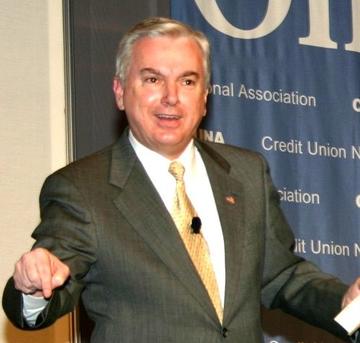
Dennis Dollar
NAFCU noted that with the Appeals Court ruling ensuring that the director of the CFPB can be removed by the President, “gives some accountability. However, in addition to the single director structure, the agency also has extremely broad authority granted to it by Congress to regulate financial markets and consumer protection,” said NAFCU Executive Vice President of Government Affairs and General Counsel Carrie Hunt. “Until the CFPB structure is changed to that of a board, there will not be the opportunity for true open debate of policy issues—including those that impact credit unions.”
Watch The Elections
The Appeals Court ruling, according to Bacino, lays out prescriptive solutions.
“But Director Cordray, when he got up the morning following the Appeals Court ruling, had as much power as he always had,” said Bacino. “I can’t predict if this ruling will change the CFPB’s viewpoints. I hope that Director Cordray looked at the decision and did not say, ‘I am right. They are wrong.’ I hope he said, ‘There are places where I might need to change.’ In a way it’s kind of an exercise in self-awareness. I’d like to think that the CFPB, as a whole, could look at this decision and say maybe there are some areas where we could improve.”
Dollar said those hoping regulatory relief will come from the ruling will want to watch the elections closely.
“The appeals court decision will help the cause of needed reforms at CFPB, but the final decision will rest in Congress, at the White House and at the Supreme Court,” he said. “In other words, the 2016 elections will make or break the CFPB reform push as it will impact all three branches of government this year. That is a very unique set of circumstances that the 2016 elections bring to the forefront. The CFPB's future and structure—as it is likely to remain in existence—will be decided, as are so many matters in this country, by who wins in November from the White House to Congress."