

KOLOA, Kauai–When it comes to the relationship between large and small credit unions it doesn’t have to be a one-way street that involves a merger, according to one person, who shared examples of how such relationships can be mutually beneficial for both.
At a meeting at which a show of hands indicated approximately 75% of attendees were board members at CUs of more than $1 billion in assets, and at which there were just a few people from CUs of less than $100 million in assets, Tom Sakash, the manager of Small Credit Union Initiatives with America’s Credit Unions, outlined examples of partnerships between large and small CUs he said have had benefits for each of the parties, in addition to the broader credit union community overall.

Tom Sakash speaking to Volunteer Leadership Institute.
‘So Vital to Communities’
“Small credit unions make up a smaller percentage of our assets and members, but they still serve 15 million Americans,” Sakash told Rochdale’s Volunteer Leadership Institute. “So many are so vital to their communities. Sometimes, they are the only financial institution in their communities. There is an opportunity, I think, to come together as an industry to help support these small CUs that do such amazing work. And the best part of this is there is a benefit to the larger credit union, too.”
He surprised many in the audience when he informed them there are still approximately 800 credit unions in the U.S. with less than $5 million in assets. But there are also many other larger—yet small—CUs that need assistance, he said.
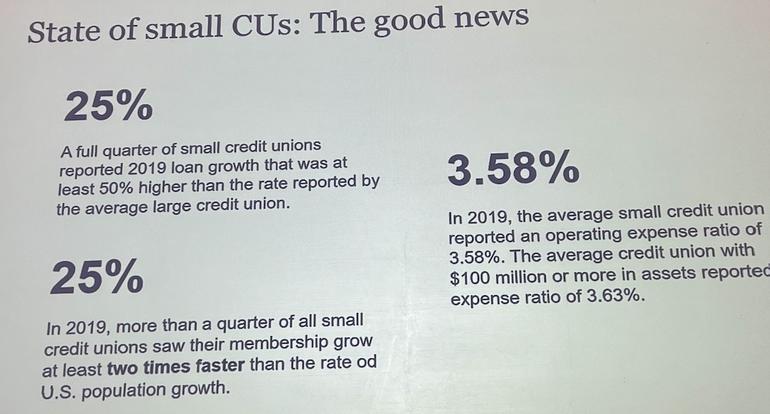
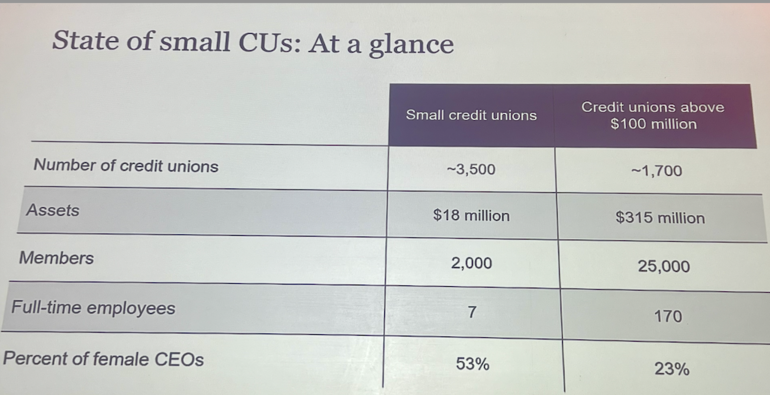
Sakash, who serves on the board of a credit union in Madison, Wis., shared the two slides below to illustrate the state of small credit unions.
He also noted that for small credit unions, regulatory costs represent 0.73% of costs as percentage of average assets, vs. 0.47% at larger credit unions.
The Challenges
According to Sakash, the biggest challenges for small CUs according to white paper:
- Technology
- Loan growth/income
- Member growth/marketing
- Board leadership/engagement
- Overall costs
- Healthcare costs
The Meaning of Small Credit Unions
Citing a State of Small Credit Unions white paper created by the trade group formerly known as CUNA, Sakash said the argument in favor of supporting small CUs include:
- Remain vital to their members and communities
- Crucial for preserving the CU tax status and to CU advocacy overall. “The more credit unions we have, the more CEOs we have, the more board members we have, and that’s more people contacting elected officials,” said Sakash. “Their stories are so powerful.”
- Diversity in size and type of institution ensures a stronger and more robust CU movement. “This is the one that resonates with me the most. The more types of credit unions we have, the more that focus on different communities and SEGs and socio-economic conditions, the better our understanding of the nuances of the challenges people have,” Sakash said. “I would contend that one homogenous credit union if we were to ever merge into one, we would not have the understanding or ability to drill down into all those different nuances."
Examples of Large CU/Small CU Partnerships
Local Government Employees FCU/State Employees’ Credit Union
Local Government Employees FCU: $4 billion in assets, 406,000 members; Raleigh, N.C.
State Employees’ CU, $50.6 billion in assets, 2.7 million members; Raleigh, N.C.
A $4-billion credit union may not seem small, but it began its life thanks to SECU, which opted in the early 1980s not to expand its FOM to non-state employees, and instead helped to charter LGEFCU. As part of the agreement, LGEFCU members can use SECU branches; SECU runs LGEFCU’s backoffice, and LGEFCU pays a percentage of its income to SECU to cover costs.
“I encourage all of you to take a step back and to think about the bottom line for the people you serve,” said Sakash. “I would suggest that of those 405,000 (LGEFCU) members, many may not have been the member of a credit union had SECU not made a decision to charter the credit union.”
BECU/Express Credit Union Partnership
Express CU: $22.1 million, 3,346 members; Seattle
BECU: $29.8 billion, 1.45 million members.
Seattle Express CU was once a very small CU that served a single SEG, which a decade ago was set to close. Sakash said the credit union realized the closure of company would be a big hit to local economy, which was not the time for a financial institution to pull up stakes and leave. So, Express CU pivoted and moved to a community charter and a CDFI certification. Employees of BECU were already on the board of Express CU and they all bought into idea of repurposing the CU around this new focus, according to Sakash.
“I would say to you as you think of entering these partnerships that maybe the most important thing in the success of these relationships is keeping yourself accountable,” Sakash said. “BECU had an executive sponsor who had bought into the idea and who made sure there were funds in the budget. That made this a lasting and successful relationship.”
According to Sakash, initiatives as part of the relationship have included:
- A Bridge Program. BECU sends underserved members to Express (which operates out of a branch provided by BECU) to help meet their needs.
- Executive Loan Program. BECU lends employees to express, including having one of its employees act as CFO. “The benefit for BECU is this person spends a year at express running a credit union. It’s on-the-job leadership training.”
- Mentorship. There is a mentorship program for all levels of the credit union that benefits employees of both CUs.
- Training.
It’s paying off, he said, explaining that over past five years Express CU has averaged nearly 20% loan growth and it had membership growth of 7% in 2023.
Another Example
Sakash said another example of a large CU/small CU partnership is that between the $2.4-billion HAPO Community CU in Richland, Wash., and evergreenDirect Credit Union and Connection Credit Union.
In this case, he said HAPO has provided:
- Help for new CEO
- IT/cybersecurity support
- Strategic planning/leadership
- Collaboration and mentorship
Why Small CUs Can Be Reluctant
Sakash cautioned the large CUs in his audience that many smaller CUs are reluctant to speak with them, believing the larger institutions only want to merge.
“If you go into it with the right mentality and right reason and you are very open and honest with the leaders of a small CU, you can do it in the right way and have these discussions,” said Sakash.
According to Sakash, other ways large and small credit unions have partnered include:
- Loan participations
- Technology expertise and support
- Extra staffing
- Mortgages
How to Get Started
How does a small credit union get started in partnering with a larger CU? Sakash recommended:
- Have confidence and don’t be afraid to ask
- Identify specific areas of need
- Be open to creative solutions
- What can a larger CU do? Sakash further recommended:
- Be proactive in reaching out
- Be committed
- Find a “non-niche.”
“When you get back home and before your next board meeting, ask your CEO to put on your agenda the question of how you can help a small credit union,” he advised.