

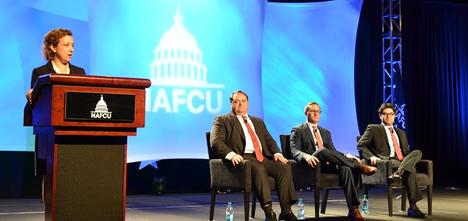
L-R: Carrie Hunt, Brad Thaler, Dan O’Brien, Alexander Monterrubio
NASHVILLE—From the potential repeal of the Durbin Amendment to Congress stepping in if NCUA does not provide CUs with sufficient regulatory relief, a panel of analysts at NAFCU’s annual meeting offered some predictions for what’s ahead for credit unions on Capitol Hill.
Hosted by Carrie Hunt, NAFCU’s SVP-government affairs and general counsel, other panelists included the trade group’s Brad Thaler, VP of legislative affairs, Dan O’Brien, director of political affairs, and Alexander Monterrubio, director of regulatory affairs—all of whom shared their insights, the first being that it is not out of the question that the card interchange rules could be rolled back.
Pointing to separate pieces of legislation introduced by Jeb Hensarling (R-TX) and Randy Neugebauer (R-TX), Thaler acknowledged there is a chance the Durbin rules may be rolled back, but it will be an “uphill fight.”
“Merchants are already attacking the legislation, saying to Washington the bills are a gift to the financial services industry,” said Thaler. “But you know different.”
No Chance This Year
Thaler said the legislation will certainly not pass this year, but what has been put forward will serve as groundwork that NAFCU and credit unions can leverage in 2017.
Thaler said the bills recently introduced are very welcomed in that credit unions have been lobbying Congress for years, saying the Durbin Amendment has not had its intended effect—consumers have not received the savings from the swipe cutback and credit unions simply have less revenue with which to serve their members.
“Now we finally have leaders in Congress listening,” said Thaler. “Now merchants have to defend the failed Durbin Amendment.”
Thaler pointed out that while bankers are always attacking the CU tax exemption, a sweeping tax reform bill from Kevin Brady (R-TX), chair of the House Ways and Means Committee—who supports credit unions and their tax exemption—is in place.
“A plan for tax reform may appear in Congress as early as next week,” said Thaler. “Everyone recognizes that legislation is not going anywhere this year, but it sets tax reform up for 2017. And anytime you have a large package of tax reform, where you throw out existing rules and start over, the credit union exemption is always a concern.”
Turning to the CFPB’s focus on overdraft reform, and the possibility of a rulemaking later this year, Monterrubio surmised that what the CFPB could put forward may impact consumers’ ability to opt in for the service, as well as fees charged by FIs.
“We expect to see something in October or November of this year,” Monterrubio said.
But Hunt noted that it has taken the CFPB a long time to move on overdraft rulemaking. Thaler said the reason is that the Bureau does not have the support of consumers who continually say that they like overdrafts.
“Congress recognizes where consumers are on this issue,” said Thaler. “So the CFPB is in a tough spot here. If they go too far on their rulemaking Congress will step in.”
Pushing Congress To Action
But to get Congress to move on tougher security standards for retailers will likely take a headline-grabbing data breach, said Thaler.
“Unfortunately, very large data breaches are the ones that move the needle, small breaches are all too common anymore,” said Thaler. “A breach much like what we saw with Target is what may push Congress to take action. But until then, we want to have groundwork ready, work with Congress and get bipartisan legislation in place in both the House and Senate.”
Looking at the future of the CFPB, Thaler made clear that despite wishful thinking, the Bureau is not going anywhere. He said, however, that as 2010 moves further into the rearview mirror, there is greater opportunity for change to the agency—such as moving away from it being led by a single director and having the Bureau placed under the appropriations process.
Recognizing that NAFCU and credit unions have been lobbying the CFPB to use its exemption authority to excuse CUs from rules when appropriate, Thaler noted there is legislation in place that if passed would have Congress examine how the CFPB has used its exemption authority and the resulting impact of its decisions there. Thaler said he hopes Congress may step in and place pressure on the CFPB to listen to credit union requests for the Bureau to use its exemption powers.
Thaler said he also believes that Congress is a friend to CUs when it comes to NCUA and regulatory relief. Giving NCUA credit for moves it has made to provide CUs with reg relief but saying much more is needed, Thaler said that if NCUA does not move far enough this year to further reduce the burden on CUs—such as extending the exam cycle—“Congress stands ready to act by the end of this year.”